
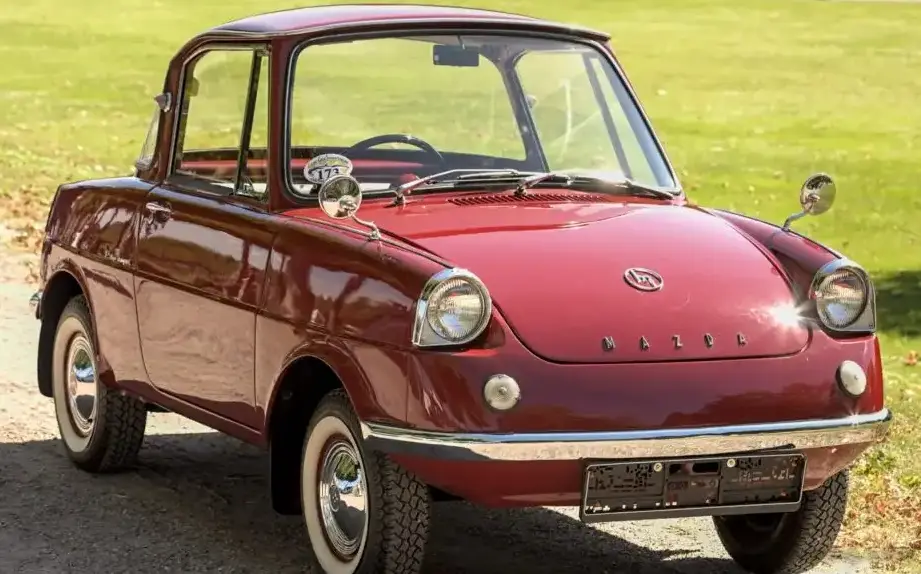
The Mazda R360, specifically the 0.4 V2 variant with the Torq Drive automatic transmission, represents a pivotal moment in Mazda’s history. Produced from 1960 to 1969, this diminutive coupe was Mazda’s first mass-produced passenger car and played a crucial role in establishing the company as an automotive manufacturer. It emerged during a period of significant economic growth in Japan, fueled by a desire for affordable personal transportation. The R360 was designed to meet the demands of this burgeoning market, offering a compact and economical solution for urban commuters. It falls within the broader R360 generation, which was Mazda’s initial foray into four-wheeled vehicle production, transitioning them from a primarily motorcycle and truck manufacturer.
Technical Specifications
| Brand | Mazda |
| Model | R360 |
| Generation | R360 |
| Type (Engine) | 0.4 V2 (16 Hp) Torq Drive |
| Start of production | 1960 |
| End of production | 1969 |
| Powertrain Architecture | Internal Combustion engine |
| Body type | Coupe |
| Seats | 2 |
| Doors | 2 |
| Fuel Type | Petrol (Gasoline) |
| Weight-to-power ratio | 25 kg/Hp, 40 Hp/tonne |
| Weight-to-torque ratio | 18.2 kg/Nm, 55 Nm/tonne |
| Power | 16 Hp @ 5300 rpm |
| Power per litre | 44.9 Hp/l |
| Torque | 22 Nm @ 4000 rpm (16.23 lb.-ft. @ 4000 rpm) |
| Engine layout | Rear, Longitudinal |
| Engine displacement | 356 cm3 (21.72 cu. in.) |
| Number of cylinders | 2 |
| Engine configuration | V-engine |
| Cylinder Bore | 60 mm (2.36 in.) |
| Piston Stroke | 63 mm (2.48 in.) |
| Compression ratio | 8:1 |
| Number of valves per cylinder | 2 |
| Fuel injection system | Carburettor |
| Engine aspiration | Naturally aspirated engine |
| Valvetrain | OHV |
| Engine oil capacity | 2.8 l (2.96 US qt | 2.46 UK qt) |
| Kerb Weight | 400 kg (881.85 lbs.) |
| Length | 2980 mm (117.32 in.) |
| Width | 1290 mm (50.79 in.) |
| Height | 1290 mm (50.79 in.) |
| Wheelbase | 1760 mm (69.29 in.) |
| Front track | 1040 mm (40.94 in.) |
| Rear (Back) track | 1100 mm (43.31 in.) |
| Front overhang | 570 mm (22.44 in.) |
| Rear overhang | 650 mm (25.59 in.) |
| Ride height (ground clearance) | 180 mm (7.09 in.) |
| Minimum turning circle (turning diameter) | 8 m (26.25 ft.) |
| Drivetrain Architecture | The Internal combustion engine (ICE) drives the rear wheels of the vehicle. |
| Drive wheel | Rear wheel drive |
| Number of gears and type of gearbox | 2 gears, automatic transmission Torq Drive |
| Front suspension | Trailing arm |
| Rear suspension | Trailing arm |
| Front brakes | Drum, 165 mm |
| Rear brakes | Drum, 165 mm |
| Steering type | Steering rack and pinion |
Powertrain & Engine Architecture
The heart of the R360 0.4 V2 is a 356cc, water-cooled, V2 engine. This engine, designated as a naturally aspirated unit, produced a modest 16 horsepower at 5300 rpm and 22 Nm (16.23 lb-ft) of torque at 4000 rpm. The engine utilized a single carburetor for fuel delivery and an overhead valve (OHV) valvetrain. Its longitudinal rear-engine layout was a common configuration for small, economy cars of the era. The “Torq Drive” transmission was a two-speed automatic, a relatively advanced feature for a car in this price range and market segment at the time. It wasn’t a conventional torque converter automatic; rather, it employed a fluid coupling system designed to provide smoother shifts and improved fuel efficiency. The engine’s small displacement and relatively high compression ratio (8:1) were aimed at maximizing fuel economy, a key consideration for Japanese buyers.
Driving Characteristics
The R360 0.4 V2, with its limited horsepower and two-speed automatic transmission, was not designed for outright speed. Acceleration was leisurely, and top speed was modest. However, the light weight of the vehicle (400 kg / 881.85 lbs) helped to mitigate the lack of power. The Torq Drive transmission, while offering convenience, did result in noticeable shift points and a somewhat sluggish response compared to a manual transmission. The rear-engine layout contributed to a unique driving experience, with a noticeable rearward weight bias. Handling was adequate for city driving, but the car was not particularly suited for high-speed cornering. Compared to potential future upgrades or larger engine options (which weren’t offered on the R360), this variant represented the entry-level choice, prioritizing affordability and ease of use over performance.
Equipment & Trim Levels
The R360 0.4 V2 was a fairly basic vehicle, reflecting its position as an affordable economy car. Standard features included simple cloth upholstery, a basic dashboard with minimal instrumentation, and a two-spoke steering wheel. Optional extras were limited, but could include a radio and upgraded interior trim. The interior was spartan but functional, designed to maximize space within the car’s small footprint. The exterior featured a simple, rounded design with small bumpers and relatively narrow tires. The car’s overall aesthetic was typical of early 1960s Japanese automotive design.
Chassis & Braking
The R360 featured a simple chassis design with a trailing arm suspension at both the front and rear. This suspension setup was common for economy cars of the period and provided a reasonably comfortable ride, although it wasn’t particularly sophisticated. Braking was provided by drum brakes on all four wheels, measuring 165mm in diameter. The steering system was a rack and pinion setup, offering relatively precise steering feel. The car’s light weight helped to compensate for the relatively modest braking performance.
Market Reception & Comparison
The Mazda R360 was generally well-received in the Japanese market. It offered a compelling combination of affordability, compactness, and convenience. Critics praised its fuel efficiency and ease of driving, particularly in congested urban environments. However, some reviewers noted its limited performance and basic interior. Compared to other kei cars of the time, such as the Honda S500 and the Daihatsu Fellow Max, the R360 offered a more practical and affordable option, albeit with less sporting pretensions. Its automatic transmission was a significant selling point, appealing to drivers who preferred the convenience of an automatic over a manual gearbox.
Legacy
The Mazda R360 holds a significant place in Mazda’s history as the company’s first passenger car. It laid the foundation for Mazda’s future success in the automotive industry. While the 0.4 V2 variant with the Torq Drive automatic transmission wasn’t the most powerful or sophisticated version of the R360, it was a popular choice among buyers who prioritized affordability and ease of use. Today, the R360 is a sought-after classic car, particularly among collectors of Japanese automotive history. The powertrain, while simple, proved to be relatively reliable, and many examples are still on the road today. Its enduring appeal lies in its historical significance and its charmingly retro design.
