
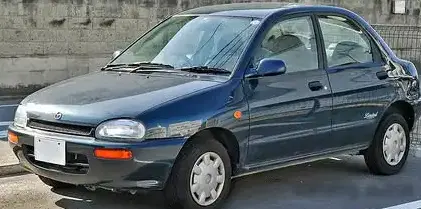
The Mazda Revue 1.3i 16V, produced between 1990 and 1996, was a compact sedan primarily aimed at the Japanese domestic market (JDM). Positioned as an affordable and practical family vehicle, the Revue occupied a crucial space in Mazda’s lineup during a period of significant automotive development. It was based on Mazda’s EJ platform, sharing components with other models like the Mazda Familia/323. The 1.3i 16V represented an entry-level offering within the Revue range, focusing on fuel efficiency and ease of use rather than outright performance. This model was never officially sold in the United States.
Technical Specifications
| Brand | Mazda |
| Model | Revue |
| Generation | Revue |
| Type (Engine) | 1.3i 16V (73 Hp) |
| Start of production | 1990 |
| End of production | 1996 |
| Powertrain Architecture | Internal Combustion engine |
| Body type | Sedan |
| Seats | 5 |
| Doors | 4 |
| Fuel consumption (urban) | 7.1 l/100 km (33.1 US mpg) |
| Fuel consumption (extra urban) | 5.3 l/100 km (44.4 US mpg) |
| Fuel consumption (combined) | 7.3 l/100 km (32.2 US mpg) |
| Fuel Type | Petrol (Gasoline) |
| Acceleration 0 – 100 km/h | 11.4 sec |
| Acceleration 0 – 62 mph | 11.4 sec |
| Acceleration 0 – 60 mph | 10.8 sec |
| Maximum speed | 164 km/h (101.9 mph) |
| Weight-to-power ratio | 10.8 kg/Hp |
| Weight-to-torque ratio | 7.3 kg/Nm |
| Power | 73 Hp @ 5500 rpm |
| Power per litre | 55.1 Hp/l |
| Torque | 108 Nm @ 4000 rpm (79.66 lb.-ft. @ 4000 rpm) |
| Engine layout | Front, Transverse |
| Engine displacement | 1324 cm3 (80.8 cu. in.) |
| Number of cylinders | 4 |
| Engine configuration | Inline |
| Cylinder Bore | 71 mm (2.8 in.) |
| Piston Stroke | 83.6 mm (3.29 in.) |
| Compression ratio | 9.4:1 |
| Number of valves per cylinder | 4 |
| Fuel injection system | Multi-port manifold injection |
| Engine aspiration | Naturally aspirated engine |
| Valvetrain | OHC |
| Kerb Weight | 790 kg (1741.65 lbs.) |
| Trunk (boot) space – minimum | 290 l (10.24 cu. ft.) |
| Trunk (boot) space – maximum | 955 l (33.73 cu. ft.) |
| Fuel tank capacity | 43 l (11.36 US gal) |
| Length | 3800 mm (149.61 in.) |
| Width | 1655 mm (65.16 in.) |
| Height | 1470 mm (57.87 in.) |
| Wheelbase | 2390 mm (94.09 in.) |
| Front track | 1420 mm (55.91 in.) |
| Rear (Back) track | 1400 mm (55.12 in.) |
| Drivetrain Architecture | Front wheel drive |
| Number of gears and type of gearbox | 5 gears, manual transmission |
| Front suspension | Spring Strut |
| Rear suspension | Coil spring |
| Front brakes | Ventilated discs |
| Rear brakes | Disc |
| Assisting systems | ABS (Anti-lock braking system) |
| Steering type | Steering rack and pinion |
| Power steering | Hydraulic Steering |
| Tires size | 175/60 SR14 |
Powertrain & Engine Architecture
The heart of the Revue 1.3i 16V is the Mazda B6 engine, specifically the B6-ME variant. This 1.3-liter inline-four cylinder engine utilizes a single overhead camshaft (SOHC) valvetrain operating 16 valves (four per cylinder). The engine employs multi-port fuel injection, a relatively advanced system for its time, contributing to improved fuel efficiency and smoother operation compared to carbureted engines. The 16-valve configuration, while not offering the high-revving potential of a dual overhead cam (DOHC) setup, provided a good balance of low-end torque and reasonable power output. The engine’s 9.4:1 compression ratio was a compromise between performance and the quality of fuel available in the Japanese market. The five-speed manual transmission was the standard offering, designed for durability and ease of maintenance.
Driving Characteristics
The 1.3i 16V version of the Revue was not designed for spirited driving. With 73 horsepower and 79.66 lb-ft of torque, acceleration was modest, taking approximately 11.4 seconds to reach 62 mph. The focus was on providing adequate power for everyday commuting and urban driving. The five-speed manual transmission allowed drivers to keep the engine in its optimal power band, but the overall experience was characterized by a relaxed and unhurried pace. Compared to higher-spec Revue models equipped with larger engines (like the 1.6L), the 1.3i felt noticeably slower, particularly when fully loaded with passengers or cargo. The gear ratios were tuned for fuel economy, meaning the engine could feel strained at higher speeds.
Equipment & Trim Levels
The 1.3i 16V typically represented the base trim level for the Revue. Standard features generally included power steering, a basic audio system, and cloth upholstery. Air conditioning was often an optional extra, as were power windows and central locking. Interior appointments were functional and durable, prioritizing practicality over luxury. The dashboard layout was straightforward and easy to use, with clearly labeled controls. The exterior styling was conservative, reflecting the car’s focus on affordability and reliability. Available colors were typically limited to a range of solid and metallic shades.
Chassis & Braking
The Revue 1.3i 16V utilized a relatively simple chassis design. Front suspension consisted of MacPherson strut springs, while the rear employed a coil spring setup. This configuration provided a comfortable ride quality, suitable for navigating urban roads. Braking duties were handled by ventilated discs at the front and solid discs at the rear, equipped with an Anti-lock Braking System (ABS) as standard. The ABS system enhanced safety by preventing wheel lockup during hard braking. The relatively light weight of the vehicle (approximately 1741.65 lbs) helped to compensate for the modest braking power.
Market Reception & Comparison
The Mazda Revue 1.3i 16V was well-received in Japan as a practical and economical family car. Critics praised its fuel efficiency, comfortable ride, and reliable engine. However, its lack of performance and relatively basic interior appointments were noted. Compared to other compact sedans in the Japanese market, such as the Toyota Corolla and Honda Civic, the Revue offered a competitive price point and a good level of standard equipment. The 1.3i variant was particularly popular among first-time car buyers and those seeking a low-cost, reliable mode of transportation.
Legacy
The Mazda Revue, while not a globally recognized model, holds a significant place in Mazda’s history as a popular and affordable compact car. The B6 engine proved to be a durable and reliable powerplant, and many examples of the 1.3i 16V are still on the road today. In the used car market, these Revues are valued for their simplicity, low running costs, and ease of maintenance. Parts availability can be a challenge outside of Japan, but the engine’s robust design and relatively simple mechanics make it a popular choice for enthusiasts and DIY mechanics. The Revue represents a snapshot of Japanese automotive engineering in the early 1990s, prioritizing practicality, efficiency, and reliability.
