
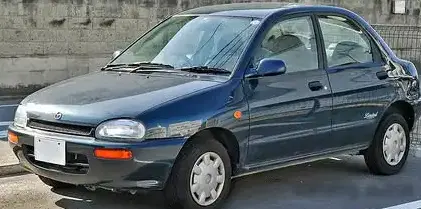
The Mazda Revue 1.5 i 16V, produced between 1990 and 1997, was a compact sedan primarily aimed at the Japanese domestic market (JDM). Positioned as an affordable and practical family vehicle, the Revue occupied a crucial space in Mazda’s lineup during a period of significant automotive development. This particular variant, equipped with the 1.5-liter 16-valve engine producing 88 horsepower, represented a mid-range offering within the Revue family, balancing fuel efficiency with adequate performance for everyday driving. The Revue was notable for its relatively spacious interior and practical hatchback-style trunk, offering versatility uncommon in its class.
Technical Specifications
| Brand | Mazda |
| Model | Revue |
| Generation | Revue |
| Type (Engine) | 1.5 i 16V (88 Hp) |
| Start of production | 1990 year |
| End of production | 1997 year |
| Powertrain Architecture | Internal Combustion engine |
| Body type | Sedan |
| Seats | 5 |
| Doors | 4 |
| Fuel consumption (urban) | 10 l/100 km (23.5 US mpg) |
| Fuel consumption (extra urban) | 6 l/100 km (39.2 US mpg) |
| Fuel Type | Petrol (Gasoline) |
| Maximum speed | 165 km/h (102.53 mph) |
| Weight-to-power ratio | 9 kg/Hp |
| Weight-to-torque ratio | 6.7 kg/Nm |
| Power | 88 Hp @ 6500 rpm |
| Power per litre | 58.7 Hp/l |
| Torque | 118 Nm @ 4000 rpm (87.03 lb.-ft. @ 4000 rpm) |
| Engine layout | Front, Transverse |
| Engine displacement | 1498 cm3 (91.41 cu. in.) |
| Number of cylinders | 4 |
| Engine configuration | Inline |
| Cylinder Bore | 78 mm (3.07 in.) |
| Piston Stroke | 78.4 mm (3.09 in.) |
| Compression ratio | 9.4:1 |
| Number of valves per cylinder | 4 |
| Fuel injection system | Single-point injection |
| Engine aspiration | Naturally aspirated engine |
| Valvetrain | OHC |
| Kerb Weight | 790 kg (1741.65 lbs.) |
| Trunk (boot) space – minimum | 290 l (10.24 cu. ft.) |
| Trunk (boot) space – maximum | 955 l (33.73 cu. ft.) |
| Fuel tank capacity | 43 l (11.36 US gal) |
| Length | 3800 mm (149.61 in.) |
| Width | 1655 mm (65.16 in.) |
| Height | 1470 mm (57.87 in.) |
| Wheelbase | 2390 mm (94.09 in.) |
| Front track | 1420 mm (55.91 in.) |
| Rear (Back) track | 1400 mm (55.12 in.) |
| Drivetrain Architecture | The Internal combustion engine (ICE) drives the front wheels of the vehicle. |
| Drive wheel | Front wheel drive |
| Number of gears and type of gearbox | 5 gears, manual transmission |
| Front suspension | Spring Strut |
| Rear suspension | Coil spring |
| Front brakes | Ventilated discs |
| Rear brakes | Disc |
| Assisting systems | ABS (Anti-lock braking system) |
| Steering type | Steering rack and pinion |
| Power steering | Hydraulic Steering |
| Tires size | 175/60 SR14 |
Powertrain & Engine Architecture
The heart of the Revue 1.5 i 16V is the Mazda B5 engine, a 1.5-liter inline-four cylinder gasoline engine. This engine, designated as the B5-ME, utilized a single-point fuel injection system, a common feature for vehicles of this era. The 16-valve configuration, with four valves per cylinder, contributed to improved breathing and a slightly higher power output compared to earlier 8-valve versions. The engine’s overhead camshaft (OHC) design simplified the valvetrain, reducing weight and complexity. Producing 88 horsepower at 6500 rpm and 118 Nm (87 lb-ft) of torque at 4000 rpm, the B5-ME was designed for efficiency and reliability rather than outright performance. The engine’s transverse mounting and front-wheel-drive configuration were typical for compact cars of the 1990s, maximizing interior space and improving packaging.
Driving Characteristics
The 1.5-liter engine, paired with a five-speed manual transmission, provided adequate, though not exhilarating, performance. Acceleration was modest, with a focus on smooth and predictable power delivery. The gear ratios were tuned for fuel economy, meaning the engine needed to be revved to access its full potential. Compared to higher-spec Revue models equipped with larger engines, the 1.5 i 16V felt noticeably less powerful, particularly when fully loaded or tackling inclines. However, its lighter weight and responsive steering made it enjoyable to drive in urban environments. The suspension, tuned for comfort, absorbed bumps reasonably well, but body roll was evident during cornering.
Equipment & Trim Levels
The 1.5 i 16V trim level typically included basic amenities such as power steering, a radio/cassette player, and cloth upholstery. Air conditioning was often an optional extra. Interior plastics were durable but utilitarian, reflecting the car’s affordable positioning. The dashboard layout was functional and straightforward, prioritizing ease of use over aesthetic flair. Higher trim levels offered features like electric windows, central locking, and upgraded interior trim, but the 1.5 i 16V represented the entry point to the Revue range.
Chassis & Braking
The Revue utilized a front-wheel-drive chassis with a MacPherson strut suspension in the front and a coil spring setup in the rear. The front brakes were ventilated discs, providing adequate stopping power, while the rear brakes were solid discs. Anti-lock braking system (ABS) was available, enhancing safety, particularly in wet or slippery conditions. The steering employed a rack-and-pinion system with hydraulic power assistance, offering a reasonable level of responsiveness and ease of maneuvering. The relatively lightweight construction of the Revue contributed to its nimble handling characteristics.
Market Reception & Comparison
The Mazda Revue 1.5 i 16V was generally well-received as a practical and economical family car. Critics praised its spacious interior, versatile hatchback design, and reasonable fuel economy. However, the engine’s modest power output was often cited as a drawback, particularly when compared to competitors offering more powerful engines. Compared to other trims within the Revue lineup, the 1.5 i 16V offered the most affordable entry point, appealing to budget-conscious buyers. The 1.8-liter versions provided a noticeable performance boost, while diesel variants prioritized fuel efficiency.
Legacy
The Mazda Revue, while not a groundbreaking vehicle, played a significant role in Mazda’s product lineup during the 1990s. The 1.5 i 16V powertrain proved to be relatively reliable, with many examples still on the road today. The B5 engine, while not known for exceptional performance, was durable and relatively easy to maintain. In the used car market, the Revue 1.5 i 16V remains an affordable and practical option for those seeking a simple, reliable, and economical compact sedan. Its enduring appeal lies in its practicality, ease of ownership, and the reputation for dependability associated with the Mazda brand.
