
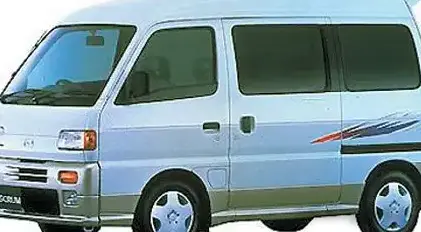
The Mazda Scrum (ED) 0.7 12V, producing 42 horsepower, was a compact, rear-wheel drive minivan produced by Mazda between 1995 and 2000. Positioned as the entry-level variant of the ED generation Scrum, it served as an affordable and practical transportation solution, primarily within the Japanese domestic market (JDM). The Scrum, in general, was designed to fit within the Japanese Kei car regulations, offering tax and insurance benefits to buyers. This particular 0.7-liter engine and five-speed manual transmission combination represented the base model, prioritizing fuel efficiency and low running costs over outright performance. It was a popular choice for businesses and individuals needing a small, utilitarian vehicle for urban deliveries and short-distance commuting.
Technical Specifications
| Brand | Mazda |
| Model | Scrum |
| Generation | Scrum (ED) |
| Type (Engine) | 0.7 12V (42 Hp) |
| Start of production | 1995 |
| End of production | 2000 |
| Powertrain Architecture | Internal Combustion engine |
| Body type | Minivan |
| Seats | 4 |
| Doors | 4 |
| Fuel consumption (combined) | 4.4 l/100 km (53.5 US mpg, 64.2 UK mpg, 22.7 km/l) |
| Fuel Type | Petrol (Gasoline) |
| Maximum speed | 125 km/h (77.67 mph) |
| Weight-to-power ratio | 18.6 kg/Hp, 53.8 Hp/tonne |
| Weight-to-torque ratio | 13.7 kg/Nm, 73.1 Nm/tonne |
| Power | 42 Hp @ 5500 rpm |
| Power per litre | 63.9 Hp/l |
| Torque | 57 Nm @ 4000 rpm (42.04 lb.-ft. @ 4000 rpm) |
| Engine layout | Front, Longitudinal |
| Engine displacement | 657 cm3 (40.09 cu. in.) |
| Number of cylinders | 3 |
| Engine configuration | Inline |
| Cylinder Bore | 65 mm (2.56 in.) |
| Piston Stroke | 66 mm (2.6 in.) |
| Compression ratio | 10.5:1 |
| Number of valves per cylinder | 4 |
| Fuel injection system | Carburettor |
| Engine aspiration | Naturally aspirated engine |
| Valvetrain | OHC |
| Kerb Weight | 780 kg (1719.61 lbs.) |
| Fuel tank capacity | 37 l (9.77 US gal | 8.14 UK gal) |
| Length | 3295 mm (129.72 in.) |
| Width | 1395 mm (54.92 in.) |
| Height | 1870 mm (73.62 in.) |
| Wheelbase | 1840 mm (72.44 in.) |
| Front track | 1210 mm (47.64 in.) |
| Rear track | 1200 mm (47.24 in.) |
| Minimum turning circle | 9 m (29.53 ft.) |
| Drivetrain Architecture | Rear wheel drive |
| Drive wheel | Rear wheel drive |
| Number of gears and type of gearbox | 5 gears, manual transmission |
| Front suspension | Coil spring |
| Rear suspension | Coil spring |
| Front brakes | Disc |
| Rear brakes | Drum |
| Assisting systems | ABS (Anti-lock braking system) |
| Tires size | 145/80 R12 S |
| Wheel rims size | 4J x 12 ET 35 |
Powertrain & Engine Architecture
The heart of the Scrum 0.7 was the F6A engine, a 657cc inline-three cylinder petrol engine. This engine utilized a single overhead camshaft (OHC) and four valves per cylinder. The fuel delivery system relied on a carburetor, a relatively simple and cost-effective solution for the time, but less efficient and precise than fuel injection. The 12-valve configuration (four valves per cylinder) helped to improve breathing and, consequently, power output for its displacement. The engine was mounted longitudinally in the front of the vehicle, driving the rear wheels. The five-speed manual transmission was a standard feature, providing a reasonable range of gears for both city driving and highway cruising, although the limited horsepower meant frequent downshifting was often necessary. The engine code is often referenced as F6A, and variations existed depending on specific production years.
Driving Characteristics
The 42 horsepower and 57 Nm (42 lb-ft) of torque produced by the 0.7-liter engine resulted in modest performance. Acceleration was slow, particularly when loaded with passengers or cargo. The five-speed manual transmission allowed drivers to keep the engine in its optimal power band, but even then, overtaking maneuvers required careful planning. The rear-wheel drive configuration provided a relatively stable driving experience, especially in dry conditions. Compared to later, more powerful Scrum variants (such as those with larger engines), the 0.7-liter model prioritized fuel economy and ease of driving over outright speed. The gear ratios were tuned for maximizing fuel efficiency, meaning the engine could feel strained at higher speeds. The light weight of the vehicle (780 kg) helped to mitigate the lack of power to some extent.
Equipment & Trim Levels
The base-model Scrum 0.7 was sparsely equipped, reflecting its position as the entry-level variant. Standard features typically included basic cloth upholstery, a simple dashboard layout with minimal instrumentation, and manually operated windows and door locks. Air conditioning was often an optional extra, as were power steering and a radio. The interior was designed for practicality and durability rather than luxury. The focus was on providing a functional workspace for commercial users or a basic, reliable vehicle for personal transportation. Trim levels were minimal, with most variations stemming from optional extras added by the buyer.
Chassis & Braking
The Scrum ED featured a relatively simple chassis design. Both the front and rear suspension utilized coil springs, providing a comfortable ride quality, especially considering the vehicle’s utilitarian purpose. The front brakes were disc brakes, offering better stopping power than the drum brakes fitted to the rear wheels. An Anti-lock Braking System (ABS) was available as an option, enhancing safety by preventing wheel lockup during hard braking. The tires were typically 145/80 R12, chosen for their balance of affordability, fuel efficiency, and grip. The relatively narrow track width contributed to the vehicle’s compact dimensions, making it easy to maneuver in tight urban environments.
Market Reception & Comparison
The Mazda Scrum 0.7 12V was well-received in Japan as an affordable and practical Kei car. Critics praised its fuel efficiency and maneuverability, but noted its limited power and basic interior. Compared to other Kei car rivals, such as the Suzuki Carry and the Daihatsu Hijet, the Scrum offered a similar level of practicality and affordability. However, the Scrum’s carburetor-equipped engine was less sophisticated than the fuel-injected engines found in some competitors, resulting in slightly lower fuel economy and higher emissions. The manual transmission was favored by many drivers for its simplicity and control, but an automatic transmission was also available as an option, albeit with a further reduction in performance.
Legacy
The Mazda Scrum ED 0.7 12V, while not a performance icon, remains a popular choice among enthusiasts of JDM vehicles and those seeking a reliable and affordable workhorse. The F6A engine is known for its durability and relative simplicity, making it relatively easy to maintain. Parts availability can be a challenge outside of Japan, but a dedicated community of owners and enthusiasts helps to keep these vehicles on the road. In the used car market, these Scrums are often sought after for their low running costs and compact size, making them ideal for urban environments or as a second vehicle. The 0.7-liter variant represents a significant entry point into the world of classic Kei cars, offering a unique and charming driving experience.
