
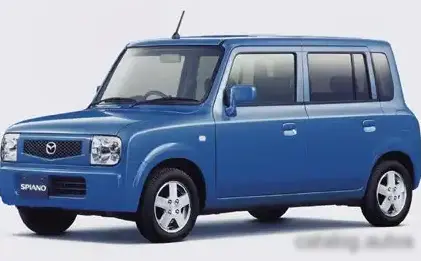
The Mazda Spiano (F21) 0.7 i 12V 2WD, produced from 2002 to 2008, represents a unique entry in Mazda’s history, primarily aimed at the Japanese domestic market (JDM) as a kei car. This diminutive hatchback, falling under Japan’s strict kei car regulations, offered affordable and practical transportation. The “0.7 i 12V 2WD” designation specifically refers to the model equipped with the 658cc inline-three engine, a 12-valve cylinder head, and a two-wheel drive configuration paired with a four-speed automatic transmission. This variant occupied the base trim level within the Spiano lineup, prioritizing fuel efficiency and ease of use over outright performance.
Technical Specifications
| Brand | Mazda |
| Model | Spiano |
| Generation | Spiano (F21) |
| Type (Engine) | 0.7 i 12V 2WD (54 Hp) |
| Start of production | 2002 |
| End of production | 2008 |
| Powertrain Architecture | Internal Combustion engine |
| Body type | Hatchback |
| Seats | 5 |
| Doors | 5 |
| Fuel consumption (urban) | 5.2 l/100 km (45.2 US mpg, 54.3 UK mpg, 19.2 km/l) |
| Fuel Type | Petrol (Gasoline) |
| Weight-to-power ratio | 14.4 kg/Hp, 69.2 Hp/tonne |
| Weight-to-torque ratio | 12.8 kg/Nm, 78.2 Nm/tonne |
| Power | 54 Hp @ 6500 rpm |
| Power per litre | 82.1 Hp/l |
| Torque | 61 Nm @ 4000 rpm (44.99 lb.-ft. @ 4000 rpm) |
| Engine layout | Front, Transverse |
| Engine displacement | 658 cm3 (40.15 cu. in.) |
| Number of cylinders | 3 |
| Engine configuration | Inline |
| Cylinder Bore | 68 mm (2.68 in.) |
| Piston Stroke | 60.4 mm (2.38 in.) |
| Compression ratio | 10.5:1 |
| Number of valves per cylinder | 4 |
| Fuel injection system | Multi-port manifold injection |
| Engine aspiration | Naturally aspirated engine |
| Valvetrain | DOHC |
| Kerb Weight | 780 kg (1719.61 lbs.) |
| Max. weight | 1000 kg (2204.62 lbs.) |
| Max load | 220 kg (485.02 lbs.) |
| Fuel tank capacity | 30 l (7.93 US gal | 6.6 UK gal) |
| Length | 3395 mm (133.66 in.) |
| Width | 1475 mm (58.07 in.) |
| Height | 1505 mm (59.25 in.) |
| Wheelbase | 2360 mm (92.91 in.) |
| Front track | 1295 mm (50.98 in.) |
| Rear track | 1290 mm (50.79 in.) |
| Minimum turning circle | 8.4 m (27.56 ft.) |
| Drivetrain Architecture | Front wheel drive |
| Number of gears | 4 |
| Gearbox type | automatic transmission |
| Front suspension | Coil spring |
| Rear suspension | Coil spring |
| Front brakes | Disc |
| Rear brakes | Drum |
| Assisting systems | ABS (Anti-lock braking system) |
| Steering type | Steering rack and pinion |
| Power steering | Hydraulic Steering |
| Tires size | 155/65 R13 73 S |
| Wheel rims size | 4J x 13 ET 45 |
Powertrain & Engine Architecture
The heart of the Spiano 0.7 i is the F6A engine, a 658cc inline-three cylinder unit. This engine, common in many kei cars of the era, featured a double overhead camshaft (DOHC) valvetrain operating 12 valves (four per cylinder). Multi-port fuel injection was utilized to deliver fuel, contributing to reasonable efficiency for its time. The engine’s small displacement necessitated a relatively high-revving nature to produce its peak output of 54 horsepower at 6500 rpm and 61 Nm (45 lb-ft) of torque at 4000 rpm. The four-speed automatic transmission was a conventional hydraulic unit, chosen for its simplicity and ease of use, aligning with the target demographic’s preference for convenience. The transmission’s gear ratios were optimized for city driving and maximizing fuel economy, rather than providing spirited acceleration.
Driving Characteristics
The Spiano 0.7 i Automatic offered a predictably leisurely driving experience. Acceleration was modest, particularly when fully loaded. The automatic transmission, while smooth, lacked the responsiveness of a manual gearbox. The gear ratios were spaced to prioritize fuel efficiency, meaning the engine often felt strained during overtaking maneuvers or when climbing hills. Compared to the available manual transmission, the automatic version resulted in a noticeable performance decrease. The Spiano’s light weight (780 kg / 1719 lbs) helped mitigate the lack of power to some extent, making it feel reasonably nimble in urban environments. Steering was light and easy, further enhancing its suitability for city driving.
Equipment & Trim Levels
As the base trim level, the 0.7 i 2WD typically came equipped with basic amenities. Standard features included air conditioning, power steering, and a basic audio system. Interior upholstery was typically a simple cloth material. Optional extras included power windows, central locking, and upgraded audio systems. The dashboard layout was functional and straightforward, prioritizing usability over aesthetic flair. Safety features were limited by the standards of the time, typically including only a driver’s airbag and ABS (Anti-lock Braking System).
Chassis & Braking
The Spiano utilized a simple, yet effective chassis design. Front suspension consisted of coil springs, while the rear also employed coil springs. The front brakes were discs, providing adequate stopping power for the vehicle’s weight and performance. However, the rear brakes were drums, a cost-saving measure common in kei cars. The Spiano’s relatively narrow tires (155/65 R13) contributed to its fuel efficiency but limited grip in cornering. A stabilizer bar was not typically included in the base trim, further emphasizing the focus on affordability.
Market Reception & Comparison
The Mazda Spiano, and particularly the 0.7 i Automatic variant, was well-received in Japan as a practical and economical city car. Critics praised its fuel efficiency and ease of use, but noted its limited performance. Compared to other kei car offerings like the Suzuki Wagon R or the Daihatsu Mira, the Spiano offered a slightly more stylish design, but often at a slightly higher price point. The automatic transmission, while convenient, was often criticized for diminishing the already modest performance. Fuel economy figures of around 5.2 l/100km (45.2 US mpg) were competitive for the segment.
Legacy
The Mazda Spiano, while not a groundbreaking vehicle, holds a place in automotive history as a representative of Japan’s unique kei car culture. The 0.7 i 12V 2WD automatic powertrain, while not known for its robustness, generally proved reliable with regular maintenance. Today, the Spiano is a relatively uncommon sight, even in Japan. Well-maintained examples are sought after by enthusiasts of JDM cars and kei car aficionados. The engine’s simplicity makes it relatively easy to repair, but finding replacement parts can be challenging outside of Japan. The Spiano serves as a reminder of a time when small, efficient, and affordable transportation was prioritized, and continues to appeal to those seeking a unique and charming automotive experience.
