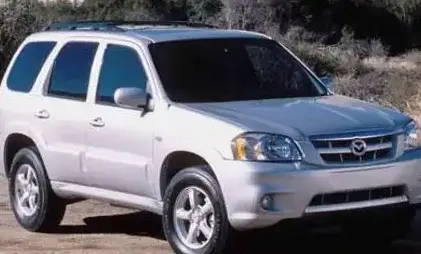
The Mazda Tribute 2.0i 16V 2WD, produced from 2000 to 2004, represented the entry point into Mazda’s compact SUV lineup during its first generation (2001-2008). Sharing a platform with the Ford Escape, the Tribute was Mazda’s initial foray into the rapidly growing SUV market. This particular 2.0-liter, front-wheel-drive variant with a five-speed manual transmission was positioned as the most economical and accessible option, targeting buyers prioritizing fuel efficiency and affordability over outright performance. It served as a crucial model for establishing Mazda’s presence in the segment and broadening its customer base.
Technical Specifications
| Brand | Mazda |
| Model | Tribute |
| Generation | Tribute (First Generation) |
| Type (Engine) | 2.0 i 16V 2WD (124 Hp) |
| Start of production | 2000 |
| End of production | 2004 |
| Powertrain Architecture | Internal Combustion Engine |
| Body type | SUV |
| Seats | 5 |
| Doors | 5 |
| Fuel consumption (urban) | 12.9 l/100 km (18.2 US mpg) |
| Fuel consumption (extra urban) | 7.8 l/100 km (30.2 US mpg) |
| Fuel consumption (combined) | 9.4 l/100 km (25 US mpg) |
| Fuel Type | Petrol (Gasoline) |
| Acceleration 0 – 100 km/h | 13 sec |
| Acceleration 0 – 62 mph | 13 sec |
| Acceleration 0 – 60 mph | 12.4 sec |
| Maximum speed | 169 km/h (105.01 mph) |
| Weight-to-power ratio | 11.5 kg/Hp |
| Weight-to-torque ratio | 8.1 kg/Nm |
| Power | 124 Hp @ 5300 rpm |
| Torque | 175 Nm @ 4500 rpm (129.07 lb.-ft. @ 4500 rpm) |
| Engine layout | Front, Transverse |
| Engine Model/Code | YF |
| Engine displacement | 1989 cm3 (121.38 cu. in.) |
| Number of cylinders | 4 |
| Engine configuration | Inline |
| Cylinder Bore | 84.8 mm (3.34 in.) |
| Piston Stroke | 88 mm (3.46 in.) |
| Compression ratio | 9.6:1 |
| Number of valves per cylinder | 4 |
| Fuel injection system | Multi-port manifold injection |
| Engine aspiration | Naturally aspirated |
| Valvetrain | DOHC |
| Engine oil capacity | 4.25 l (4.49 US qt | 3.74 UK qt) |
| Coolant capacity | 6.6 l (6.97 US qt | 5.81 UK qt) |
| Kerb Weight | 1425 kg (3141.59 lbs.) |
| Max. weight | 1915 kg (4221.85 lbs.) |
| Max load | 490 kg (1080.27 lbs.) |
| Trunk (boot) space – minimum | 368 l (13 cu. ft.) |
| Trunk (boot) space – maximum | 2245 l (79.28 cu. ft.) |
| Fuel tank capacity | 57 l (15.06 US gal | 12.54 UK gal) |
| Length | 4395 mm (173.03 in.) |
| Width | 1800 mm (70.87 in.) |
| Height | 1710 mm (67.32 in.) |
| Wheelbase | 2620 mm (103.15 in.) |
| Front track | 1540 mm (60.63 in.) |
| Rear track | 1520 mm (59.84 in.) |
| Drivetrain | Front Wheel Drive |
| Number of gears | 5 |
| Gearbox type | Manual Transmission |
| Front suspension | Independent type McPherson |
| Rear suspension | Independent multi-link spring suspension with stabilizer |
| Front brakes | Disc |
| Rear brakes | Drum |
| Assisting systems | ABS (Anti-lock braking system) |
| Steering type | Steering rack and pinion |
| Power steering | Hydraulic |
| Tires size | 215/70 R16 99 S |
| Wheel rims size | 6.5J x 16 ET 50 |
Powertrain & Engine Architecture
The heart of the 2.0i Tribute was the Mazda-developed YF engine, a 1.999-liter inline-four cylinder powerplant. This engine utilized a multi-port fuel injection system and a double overhead camshaft (DOHC) valvetrain, contributing to its relatively efficient operation for its time. The 9.6:1 compression ratio was a standard figure for naturally aspirated engines of this era. The YF engine, while not known for its high performance, was regarded as a reliable and durable unit. Paired with the five-speed manual transmission, the engine delivered power to the front wheels. The transmission itself was a conventional setup, offering smooth shifts but lacking the sophistication of more modern gearboxes.
Driving Characteristics
The 124 horsepower and 175 Nm (129 lb-ft) of torque produced by the 2.0i engine translated to adequate, but not exhilarating, performance. Acceleration from 0 to 60 mph took around 12.4 seconds, and top speed was limited to 105 mph. Compared to the available V6 engine option in the Tribute, this variant felt noticeably slower, particularly when fully loaded or tackling inclines. The five-speed manual transmission allowed drivers to maintain optimal engine speed for given conditions, but the relatively long gear ratios prioritized fuel economy over rapid acceleration. The front-wheel-drive configuration provided predictable handling in most conditions, but lacked the all-weather capability of the available four-wheel-drive models.
Equipment & Trim Levels
The 2.0i Tribute typically came with a fairly basic level of standard equipment. Interior features generally included cloth upholstery, a basic audio system, manual air conditioning, and power windows and locks. Safety features included dual front airbags and ABS brakes. Optional extras, such as a CD player, upgraded audio systems, and alloy wheels, were available, but often added significantly to the vehicle’s price. The interior design was functional and straightforward, prioritizing practicality over luxury.
Chassis & Braking
The Tribute’s chassis featured an independent McPherson strut suspension in the front and an independent multi-link suspension in the rear, providing a reasonably comfortable ride. A stabilizer bar was included in the rear suspension to reduce body roll during cornering. Braking duties were handled by disc brakes in the front and drum brakes in the rear. While adequate for everyday driving, the braking system lacked the stopping power and feel of more advanced setups. The relatively lightweight nature of the 2.0i model, compared to the V6 variants, helped to mitigate the limitations of the braking system.
Market Reception & Comparison
The Mazda Tribute 2.0i 16V 2WD was generally well-received as an affordable and practical entry-level SUV. Critics praised its fuel efficiency and spacious interior, but noted its lack of performance compared to competitors and higher-trim Tribute models. Compared to the V6-powered Tribute, the 2.0i offered significantly better fuel economy (around 25 mpg combined) but considerably less power. The Ford Escape, being mechanically similar, offered a comparable alternative. The 2.0i appealed to buyers who prioritized value and practicality over sporty driving dynamics.
Legacy
The Mazda Tribute 2.0i 16V 2WD, while not a performance icon, proved to be a reliable and durable vehicle. The YF engine, when properly maintained, is known for its longevity. On the used car market, these models are often found with relatively high mileage but remain affordable and represent a good value for buyers seeking a basic, dependable SUV. Common maintenance issues include wear and tear on suspension components and potential corrosion in areas exposed to road salt. The Tribute, in general, helped establish Mazda as a serious contender in the SUV market and paved the way for future generations of Mazda crossovers.