
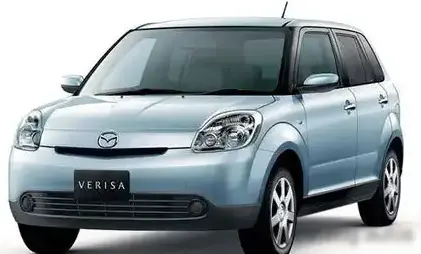
The Mazda Verisa L 1.5 16V, produced from 2004 to 2015, was a compact hatchback designed primarily for the Japanese domestic market (JDM). Positioned as a practical and stylish vehicle, the Verisa aimed to appeal to buyers seeking a blend of space, fuel efficiency, and ease of use. It occupied a niche between smaller kei cars and larger family hatchbacks, offering a unique proposition within Mazda’s lineup. The “L” trim represented a mid-range offering, balancing features and affordability. The Verisa was built on Mazda’s DY platform, sharing components with other models of the era, but distinguished itself with its distinctive styling and focus on interior space.
Technical Specifications
| Brand | Mazda |
| Model | Verisa |
| Generation | Verisa L |
| Type (Engine) | 1.5 16V (113 Hp) |
| Start of production | 2004 |
| End of production | 2015 |
| Powertrain Architecture | Internal Combustion engine |
| Body type | Hatchback |
| Seats | 5 |
| Doors | 5 |
| Fuel Type | Petrol (Gasoline) |
| Maximum speed | 180 km/h (111.85 mph) |
| Weight-to-power ratio | 9.7 kg/Hp, 102.7 Hp/tonne |
| Weight-to-torque ratio | 7.9 kg/Nm, 127.3 Nm/tonne |
| Power | 113 Hp @ 6000 rpm |
| Power per litre | 75.4 Hp/l |
| Torque | 140 Nm (103.26 lb.-ft.) |
| Engine layout | Front, Transverse |
| Engine displacement | 1498 cm3 (91.41 cu. in.) |
| Number of cylinders | 4 |
| Engine configuration | Inline |
| Cylinder Bore | 78 mm (3.07 in.) |
| Piston Stroke | 78.4 mm (3.09 in.) |
| Compression ratio | 10:1 |
| Number of valves per cylinder | 4 |
| Fuel injection system | Multi-port manifold injection |
| Engine aspiration | Naturally aspirated engine |
| Kerb Weight | 1100 kg (2425.08 lbs.) |
| Max. weight | 1375 kg (3031.36 lbs.) |
| Max load | 275 kg (606.27 lbs.) |
| Trunk (boot) space – minimum | 335 l (11.83 cu. ft.) |
| Trunk (boot) space – maximum | 1175 l (41.49 cu. ft.) |
| Fuel tank capacity | 45 l (11.89 US gal | 9.9 UK gal) |
| Length | 3975 mm (156.5 in.) |
| Width | 1695 mm (66.73 in.) |
| Height | 1530 mm (60.24 in.) |
| Wheelbase | 2490 mm (98.03 in.) |
| Front track | 1475 mm (58.07 in.) |
| Rear (Back) track | 1450 mm (57.09 in.) |
| Drivetrain Architecture | The Internal combustion engine (ICE) drives the front wheels of the vehicle. |
| Drive wheel | Front wheel drive |
| Number of gears and type of gearbox | 4 gears, automatic transmission |
| Front suspension | Independent coil spring |
| Rear suspension | Independent coil spring |
| Front brakes | Disc |
| Rear brakes | Drum |
| Assisting systems | ABS (Anti-lock braking system) |
| Tires size | 185/55 R15 |
Powertrain & Engine Architecture
The Mazda Verisa L 1.5 16V was powered by the Mazda ZJ-VE engine, a 1.5-liter inline-four cylinder gasoline engine. This engine, part of Mazda’s Z series, featured a single overhead camshaft (SOHC) design with four valves per cylinder. The ZJ-VE utilized multi-point fuel injection to deliver fuel directly into the intake ports, optimizing combustion efficiency. The engine produced 113 horsepower at 6000 rpm and 140 Nm (103.26 lb.-ft.) of torque. The engine’s design prioritized fuel economy and smooth operation over outright performance. The Verisa L was exclusively offered with a four-speed automatic transmission. This transmission was chosen to provide a comfortable and convenient driving experience, aligning with the car’s target demographic. The automatic transmission featured electronically controlled torque converter lock-up for improved fuel efficiency at highway speeds.
Driving Characteristics
The 1.5L engine and four-speed automatic combination in the Verisa L delivered adequate, but not particularly sporty, performance. Acceleration was linear and predictable, suitable for city driving and highway cruising. The automatic transmission’s gear ratios were tuned for fuel efficiency, resulting in a slightly relaxed feel. Compared to a manual transmission equipped Verisa (available in other trims), the automatic version offered less driver engagement and slightly slower acceleration times. However, the automatic provided a smoother and more effortless driving experience, particularly in congested traffic. The Verisa L wasn’t designed to be a performance car; its focus was on providing a comfortable and practical mode of transportation.
Equipment & Trim Levels
The Verisa L trim level offered a good balance of features and affordability. Standard equipment typically included air conditioning, power windows, power door locks, and a basic audio system with CD player. Interior upholstery was typically cloth, with a focus on durability and practicality. Optional extras available for the Verisa L included alloy wheels, a more advanced audio system, and a navigation system. The dashboard layout was functional and straightforward, prioritizing ease of use. The Verisa’s interior was designed to maximize space and comfort, with a relatively high roofline and ample legroom for both front and rear passengers.
Chassis & Braking
The Mazda Verisa L featured a front-wheel-drive layout with independent coil spring suspension on all four wheels. The front suspension utilized MacPherson struts, while the rear suspension employed a torsion beam setup. This suspension configuration provided a comfortable ride quality, absorbing bumps and irregularities in the road surface effectively. The Verisa L was equipped with disc brakes on the front wheels and drum brakes on the rear wheels. Anti-lock Braking System (ABS) was standard, enhancing braking performance and stability, especially in wet or slippery conditions. The chassis was designed to provide a stable and predictable handling experience, prioritizing safety and comfort over sporty handling characteristics.
Market Reception & Comparison
The Mazda Verisa was generally well-received in the Japanese market as a practical and stylish compact hatchback. Critics praised its spacious interior, fuel efficiency, and comfortable ride. However, some reviewers noted that the 1.5L engine and automatic transmission combination lacked the performance of some competitors. Compared to other trims in the Verisa lineup, the L trim offered a good value proposition, providing a solid set of features at an affordable price point. Fuel economy was a strong point for the Verisa L, typically achieving around 6.0-7.0 liters per 100 kilometers (39-45 mpg) in mixed driving conditions. Reliability was generally good, with the ZJ-VE engine proving to be a durable and dependable unit.
Legacy
The Mazda Verisa, while not widely exported outside of Japan, remains a popular choice in the used car market. The 1.5L engine and four-speed automatic transmission combination is known for its reliability and relatively low maintenance costs. Parts availability is generally good, particularly in Japan. The Verisa’s spacious interior and practical design continue to appeal to buyers seeking a comfortable and efficient compact hatchback. While it may not be a collector’s item, the Verisa L 1.5 16V represents a well-engineered and thoughtfully designed vehicle that provided a valuable transportation solution for many Japanese drivers.
