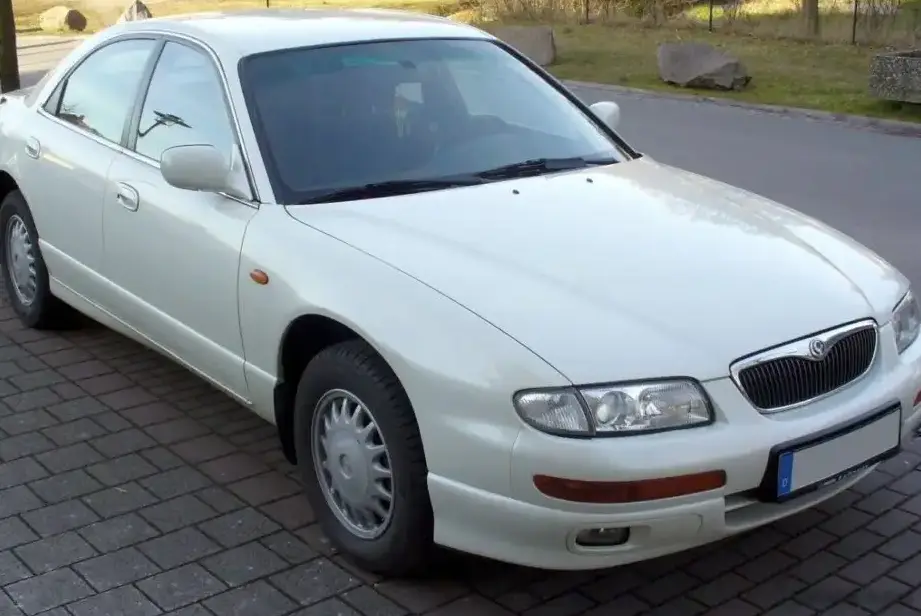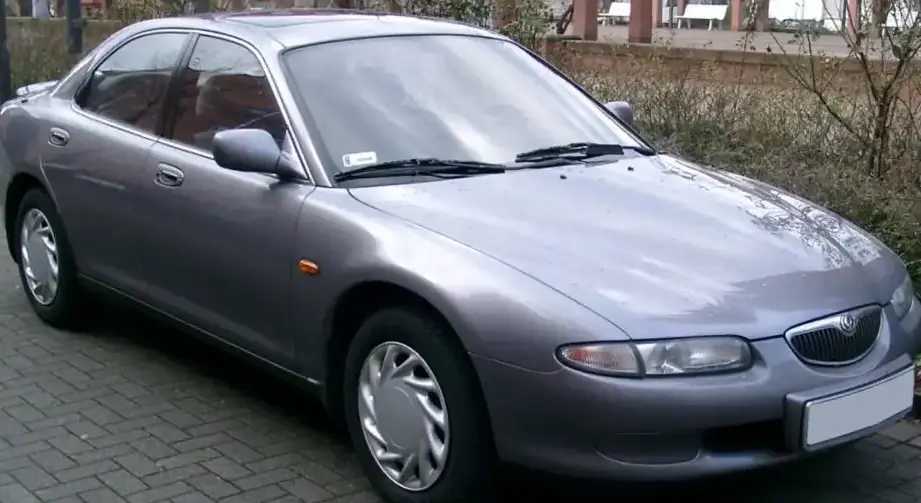
The Mazda Xedos 6, produced between 1995 and 1999, represented Mazda’s foray into the premium, near-luxury segment of the automotive market, primarily aimed at European buyers. Positioned above the Mazda 626, the Xedos 6 (chassis code CA) sought to offer a more refined driving experience and a higher level of equipment. This article focuses specifically on the 2.0-liter V6 variant paired with a four-speed automatic transmission, a configuration that occupied a mid-range position within the Xedos 6 lineup. It was designed to appeal to buyers seeking a balance between performance and convenience, without the higher price tag of the flagship models.
Technical Specifications
| Brand | Mazda |
| Model | Xedos 6 |
| Generation | Xedos 6 (CA) |
| Type (Engine) | 2.0 V6 (144 Hp) Automatic |
| Start of production | 1995 |
| End of production | 1999 |
| Powertrain Architecture | Internal Combustion engine |
| Body type | Sedan |
| Seats | 5 |
| Doors | 4 |
| Fuel consumption (urban) | 12.7 l/100 km (18.5 US mpg, 22.2 UK mpg, 7.9 km/l) |
| Fuel consumption (extra urban) | 7.2 l/100 km (32.7 US mpg, 39.2 UK mpg, 13.9 km/l) |
| Fuel Type | Petrol (Gasoline) |
| Acceleration 0 – 100 km/h | 12.1 sec |
| Acceleration 0 – 62 mph | 12.1 sec |
| Acceleration 0 – 60 mph | 11.5 sec |
| Maximum speed | 201 km/h (124.9 mph) |
| Weight-to-power ratio | 8.3 kg/Hp, 121 Hp/tonne |
| Weight-to-torque ratio | 7 kg/Nm, 142.9 Nm/tonne |
| Power | 144 Hp @ 6000 rpm |
| Power per litre | 72.2 Hp/l |
| Torque | 170 Nm @ 5000 rpm (125.39 lb.-ft. @ 5000 rpm) |
| Engine layout | Front, Transverse |
| Engine displacement | 1995 cm3 (121.74 cu. in.) |
| Number of cylinders | 6 |
| Engine configuration | V-engine |
| Cylinder Bore | 78 mm (3.07 in.) |
| Piston Stroke | 69.6 mm (2.74 in.) |
| Compression ratio | 9.5:1 |
| Number of valves per cylinder | 4 |
| Fuel injection system | Multi-port manifold injection |
| Engine aspiration | Naturally aspirated engine |
| Valvetrain | DOHC |
| Kerb Weight | 1190 kg (2623.5 lbs.) |
| Max. weight | 1710 kg (3769.9 lbs.) |
| Max load | 520 kg (1146.4 lbs.) |
| Trunk (boot) space – minimum | 390 l (13.77 cu. ft.) |
| Fuel tank capacity | 60 l (15.85 US gal | 13.2 UK gal) |
| Length | 4560 mm (179.53 in.) |
| Width | 1700 mm (66.93 in.) |
| Height | 1355 mm (53.35 in.) |
| Wheelbase | 2610 mm (102.76 in.) |
| Front track | 1470 mm (57.87 in.) |
| Rear (Back) track | 1480 mm (58.27 in.) |
| Drivetrain Architecture | The Internal combustion engine (ICE) drives the front wheels of the vehicle. |
| Drive wheel | Front wheel drive |
| Number of gears and type of gearbox | 4 gears, automatic transmission |
| Front suspension | Wishbone |
| Rear suspension | Trailing arm |
| Front brakes | Ventilated discs |
| Rear brakes | Disc |
| Assisting systems | ABS (Anti-lock braking system) |
| Steering type | Steering rack and pinion |
| Power steering | Hydraulic Steering |
| Tires size | 195/60 R15 |
| Wheel rims size | 15 |
INTRODUCTION
The Mazda Xedos 6, launched in 1995, was a significant departure for Mazda, representing an attempt to move upmarket and compete with established European brands. Built on the 1HX0/A3 platform (shared with the contemporary 626), the Xedos 6 distinguished itself through its more sophisticated styling, improved interior quality, and a focus on driving refinement. The 2.0-liter V6 automatic model was a key part of the range, offering a smooth and relatively powerful powertrain in a comfortable and well-equipped package. Production continued until 1999, with the model being primarily sold in Europe and Japan.
Powertrain & Engine Architecture
The heart of this Xedos 6 variant is the Mazda KF-DE 2.0-liter V6 engine. This engine, part of Mazda’s KF series, is a naturally aspirated, 60-degree V6 featuring a cast iron block and aluminum cylinder heads. It utilizes a multi-port fuel injection system and a double overhead camshaft (DOHC) valvetrain with four valves per cylinder. The engine code is often found as KF-DE. The V6 configuration inherently provides smooth power delivery, and the KF-DE is no exception. Paired with this engine is a four-speed automatic transmission, designed for comfortable cruising rather than sporty performance. This transmission, while reliable, lacks the responsiveness of more modern automatic gearboxes or a manual transmission. The automatic transmission was chosen to appeal to a broader audience seeking ease of use, particularly in congested European cities.
Driving Characteristics
The 2.0 V6 automatic Xedos 6 delivers a comfortable and refined driving experience. The V6 engine provides adequate power for everyday driving, with a quoted 0-60 mph time of around 11.5 seconds. However, it’s not a particularly quick car by modern standards. The four-speed automatic transmission contributes to a relaxed driving style, but it can feel somewhat sluggish during quick acceleration or when attempting to overtake. The gear ratios are geared towards fuel efficiency and smooth cruising, rather than maximizing performance. Compared to the manual transmission versions, the automatic sacrifices some responsiveness. The higher-output 2.5-liter V6 models offered significantly more performance, but at a higher price point. The suspension is tuned for comfort, providing a smooth ride over most road surfaces, although it can feel a little soft in the corners.
Equipment & Trim Levels
The 2.0 V6 automatic Xedos 6 typically came well-equipped, reflecting its positioning as a near-luxury vehicle. Standard features generally included power windows, power steering, central locking, air conditioning, and an upgraded audio system. Interior upholstery was typically cloth, although leather options were available. Dashboard design was clean and functional, with a focus on ergonomics. Optional extras included a sunroof, upgraded audio systems, and alloy wheels. Higher trim levels offered additional features such as leather seats, wood trim, and automatic climate control. The overall interior ambiance aimed for a premium feel, although it didn’t quite match the standards set by some of its German competitors.
Chassis & Braking
The Xedos 6 utilizes a front-engine, front-wheel-drive layout. The front suspension employs a wishbone configuration, while the rear suspension uses a trailing arm setup. This suspension design prioritizes ride comfort and stability. Braking duties are handled by ventilated discs at the front and solid discs at the rear. An Anti-lock Braking System (ABS) was standard, enhancing safety and control during emergency braking. The chassis was designed to provide a balance between handling and comfort, but it wasn’t particularly sporty. Stabilizer bars were fitted to both the front and rear axles to reduce body roll during cornering.
Market Reception & Comparison
The Mazda Xedos 6 was generally well-received by automotive critics, who praised its stylish design, comfortable ride, and refined interior. However, it was often criticized for its lack of outright performance and its relatively high price compared to other Mazda models. The 2.0 V6 automatic variant was seen as a good compromise between performance and convenience, but it wasn’t the most exciting option in the lineup. Fuel economy was reasonable for a V6 engine of that era, but it wasn’t class-leading. Compared to the 1.8-liter four-cylinder models, the V6 offered more power and refinement, but at the cost of increased fuel consumption. The 2.5-liter V6 provided significantly more performance, but was considerably more expensive.
Legacy
The Mazda Xedos 6, while not a massive sales success, remains a fondly remembered car among enthusiasts. The 2.0 V6 automatic powertrain is generally considered to be reliable, although regular maintenance is essential. The KF-DE V6 engine is known for its smoothness and durability. Today, Xedos 6 models are becoming increasingly rare, and well-maintained examples are sought after by collectors. The car represents a unique chapter in Mazda’s history, demonstrating the company’s ambition to compete in the premium segment. While the four-speed automatic transmission may feel dated by modern standards, it remains a reliable unit when properly maintained. The Xedos 6’s legacy lies in its attempt to offer a blend of Japanese reliability, European refinement, and distinctive styling.