
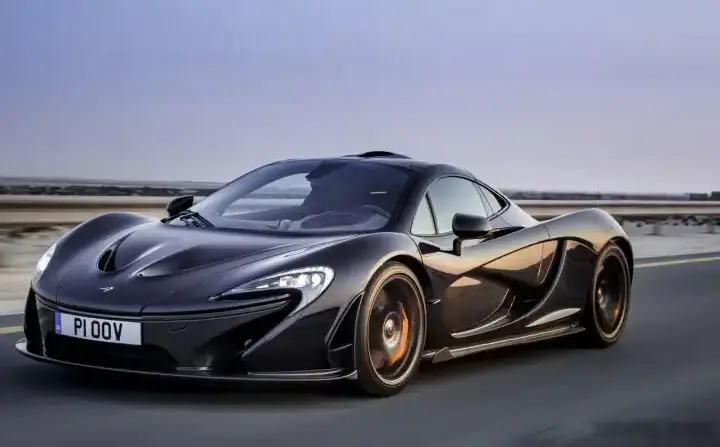
The McLaren P1, produced from 2013 to 2015, represents a pivotal moment in the evolution of hybrid hypercars. Limited to just 375 units, the P1 was McLaren’s initial foray into a new segment, directly challenging the established dominance of the Porsche 918 Spyder and the Ferrari LaFerrari. Built around a carbon fiber monocoque chassis – the MonoCage – the P1 wasn’t simply about raw power; it was a demonstration of integrated hybrid technology designed for both blistering track performance and a degree of road usability. This article focuses specifically on the core P1 configuration: the 3.8-liter twin-turbocharged V8 engine paired with a seven-speed dual-clutch transmission and electric motor, delivering a combined output of 916 horsepower.
Technical Specifications
| Brand | McLaren |
| Model | P1 |
| Generation | P1 |
| Type (Engine) | P1 V8 (916 Hp) SSG Hybrid |
| Start of production | 2013 |
| End of production | 2015 |
| Powertrain Architecture | PHEV (Plug-in Hybrid Electric Vehicle) |
| Body type | Coupe |
| Seats | 2 |
| Doors | 2 |
| Fuel consumption (combined) | 8.3 l/100 km (28.3 US mpg, 34 UK mpg, 12 km/l) |
| CO2 emissions | 194 g/km |
| Fuel Type | Petrol / electricity |
| Acceleration 0 – 100 km/h | 2.8 sec |
| Acceleration 0 – 62 mph | 2.8 sec |
| Acceleration 0 – 60 mph | 2.6 sec |
| Acceleration 0 – 200 km/h | 6.8 sec |
| Acceleration 0 – 300 km/h | 16.5 sec |
| Maximum speed | 350 km/h (217.48 mph) |
| Electric motor power | 179 Hp |
| Electric motor Torque | 260 Nm (191.77 lb.-ft.) |
| System power | 916 Hp |
| System torque | 900 Nm (663.81 lb.-ft.) |
| Engine Power | 737 Hp @ 7300 rpm |
| Engine Torque | 720 Nm @ 4000 rpm (531.04 lb.-ft. @ 4000 rpm) |
| Engine layout | Middle, Longitudinal |
| Engine Model/Code | M838TQ |
| Engine displacement | 3799 cm3 (231.83 cu. in.) |
| Number of cylinders | 8 |
| Engine configuration | V-engine |
| Fuel injection system | Direct injection |
| Engine aspiration | Twin-Turbo, Intercooler |
| Engine oil capacity | 8 l (8.45 US qt | 7.04 UK qt) |
| Kerb Weight | 1395 kg (3075.45 lbs.) |
| Length | 4588 mm (180.63 in.) |
| Width with mirrors folded | 1946 mm (76.61 in.) |
| Width including mirrors | 2144 mm (84.41 in.) |
| Height | 1188 mm (46.77 in.) |
| Wheelbase | 2670 mm (105.12 in.) |
| Front track | 1658 mm (65.28 in.) |
| Rear track | 1604 mm (63.15 in.) |
| Drive wheel | All wheel drive (4×4) |
| Number of gears and type of gearbox | 7 gears, automatic transmission SSG |
| Front brakes | Ventilated discs |
| Rear brakes | Ventilated discs |
| Assisting systems | ABS (Anti-lock braking system) |
| Steering type | Steering rack and pinion |
| Power steering | Electric Steering |
| Tires size | 245/35 ZR19; 315/30 ZR20 |
| Wheel rims size | 9J x 19; 11.5J x 20 |
Powertrain & Engine Architecture
At the heart of the P1 lies the M838TQ, a 3.8-liter twin-turbocharged V8 engine derived from the McLaren MP4-12C, but significantly upgraded. The engine utilizes direct fuel injection and a flat-plane crankshaft, contributing to its high-revving nature and distinctive exhaust note. The twin turbochargers, with electric wastegates, provide near-instantaneous boost response, minimizing turbo lag. Crucially, the engine is paired with a 179 horsepower electric motor integrated into the drivetrain. This electric motor isn’t just for supplemental power; it can drive the car independently for short distances, offering a limited all-electric range. The combined system output of 916 horsepower and 900 Nm (663.81 lb-ft) of torque is channeled through a seven-speed dual-clutch transmission (SSG – Seamless Shift Gearbox) optimized for rapid shifts. The SSG transmission is not a traditional automatic; it’s a highly sophisticated automated manual gearbox designed for performance, prioritizing speed and driver engagement.
Driving Characteristics
The P1’s driving experience is dominated by its astonishing acceleration. The instant torque delivery from the electric motor, combined with the V8’s power, results in a 0-60 mph time of just 2.6 seconds. The SSG transmission provides incredibly quick gear changes, further enhancing the acceleration. However, the P1 isn’t simply about straight-line speed. McLaren engineers focused heavily on aerodynamics, incorporating an active rear wing that adjusts its angle based on speed and driving conditions, providing significant downforce. The suspension, featuring adjustable dampers, allows for a surprisingly compliant ride in road mode, but stiffens considerably in track mode, minimizing body roll and maximizing grip. Compared to the MP4-12C, the P1 feels significantly more focused and aggressive, prioritizing track performance over everyday usability. The electric motor also allows for torque vectoring, enhancing cornering agility.
Equipment & Trim Levels
Given its limited production run and hypercar status, the P1 offered relatively few options in the traditional sense. The interior was focused on functionality and weight reduction, featuring lightweight carbon fiber seats and a minimalist dashboard design. Standard features included air conditioning, a basic audio system, and navigation. Customers could personalize their P1 with a range of bespoke paint colors and interior trim options through McLaren Special Operations (MSO), the company’s customization division. These MSO options could significantly increase the price of the vehicle. The focus was on creating a driver-centric environment, with all controls positioned for easy access during performance driving.
Chassis & Braking
The P1’s chassis is a carbon fiber monocoque – the MonoCage – providing exceptional rigidity and minimizing weight. The suspension utilizes double wishbones at all four corners, with adjustable dampers and anti-roll bars. Braking is provided by ventilated carbon ceramic discs, offering immense stopping power and resistance to fade. The P1 also features an advanced ABS system and electronic stability control, but these systems are calibrated to allow for a degree of driver involvement. The lightweight construction and advanced braking system contribute to the P1’s impressive performance on both the road and the track.
Market Reception & Comparison
The McLaren P1 was widely praised by automotive journalists for its performance, technology, and driving experience. Critics lauded its blistering acceleration, exceptional handling, and innovative hybrid powertrain. Compared to its rivals, the Porsche 918 Spyder and Ferrari LaFerrari, the P1 was often considered the most track-focused and aggressive of the three. While the 918 Spyder offered a more refined driving experience and the LaFerrari prioritized exotic styling, the P1 stood out for its raw performance and technological innovation. Fuel economy, while not a primary concern for P1 buyers, was surprisingly reasonable for a hypercar, with a combined fuel consumption of 8.3 l/100 km (28.3 US mpg).
Legacy
The McLaren P1 established McLaren as a serious contender in the hypercar market and paved the way for future hybrid performance vehicles. The technologies developed for the P1, such as the carbon fiber chassis, active aerodynamics, and integrated hybrid powertrain, have been incorporated into subsequent McLaren models. Today, the P1 remains a highly sought-after collector’s item, with prices continuing to rise. The powertrain, while complex, has proven to be relatively reliable, although maintenance costs are substantial due to the specialized components and expertise required. The P1 represents a significant milestone in automotive history, demonstrating the potential of hybrid technology to deliver unparalleled performance and driving excitement.
