
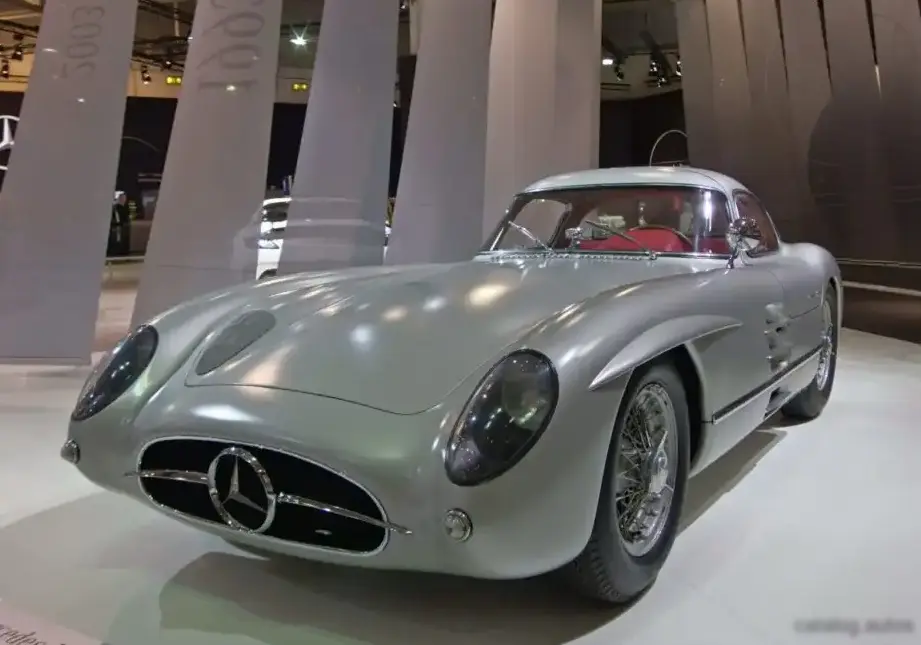
The Mercedes-Benz 300 SLR Coupe (W196S) represents a pinnacle of 1950s automotive engineering, born from the company’s dominant success in the World Sportscar Championship. Produced in a very limited run during 1955, it was essentially a road-going version of the highly successful 300 SLR racing car. The “SLR” designation stood for “Sport Leicht Rennwagen” (Sport Light Racing Car). Only 25 examples were built, making it one of the rarest and most coveted Mercedes-Benz models ever created. This article focuses specifically on the 3.0-liter, 310 horsepower variant, the definitive specification of the coupe.
Technical Specifications
| Brand | Mercedes-Benz |
| Model | 300 SLR |
| Generation | 300 SLR Coupe (W196S) |
| Type (Engine) | 3.0 (310 Hp) |
| Start of production | 1955 |
| End of production | 1955 |
| Powertrain Architecture | Internal Combustion engine |
| Body type | Coupe |
| Seats | 2 |
| Doors | 2 |
| Fuel consumption (combined) | 30 l/100 km (7.8 US mpg, 9.4 UK mpg, 3.3 km/l) |
| Fuel Type | Petrol (Gasoline) |
| Maximum speed | 284 km/h (176.47 mph) |
| Weight-to-power ratio | 3.6 kg/Hp, 277.5 Hp/tonne |
| Weight-to-torque ratio | 3.6 kg/Nm, 278.4 Nm/tonne |
| Power | 310 Hp @ 7400 rpm |
| Power per litre | 104 Hp/l |
| Torque | 311 Nm @ 5950 rpm (229.38 lb.-ft. @ 5950 rpm) |
| Maximum engine speed | 7800 rpm |
| Engine layout | Front, Longitudinal |
| Engine Model/Code | M 196 S |
| Engine displacement | 2982 cm3 (181.97 cu. in.) |
| Number of cylinders | 8 |
| Engine configuration | Inline |
| Cylinder Bore | 78 mm (3.07 in.) |
| Piston Stroke | 78 mm (3.07 in.) |
| Compression ratio | 9:1 |
| Number of valves per cylinder | 2 |
| Fuel injection system | Direct injection |
| Engine aspiration | Naturally aspirated engine |
| Valvetrain | DOHC |
| Kerb Weight | 1117 kg (2462.56 lbs.) |
| Fuel tank capacity | 155 l (40.95 US gal | 34.1 UK gal) |
| Length | 4350 mm (171.26 in.) |
| Width | 1750 mm (68.9 in.) |
| Height | 1210 mm (47.64 in.) |
| Wheelbase | 2370 mm (93.31 in.) |
| Front track | 1330 mm (52.36 in.) |
| Rear track | 1380 mm (54.33 in.) |
| Drivetrain Architecture | Rear wheel drive. Internal Combustion engine (ICE) drives the rear wheels. |
| Drive wheel | Rear wheel drive |
| Number of gears and type of gearbox | 5 gears, manual transmission |
| Front suspension | Double wishbone |
| Front brakes | Drum, 350 mm |
| Rear brakes | Drum, 275 mm |
| Steering type | Worm-reduction unit |
| Tires size | Front: 175/95 R16, Rear: 205/90 R16 |
| Wheel rims size | Front: 16″, Rear: 16″ |
INTRODUCTION
The 300 SLR Coupe was conceived as a homologation special, intended to allow Mercedes-Benz to compete in the sports car racing series of the mid-1950s. However, the coupe quickly transcended its racing origins, becoming a symbol of luxury and performance. The W196S chassis was a significant departure from the open-top 300 SLR race cars, featuring a fully enclosed coupe body crafted primarily from aluminum alloy. The 3.0-liter engine, a further development of the racing unit, delivered an astonishing 310 horsepower, making it one of the fastest road cars of its time. Production was limited to just 25 units, each hand-built to exacting standards.
Powertrain & Engine Architecture
The heart of the 300 SLR Coupe is the M 196 S engine, a 2.982-liter inline-eight cylinder powerplant. This engine was a direct descendant of the engines used in the successful 300 SLR racing cars, but with modifications for road use. It featured a lightweight alloy block and cylinder head, and employed direct fuel injection – a relatively advanced technology for the era. The direct injection system, developed by Bosch, significantly improved fuel atomization and combustion efficiency, contributing to the engine’s high output. The engine utilized a dual overhead camshaft (DOHC) valvetrain, operating two valves per cylinder. The engine’s high-revving nature (redlining at 7800 rpm) and sophisticated fuel injection system demanded precise maintenance. The 300 SLR Coupe was equipped with a five-speed manual transmission, designed to handle the engine’s substantial power and torque. The transmission was robust, but required skilled operation to extract the engine’s full potential.
Driving Characteristics
The 300 SLR Coupe offered a driving experience unlike anything else available in 1955. Its lightweight construction and powerful engine resulted in exhilarating acceleration and a top speed of 176.47 mph. The direct fuel injection provided a crisp throttle response, and the engine pulled strongly throughout the rev range. However, the car’s high performance demanded respect. The steering, while precise, was unassisted and required considerable effort at low speeds. The drum brakes, while effective for the time, lacked the stopping power of modern disc brakes. The five-speed manual transmission required a skilled driver to maintain optimal performance, and the car’s limited ground clearance made it susceptible to damage on uneven surfaces. Compared to a hypothetical 300 SL “Gullwing” with a similar engine, the SLR Coupe would have offered a more raw and visceral driving experience, prioritizing outright performance over comfort and refinement.
Equipment & Trim Levels
Given its limited production run and high price, the 300 SLR Coupe was exceptionally well-equipped, though options were limited. The interior was trimmed in luxurious leather, and featured a minimalist dashboard with essential gauges. Standard features included bucket seats, a leather-wrapped steering wheel, and a comprehensive instrument panel. The car lacked many of the amenities considered commonplace today, such as air conditioning or a radio, reflecting its focus on performance. Optional extras were rare, but some customers requested custom paint schemes or interior trim colors. The overall ambiance was one of purposeful functionality, emphasizing the car’s sporting character.
Chassis & Braking
The 300 SLR Coupe’s chassis was a tubular space frame, constructed from lightweight steel alloys. This provided exceptional rigidity and strength while minimizing weight. The suspension utilized double wishbones at the front and a de Dion axle at the rear, offering a balance of handling and ride comfort. The braking system consisted of drum brakes on all four wheels, with 350mm discs at the front and 275mm drums at the rear. While adequate for the time, the drum brakes were a limiting factor in the car’s overall performance, particularly during hard braking. The car’s relatively narrow track and high center of gravity contributed to a degree of oversteer, requiring careful driving technique.
Market Reception & Comparison
The 300 SLR Coupe was not widely reviewed by the automotive press due to its extreme rarity and exclusivity. However, those who did have the opportunity to drive it were universally impressed by its performance and engineering. It was widely regarded as one of the fastest and most capable road cars of its era. Compared to other high-performance cars of the time, such as the Jaguar XK120 or the Aston Martin DB4, the 300 SLR Coupe offered a significantly higher level of performance and technological sophistication. Its fuel economy, at 7.8 US mpg, was unsurprisingly poor, reflecting its high-output engine and focus on performance. Reliability was generally good, but the car’s complex engine and fuel injection system required regular maintenance by skilled technicians.
Legacy
The Mercedes-Benz 300 SLR Coupe remains one of the most iconic and valuable automobiles in history. Its limited production run, racing pedigree, and exceptional performance have cemented its status as a collector’s dream. Today, surviving examples command prices in excess of $10 million, making them among the most expensive cars ever sold. The M 196 S engine is considered a masterpiece of engineering, and its direct fuel injection system paved the way for future advancements in engine technology. The 300 SLR Coupe’s influence can be seen in subsequent generations of Mercedes-Benz high-performance cars, and it continues to inspire automotive enthusiasts around the world. The powertrain, while demanding in terms of maintenance, has proven remarkably durable when properly cared for, and many examples continue to be driven and enjoyed today.
