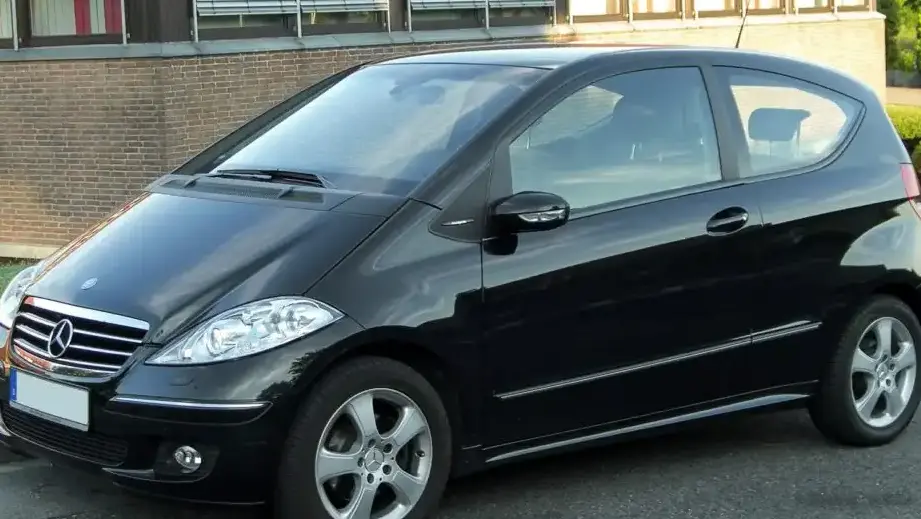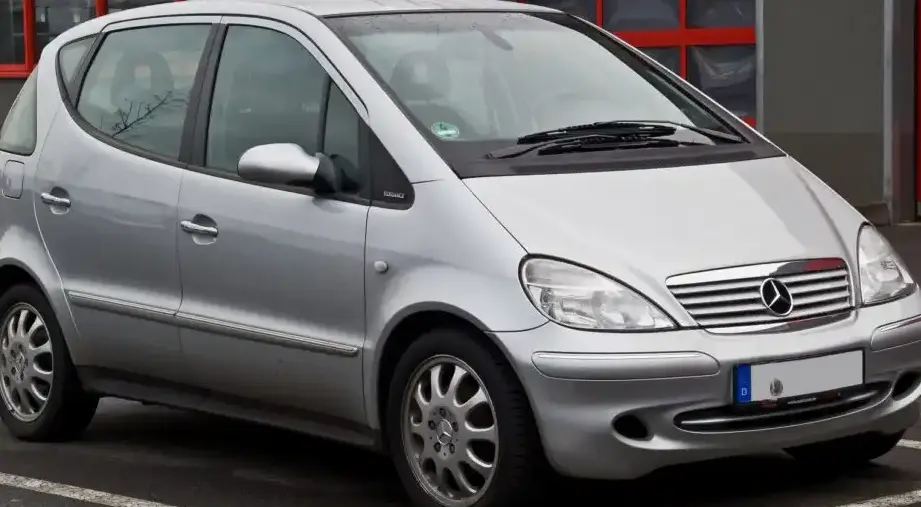
The Mercedes-Benz A-Class Long (V168) A 190, produced from 2001 to 2004, represented a key variant within the extended-wheelbase version of the first-generation A-Class (W168). Designed primarily for markets where a more spacious compact car was desired, the “Long” version offered increased rear legroom compared to the standard A-Class. The A 190, powered by a 1.9-liter gasoline engine producing 125 horsepower, served as a mid-range offering in the lineup, positioned above the base A 160 and below the more powerful A 210 models. This variant aimed to balance affordability with a reasonable level of performance and equipment, appealing to buyers seeking a practical and comfortable hatchback.
Technical Specifications
| Brand | Mercedes-Benz |
| Model | A-Class |
| Generation | A-Class Long (V168) |
| Type (Engine) | A 190 (125 Hp) |
| Start of production | 2001 |
| End of production | 2004 |
| Powertrain Architecture | Internal Combustion engine |
| Body type | Hatchback |
| Seats | 5 |
| Doors | 5 |
| Fuel consumption (economy) – urban (NEDC) | 10.7 l/100 km (22 US mpg, 26.4 UK mpg, 9.3 km/l) |
| Fuel consumption (economy) – extra urban (NEDC) | 6 l/100 km (39.2 US mpg, 47.1 UK mpg, 16.7 km/l) |
| Fuel consumption (economy) – combined (NEDC) | 7.7 l/100 km (30.5 US mpg, 36.7 UK mpg, 13 km/l) |
| CO2 emissions (NEDC) | 184 g/km |
| Fuel Type | Petrol (Gasoline) |
| Acceleration 0 – 100 km/h | 9.1 sec |
| Acceleration 0 – 62 mph | 9.1 sec |
| Acceleration 0 – 60 mph | 8.6 sec |
| Maximum speed | 198 km/h (123.03 mph) |
| Emission standard | Euro 4 |
| Weight-to-power ratio | 8.9 kg/Hp, 112.6 Hp/tonne |
| Weight-to-torque ratio | 6.2 kg/Nm, 162.2 Nm/tonne |
| Power | 125 Hp @ 5500 rpm |
| Power per litre | 65.9 Hp/l |
| Torque | 180 Nm @ 4000 rpm (132.76 lb.-ft. @ 4000 rpm) |
| Engine layout | Front, Transverse |
| Engine Model/Code | M 166.990 |
| Engine displacement | 1898 cm3 (115.82 cu. in.) |
| Number of cylinders | 4 |
| Engine configuration | Inline |
| Cylinder Bore | 84 mm (3.31 in.) |
| Piston Stroke | 85.6 mm (3.37 in.) |
| Compression ratio | 10.8:1 |
| Number of valves per cylinder | 2 |
| Fuel injection system | Multi-port manifold injection |
| Engine aspiration | Naturally aspirated engine |
| Valvetrain | DOHC |
| Engine oil capacity | 4.5 l (4.76 US qt | 3.96 UK qt) |
| Coolant | 5.5 l (5.81 US qt | 4.84 UK qt) |
| Kerb Weight | 1110 kg (2447.13 lbs.) |
| Max. weight | 1630 kg (3593.53 lbs.) |
| Max load | 520 kg (1146.4 lbs.) |
| Trunk (boot) space – minimum | 390 l (13.77 cu. ft.) |
| Trunk (boot) space – maximum | 1930 l (68.16 cu. ft.) |
| Fuel tank capacity | 54 l (14.27 US gal | 11.88 UK gal) |
| Max. roof load | 50 kg (110.23 lbs.) |
| Length | 3776 mm (148.66 in.) |
| Width | 1719 mm (67.68 in.) |
| Width including mirrors | 1950 mm (76.77 in.) |
| Height | 1601 mm (63.03 in.) |
| Wheelbase | 2593 mm (102.09 in.) |
| Front track | 1503 mm (59.17 in.) |
| Rear (Back) track | 1452 mm (57.17 in.) |
| Front overhang | 602 mm (23.7 in.) |
| Rear overhang | 581 mm (22.87 in.) |
| Drag coefficient (Cd) | 0.31 |
| Minimum turning circle (turning diameter) | 11.35 m (37.24 ft.) |
| Drivetrain Architecture | The Internal combustion engine (ICE) drives the front wheels of the vehicle. |
| Drive wheel | Front wheel drive |
| Number of gears and type of gearbox | 5 gears, manual transmission |
| Front suspension | Independent, type McPherson with coil spring and anti-roll bar |
| Rear suspension | Transverse stabilizer, Trailing arm, Coil spring |
| Front brakes | Ventilated discs |
| Rear brakes | Disc |
| Assisting systems | ABS (Anti-lock braking system) |
| Steering type | Steering rack and pinion |
| Power steering | Hydraulic Steering |
| Tires size | 195/50 R16 |
| Wheel rims size | 5.5J x 16 |
Powertrain & Engine Architecture
The A 190 utilized the Mercedes-Benz M 166.990 engine, a 1.9-liter (1898 cc) inline-four cylinder gasoline engine. This engine featured multi-port fuel injection and a double overhead camshaft (DOHC) valvetrain with two valves per cylinder. The engine produced 125 horsepower at 5500 rpm and 180 Nm (132.76 lb-ft) of torque at 4000 rpm. The engine’s compression ratio was 10.8:1. The engine was transversely mounted in the front of the vehicle. The A 190 was typically equipped with a five-speed manual transmission, although an optional four-speed automatic transmission was available. The automatic transmission, while offering convenience, did impact acceleration and fuel economy compared to the manual version.
Driving Characteristics
The A 190 with the manual transmission offered adequate performance for everyday driving. Acceleration from 0 to 60 mph took approximately 8.6 seconds, while 0-100 km/h was achieved in 9.1 seconds. The automatic transmission version was slightly slower. The engine provided sufficient power for merging onto highways and overtaking, but it wasn’t particularly sporty. The long wheelbase contributed to a comfortable ride, absorbing bumps effectively. However, the front-wheel-drive configuration and relatively narrow tires limited grip during spirited driving. The gear ratios in the five-speed manual were well-spaced, providing a balance between acceleration and fuel efficiency. The automatic transmission, while smooth, could feel somewhat sluggish, particularly during downshifts.
Equipment & Trim Levels
The A 190 typically came standard with features such as power windows, central locking, and an audio system. Air conditioning was often included as standard equipment, or available as an option. Interior upholstery was typically cloth, with optional leather available. The dashboard layout was functional and straightforward, typical of Mercedes-Benz designs of the era. Optional extras included alloy wheels, a sunroof, and upgraded audio systems. Safety features included ABS anti-lock brakes and airbags.
Chassis & Braking
The A-Class Long (V168) featured an independent McPherson strut front suspension and a trailing arm rear suspension with a transverse stabilizer. This setup provided a comfortable ride and reasonable handling. The A 190 was equipped with ventilated disc brakes at the front and solid disc brakes at the rear. The ABS anti-lock braking system enhanced braking performance and stability. The suspension was tuned for comfort rather than outright sportiness, prioritizing ride quality over sharp handling.
Market Reception & Comparison
The A 190 was generally well-received as a practical and comfortable compact car. Critics praised its spacious interior (especially in the “Long” version) and its fuel efficiency. However, some reviewers found the engine to be somewhat underpowered, particularly when paired with the automatic transmission. Compared to the A 160, the A 190 offered a noticeable performance improvement. The A 210, with its larger engine, provided even more power but came at a higher price. The A 190 represented a good compromise between performance, fuel economy, and affordability.
Legacy
The Mercedes-Benz A-Class Long (V168) A 190, while not a high-performance model, remains a relatively reliable and affordable used car. The M 166.990 engine is known for its durability, although regular maintenance is essential. Common issues include oil leaks and wear on the timing chain. The automatic transmission, if not properly maintained, can experience issues. Today, the A 190 is appreciated by enthusiasts for its practicality, comfort, and relatively low running costs. It represents a significant step forward in Mercedes-Benz’s compact car offerings, paving the way for the more sophisticated A-Class models that followed.