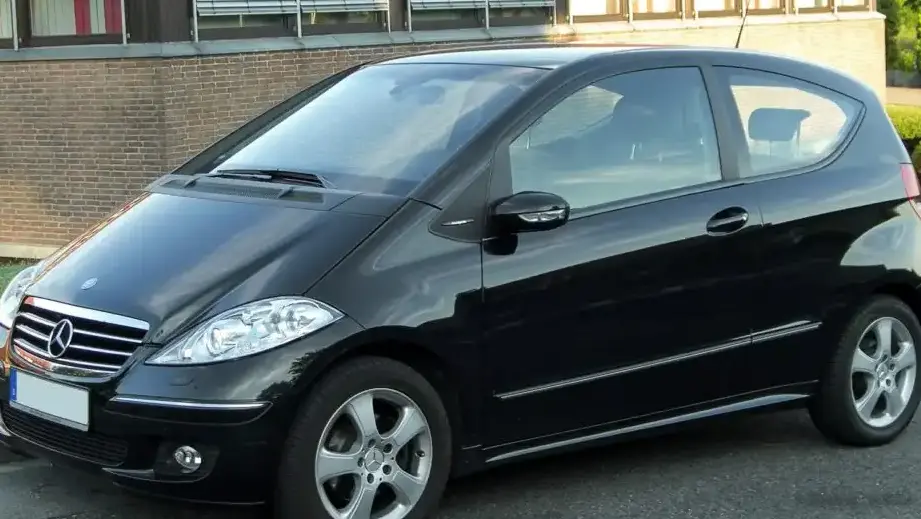
The Mercedes-Benz A-Class W169 A 160 CDI Autotronic, produced from 2004 to 2008, represented the entry point into the A-Class range during that generation. Positioned as a fuel-efficient and practical hatchback, it aimed to appeal to buyers prioritizing economy and usability over outright performance. This variant utilized a 2.0-liter turbocharged diesel engine paired with Mercedes’ Autotronic continuously variable transmission (CVT). It was a key model in the first generation of the A-Class to feature direct injection common rail diesel technology, marking a significant step forward in efficiency and refinement for the compact Mercedes-Benz.
Technical Specifications
| Brand | Mercedes-Benz |
| Model | A-Class |
| Generation | A-Class (W169) |
| Type (Engine) | A 160 CDI (82 Hp) Autotronic |
| Start of production | 2004 |
| End of production | 2008 |
| Powertrain Architecture | Internal Combustion engine |
| Body type | Hatchback |
| Seats | 5 |
| Doors | 5 |
| Fuel consumption (urban) | 6.7 l/100 km (35.1 US mpg, 42.2 UK mpg, 14.9 km/l) |
| Fuel consumption (extra urban) | 4.6 l/100 km (51.1 US mpg, 61.4 UK mpg, 21.7 km/l) |
| Fuel consumption (combined) | 4.9 l/100 km (48 US mpg, 57.6 UK mpg, 20.4 km/l) |
| Fuel Type | Diesel |
| Acceleration 0 – 100 km/h | 15.3 sec |
| Acceleration 0 – 62 mph | 15.3 sec |
| Acceleration 0 – 60 mph | 14.5 sec |
| Maximum speed | 165 km/h (102.53 mph) |
| Weight-to-power ratio | 16.2 kg/Hp, 61.9 Hp/tonne |
| Weight-to-torque ratio | 7.4 kg/Nm, 135.8 Nm/tonne |
| Power | 82 Hp @ 4200 rpm |
| Power per litre | 41.2 Hp/l |
| Torque | 180 Nm @ 1400 rpm (132.76 lb.-ft. @ 1400 rpm) |
| Engine layout | Front, Transverse |
| Engine Model/Code | OM 640.942 |
| Engine displacement | 1991 cm3 (121.5 cu. in.) |
| Number of cylinders | 4 |
| Engine configuration | Inline |
| Cylinder Bore | 83 mm (3.27 in.) |
| Piston Stroke | 92 mm (3.62 in.) |
| Compression ratio | 18:1 |
| Number of valves per cylinder | 4 |
| Fuel injection system | Diesel Commonrail |
| Engine aspiration | Turbocharger, Intercooler |
| Engine oil capacity | 5.8 l (6.13 US qt | 5.1 UK qt) |
| Coolant capacity | 8 l (8.45 US qt | 7.04 UK qt) |
| Kerb Weight | 1325 kg (2921.12 lbs.) |
| Max. weight | 1764 kg (3888.95 lbs.) |
| Max load | 439 kg (967.83 lbs.) |
| Trunk (boot) space – minimum | 435 l (15.36 cu. ft.) |
| Trunk (boot) space – maximum | 1995 l (70.45 cu. ft.) |
| Fuel tank capacity | 54 l (14.27 US gal | 11.88 UK gal) |
| Length | 3838 mm (151.1 in.) |
| Width | 1764 mm (69.45 in.) |
| Height | 1595 mm (62.8 in.) |
| Wheelbase | 2568 mm (101.1 in.) |
| Front track | 1552 mm (61.1 in.) |
| Rear track | 1547 mm (60.91 in.) |
| Drag coefficient (Cd) | 0.29 |
| Drivetrain Architecture | Front wheel drive |
| Number of gears | 1 (automatic transmission Autotronic) |
| Front suspension | Spring Strut |
| Rear suspension | Coil spring |
| Front brakes | Disc |
| Rear brakes | Disc |
| Assisting systems | ABS (Anti-lock braking system) |
| Steering type | Steering rack and pinion |
| Tires size | 185/65 R15 |
| Wheel rims size | 6J x 15 |
Powertrain & Engine Architecture
The A 160 CDI was powered by the OM 640.942, a 1.991-liter inline-four cylinder diesel engine. This engine was a significant advancement for Mercedes-Benz, incorporating common rail direct injection and a turbocharger with an intercooler. The common rail system, operating at extremely high pressures, allowed for precise fuel metering and optimized combustion, resulting in improved efficiency and reduced emissions. The turbocharger boosted power output, compensating for the relatively small displacement. The engine produced 82 horsepower at 4200 rpm and 180 Nm (132.76 lb-ft) of torque at a low 1400 rpm. This torque curve was a key characteristic, providing good low-end responsiveness for everyday driving. The Autotronic transmission, a continuously variable transmission (CVT), was designed to provide smooth, seamless gear changes and further enhance fuel economy. However, it was often criticized for its somewhat sluggish response compared to traditional automatic transmissions.
Driving Characteristics
The A 160 CDI Autotronic prioritized fuel efficiency and comfort over sporty performance. Acceleration was modest, taking around 15.3 seconds to reach 62 mph (100 km/h). The Autotronic transmission, while smooth, could feel hesitant during quick acceleration, often “hunting” for the optimal gear ratio. The engine’s strong low-end torque made it well-suited for urban driving and overtaking at lower speeds. Compared to the more powerful A 200 CDI or petrol-powered A-Class variants, the A 160 CDI felt noticeably slower. However, its fuel economy was significantly better, making it an attractive option for drivers covering long distances or prioritizing running costs. The CVT’s programming emphasized smoothness and efficiency, resulting in a relaxed driving experience.
Equipment & Trim Levels
The A 160 CDI Autotronic typically came with a reasonable level of standard equipment, though it was less lavishly equipped than higher-spec A-Class models. Standard features generally included air conditioning, power windows, central locking, and an audio system. Interior upholstery was typically cloth, and the dashboard featured a functional, if somewhat understated, design. Optional extras included alloy wheels, a sunroof, upgraded audio systems, and parking sensors. The A 160 CDI was often seen as a base model, with buyers able to add options to personalize their vehicle. Safety features such as ABS and airbags were standard.
Chassis & Braking
The W169 A-Class featured a relatively simple chassis design. Front suspension utilized MacPherson struts, while the rear employed a multi-link setup. The A 160 CDI was equipped with disc brakes on all four wheels, providing adequate stopping power for its weight and performance. ABS (Anti-lock Braking System) was standard. The suspension was tuned for comfort, providing a reasonably smooth ride, although it could feel somewhat soft during spirited driving. Stabilizer bars were fitted to both the front and rear axles to reduce body roll.
Market Reception & Comparison
The A 160 CDI Autotronic was generally well-received by critics as a practical and economical city car. Its fuel efficiency was a major selling point, and its comfortable ride made it suitable for long journeys. However, the Autotronic transmission was often criticized for its lack of responsiveness and occasional hesitation. Compared to the A 200 CDI, the A 160 CDI offered lower running costs but significantly less performance. The petrol-powered A-Class models provided more engaging driving experiences but were less fuel-efficient. The A 160 CDI appealed to buyers who prioritized economy and practicality over performance and driving dynamics.
Legacy
The OM 640 engine family, including the OM 640.942 found in the A 160 CDI, proved to be relatively reliable, although the Autotronic transmission could be prone to issues if not properly maintained. Today, the A 160 CDI Autotronic can be found as an affordable used car, appealing to buyers seeking a cheap and economical runabout. While not a particularly exciting vehicle, it represents a significant step forward in diesel technology for Mercedes-Benz and remains a practical and fuel-efficient option for those seeking a compact hatchback.