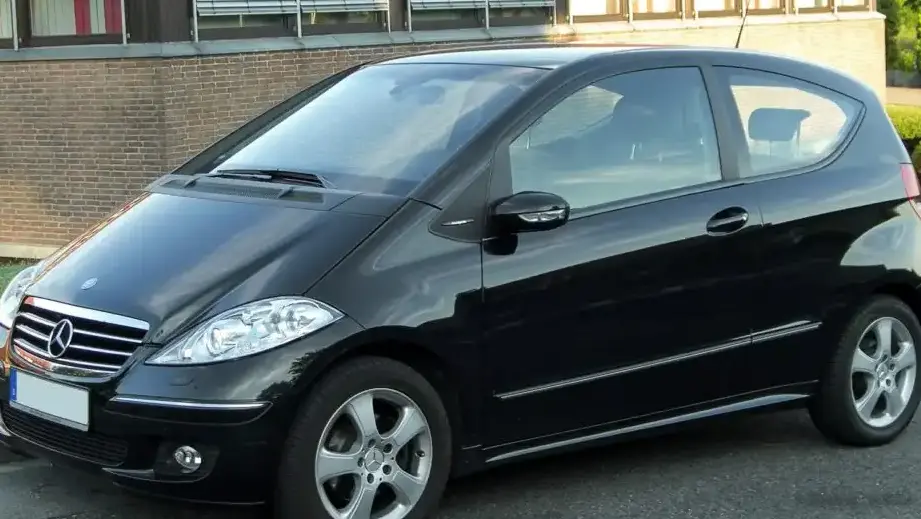
The Mercedes-Benz A-Class (W169) A 200 Turbo, produced from 2005 to 2008, represented a significant step forward for the compact Mercedes-Benz lineup. Positioned as a mid-range offering within the W169 generation, it aimed to bridge the gap between the entry-level A 150 and the more performance-oriented A 230 variants. This model was primarily targeted at European markets, offering a blend of practicality, comfort, and respectable performance in a relatively small package. The A 200 Turbo was a key component in Mercedes-Benz’s attempt to attract a younger demographic to the brand, offering a more modern and dynamic driving experience than its predecessors.
Technical Specifications
| Brand | Mercedes-Benz |
| Model | A-Class |
| Generation | A-Class (W169) |
| Type (Engine) | A 200 Turbo (193 Hp) |
| Start of production | 2005 |
| End of production | 2008 |
| Powertrain Architecture | Internal Combustion engine |
| Body type | Hatchback |
| Seats | 5 |
| Doors | 5 |
| Fuel consumption (combined) | 7.9 l/100 km |
| Fuel consumption (US mpg) | 29.8 US mpg |
| Fuel consumption (UK mpg) | 35.8 UK mpg |
| Fuel consumption (km/l) | 12.7 km/l |
| Fuel Type | Petrol (Gasoline) |
| Acceleration 0 – 100 km/h | 8 sec |
| Acceleration 0 – 62 mph | 8 sec |
| Acceleration 0 – 60 mph | 7.6 sec |
| Maximum speed | 227 km/h (141.05 mph) |
| Weight-to-power ratio | 6.8 kg/Hp |
| Weight-to-torque ratio | 4.7 kg/Nm |
| Power | 193 Hp @ 5000 rpm |
| Power per litre | 94.9 Hp/l |
| Torque | 280 Nm @ 1800 rpm (206.52 lb.-ft. @ 1800 rpm) |
| Engine layout | Front, Transverse |
| Engine Model/Code | M 266.980 |
| Engine displacement | 2034 cm3 (124.12 cu. in.) |
| Number of cylinders | 4 |
| Engine configuration | Inline |
| Cylinder Bore | 83 mm (3.27 in.) |
| Piston Stroke | 94 mm (3.7 in.) |
| Compression ratio | 9:1 |
| Number of valves per cylinder | 2 |
| Fuel injection system | Multi-port manifold injection |
| Engine aspiration | Turbocharger, Intercooler |
| Engine oil capacity | 5 l (5.28 US qt | 4.4 UK qt) |
| Coolant capacity | 8.5 l (8.98 US qt | 7.48 UK qt) |
| Kerb Weight | 1305 kg (2877.03 lbs.) |
| Max. weight | 1730 kg (3814 lbs.) |
| Max load | 425 kg (936.96 lbs.) |
| Trunk (boot) space – minimum | 435 l (15.36 cu. ft.) |
| Trunk (boot) space – maximum | 1995 l (70.45 cu. ft.) |
| Fuel tank capacity | 54 l (14.27 US gal | 11.88 UK gal) |
| Length | 3838 mm (151.1 in.) |
| Width | 1764 mm (69.45 in.) |
| Height | 1595 mm (62.8 in.) |
| Wheelbase | 2568 mm (101.1 in.) |
| Front track | 1552 mm (61.1 in.) |
| Rear track | 1547 mm (60.91 in.) |
| Drag coefficient (Cd) | 0.31 |
| Drivetrain Architecture | Front wheel drive |
| Number of gears | 6 |
| Type of gearbox | Manual transmission |
| Front suspension | Spring Strut |
| Rear suspension | Coil spring |
| Front brakes | Ventilated discs |
| Rear brakes | Disc |
| Assisting systems | ABS (Anti-lock braking system) |
| Steering type | Steering rack and pinion |
| Tires size | 195/55 R16 |
| Wheel rims size | 6J x 16 |
INTRODUCTION
The W169 A-Class, launched in 2004, represented a significant redesign for Mercedes-Benz’s entry-level offering. Moving away from the sandwich floor construction of the previous generation (W168), the W169 adopted a more conventional front-wheel-drive platform. The A 200 Turbo, introduced in 2005, was a key variant, offering a turbocharged 2.0-liter engine that provided a noticeable performance boost over the base A 150 and A 170 models. It was designed to appeal to buyers seeking a more engaging driving experience without sacrificing the practicality and comfort expected from a Mercedes-Benz.
Powertrain & Engine Architecture
At the heart of the A 200 Turbo lies the M 266.980 engine, a 1991 cc (2.0L) inline-four cylinder gasoline engine. This engine utilizes a single overhead camshaft (SOHC) valvetrain with two valves per cylinder. The key feature of this engine is its turbocharger with an intercooler, which significantly enhances power output. Fuel delivery is managed by a multi-port fuel injection system. The engine produces 193 horsepower at 5000 rpm and 280 Nm (206.52 lb-ft) of torque at a relatively low 1800 rpm. This torque curve provides good responsiveness in everyday driving situations. The A 200 Turbo was typically paired with a 6-speed manual transmission, although an optional continuously variable transmission (CVT) was also available in some markets. The engine’s design prioritized efficiency and reliability, making it a relatively robust unit.
Driving Characteristics
The A 200 Turbo offered a noticeable improvement in performance compared to the naturally aspirated A 150 and A 170 models. The turbocharger provides a surge of power in the mid-range, making overtaking and merging onto highways easier. While not a sports car, the A 200 Turbo delivers a respectable 0-60 mph time of around 7.6 seconds and a top speed of 141 mph. The 6-speed manual transmission allows for precise gear changes and enhances driver engagement. The suspension is tuned for comfort, providing a smooth ride over most road surfaces. However, it’s not particularly sporty, with some body roll noticeable during cornering. Compared to the A 230 Kompressor, the A 200 Turbo offers a slightly less powerful but more fuel-efficient alternative.
Equipment & Trim Levels
The A 200 Turbo typically came equipped with a reasonable level of standard features, including air conditioning, power windows, power mirrors, and a basic audio system. Higher trim levels offered options such as alloy wheels, a panoramic sunroof, leather upholstery, and a more advanced audio system with CD changer. Safety features included ABS brakes, front airbags, and side airbags. The interior design was functional and modern for its time, with a focus on ergonomics and ease of use. The dashboard layout was relatively simple, with clearly labeled controls. The A 200 Turbo aimed to provide a comfortable and well-equipped interior without the premium price tag of the higher-end A-Class models.
Chassis & Braking
The W169 A-Class utilizes a MacPherson strut front suspension and a multi-link rear suspension. This setup provides a good balance between ride comfort and handling. The A 200 Turbo typically came equipped with ventilated disc brakes at the front and solid disc brakes at the rear. ABS (Anti-lock Braking System) was standard, providing enhanced braking performance and stability. The steering is rack and pinion, offering precise and responsive steering feel. The chassis was designed to be lightweight, contributing to the car’s overall efficiency and agility. The standard tire size was 195/55 R16, providing adequate grip in most conditions.
Market Reception & Comparison
The A 200 Turbo was generally well-received by automotive critics. It was praised for its responsive engine, comfortable ride, and practical interior. However, some critics noted that the handling was not as sharp as some of its competitors. Compared to the A 150 and A 170, the A 200 Turbo offered a significant performance upgrade without a substantial increase in price. It also provided better fuel economy than the more powerful A 230 Kompressor. In terms of reliability, the A 200 Turbo proved to be a relatively dependable vehicle, although some owners have reported issues with the turbocharger and the CVT transmission (if equipped).
Legacy
The Mercedes-Benz A-Class (W169) A 200 Turbo remains a popular choice in the used car market today. Its combination of practicality, comfort, and reasonable performance makes it an attractive option for buyers seeking an affordable and reliable compact car. The M 266.980 engine is generally considered to be a durable unit, although regular maintenance is essential to ensure its longevity. While not a particularly rare or collectible model, the A 200 Turbo represents a significant step forward in the evolution of the A-Class, paving the way for the more sophisticated models that followed. Its blend of German engineering and everyday usability continues to appeal to a wide range of drivers.