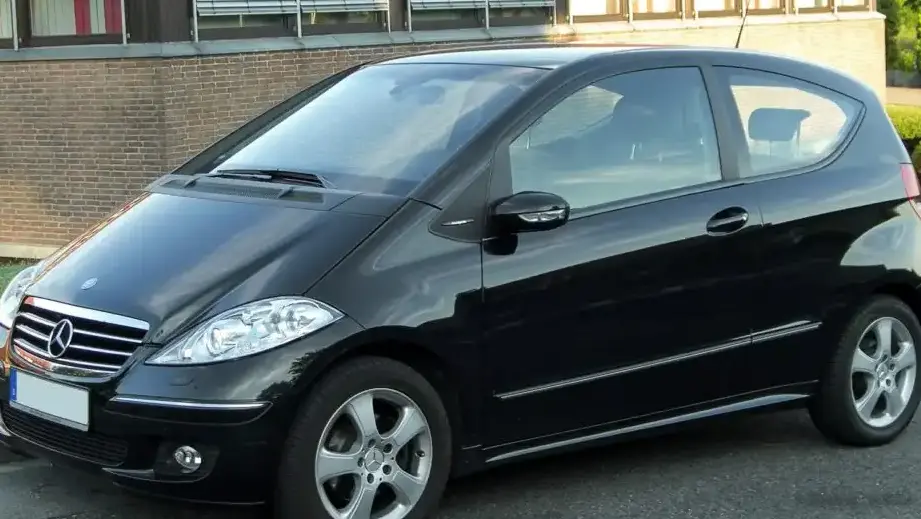
The Mercedes-Benz A-Class (W176) A 200, equipped with a 156 horsepower engine and a dual-clutch transmission (DCT), was a key variant in the refreshed A-Class lineup produced from 2015 to 2018. This facelifted version of the W176, introduced in 2015, aimed to address some criticisms of the previous generation regarding interior quality and refinement, while maintaining the A-Class’s position as a premium compact hatchback. The A 200 represented a mid-range offering, balancing performance and fuel efficiency within the broader A-Class range, which also included lower-powered A 160/180 models and higher-performance A 250 variants.
Technical Specifications
| Brand | Mercedes-Benz |
| Model | A-Class |
| Generation | A-Class (W176, facelift 2015) |
| Type (Engine) | A 200 (156 Hp) DCT |
| Start of production | 2015 |
| End of production | 2018 |
| Powertrain Architecture | Internal Combustion engine |
| Body type | Hatchback |
| Seats | 5 |
| Doors | 5 |
| Fuel consumption (urban) | 6.8-6.7 l/100 km (34.6 – 35.1 US mpg) |
| Fuel consumption (extra urban) | 4.6-4.2 l/100 km (51.1 – 56 US mpg) |
| Fuel consumption (combined) | 5.4-5.1 l/100 km (43.6 – 46.1 US mpg) |
| CO2 emissions | 126-119 g/km |
| Fuel Type | Petrol (Gasoline) |
| Acceleration 0 – 100 km/h | 7.8 sec |
| Acceleration 0 – 62 mph | 7.8 sec |
| Acceleration 0 – 60 mph | 7.4 sec |
| Maximum speed | 224 km/h (139.19 mph) |
| Emission standard | Euro 6 |
| Weight-to-power ratio | 8.5 kg/Hp |
| Weight-to-torque ratio | 5.3 kg/Nm |
| Power | 156 Hp @ 5300 rpm |
| Torque | 250 Nm @ 1250-4000 rpm (184.39 lb.-ft. @ 1250-4000 rpm) |
| Engine layout | Front, Transverse |
| Engine Model/Code | M 270.910 |
| Engine displacement | 1595 cm3 (97.33 cu. in.) |
| Number of cylinders | 4 |
| Engine configuration | Inline |
| Compression ratio | 10.3:1 |
| Number of valves per cylinder | 4 |
| Fuel injection system | Direct injection |
| Engine aspiration | Turbocharger, Intercooler |
| Engine oil capacity | 5.8 l (6.13 US qt | 5.1 UK qt) |
| Coolant capacity | 7 l (7.4 US qt | 6.16 UK qt) |
| Kerb Weight | 1320 kg (2910.1 lbs) |
| Max. weight | 1935 kg (4265.94 lbs) |
| Max load | 615 kg (1355.84 lbs) |
| Trunk (boot) space – minimum | 341 l (12.04 cu. ft.) |
| Trunk (boot) space – maximum | 1157 l (40.86 cu. ft.) |
| Fuel tank capacity | 50 l (13.21 US gal | 11 UK gal) |
| Max. roof load | 100 kg (220.46 lbs) |
| Permitted trailer load with brakes (12%) | 1400 kg (3086.47 lbs) |
| Permitted trailer load without brakes | 695 kg (1532.21 lbs) |
| Length | 4299 mm (169.25 in) |
| Width | 1780 mm (70.08 in) |
| Width including mirrors | 2022 mm (79.61 in) |
| Height | 1433 mm (56.42 in) |
| Wheelbase | 2699 mm (106.26 in) |
| Front track | 1553 mm (61.14 in) |
| Rear track | 1552 mm (61.1 in) |
| Front overhang | 913 mm (35.94 in) |
| Rear overhang | 687 mm (27.05 in) |
| Ride height (ground clearance) | 93 mm (3.66 in) |
| Drag coefficient (Cd) | 0.30 |
| Minimum turning circle | 11.00 m (36.09 ft) |
| Approach angle | 13.7° |
| Departure angle | 17.3° |
| Ramp-over angle | 9.3° |
| Drivetrain Architecture | Front wheel drive |
| Number of gears and type of gearbox | 7 gears, automatic transmission G-DCT |
| Front suspension | Independent type McPherson |
| Rear suspension | Independent multi-link suspension |
| Front brakes | Ventilated discs |
| Rear brakes | Disc |
| Assisting systems | ABS (Anti-lock braking system) |
| Steering type | Steering rack and pinion |
| Power steering | Electric Steering |
| Tires size | 205/55 R16 |
| Wheel rims size | 16 |
Powertrain & Engine Architecture
The A 200 utilized Mercedes-Benz’s M 270.910 engine, a 1.6-liter turbocharged inline-four cylinder gasoline engine. This engine was part of the M 270 family, known for its direct fuel injection and relatively compact dimensions. The M 270.910 featured a single scroll turbocharger with an intercooler, boosting power output to 156 horsepower at 5300 rpm and 250 Nm (184 lb-ft) of torque available from a low 1250 rpm to 4000 rpm. This broad torque curve was a key characteristic of the engine, providing good responsiveness in everyday driving situations. The engine employed a timing chain for durability and featured four valves per cylinder. The engine was paired with a 7-speed dual-clutch transmission (7G-DCT), which offered quick and smooth gear changes, contributing to both performance and fuel efficiency. The DCT allowed for both fully automatic operation and manual gear selection via steering wheel-mounted paddles or the gear selector.
Driving Characteristics
The A 200 DCT offered a comfortable and refined driving experience. While not overtly sporty, the 156 hp engine and 7-speed DCT provided adequate performance for most driving scenarios. Acceleration from 0 to 60 mph took approximately 7.4 seconds, and the car felt responsive in city and highway driving. The DCT transmission contributed to a smooth and seamless power delivery, with minimal turbo lag. Compared to the lower-powered A 160/180 models, the A 200 offered a noticeable improvement in acceleration and overall responsiveness. However, it didn’t possess the same level of outright performance as the A 250, which featured a more powerful 2.0-liter engine. The gear ratios were tuned for a balance between fuel economy and performance, with taller gears for cruising and shorter gears for quicker acceleration. The front-wheel-drive configuration provided good traction in most conditions, although it could exhibit some torque steer under hard acceleration.
Equipment & Trim Levels
The A 200 typically came standard with features such as automatic climate control, a multi-function steering wheel, power windows and mirrors, and a basic audio system. The interior upholstery was generally cloth, although leather options were available. The facelifted W176 models benefited from improved interior materials and design compared to the pre-facelift versions. Optional extras included a larger infotainment screen, navigation system, premium audio system, panoramic sunroof, and various driver assistance systems like lane keeping assist and collision prevention assist. Trim levels could vary depending on the market, but generally, the A 200 offered a step up in terms of features and aesthetics compared to the base A 160/180 models.
Chassis & Braking
The A 200 featured an independent McPherson strut suspension at the front and an independent multi-link suspension at the rear. This suspension setup provided a good balance between ride comfort and handling. The steering was electrically assisted, offering a light and precise feel. The braking system consisted of ventilated discs at the front and solid discs at the rear. Anti-lock braking system (ABS) was standard, along with electronic brakeforce distribution (EBD). The chassis was designed to be relatively lightweight, contributing to the car’s agility and fuel efficiency.
Market Reception & Comparison
The A 200 DCT was generally well-received by automotive critics. It was praised for its refined engine, smooth-shifting transmission, and comfortable ride. However, some critics noted that the interior, while improved, still didn’t quite match the quality of some of its rivals. Fuel economy was a strong point, with combined figures ranging from 5.1 to 5.4 l/100 km (43.6 to 46.1 US mpg). Compared to the A 160/180, the A 200 offered a significant performance upgrade, making it a more appealing option for drivers who wanted a bit more power. Compared to the A 250, it represented a more affordable entry point into the A-Class range, albeit with less performance.
Legacy
The M 270 engine, while generally reliable, has been known to exhibit some issues with carbon buildup on the intake valves over time, particularly in vehicles that primarily see short trips. Regular maintenance, including the use of high-quality fuel and occasional Italian tune-ups, can help mitigate this issue. The 7G-DCT transmission is also generally reliable, but requires regular fluid changes to ensure smooth operation. Today, the W176 A 200 DCT represents a relatively affordable entry point into the Mercedes-Benz brand. It offers a good balance of comfort, fuel efficiency, and performance, making it a popular choice in the used car market. Its relatively modern features and refined driving experience continue to appeal to buyers looking for a premium compact hatchback.