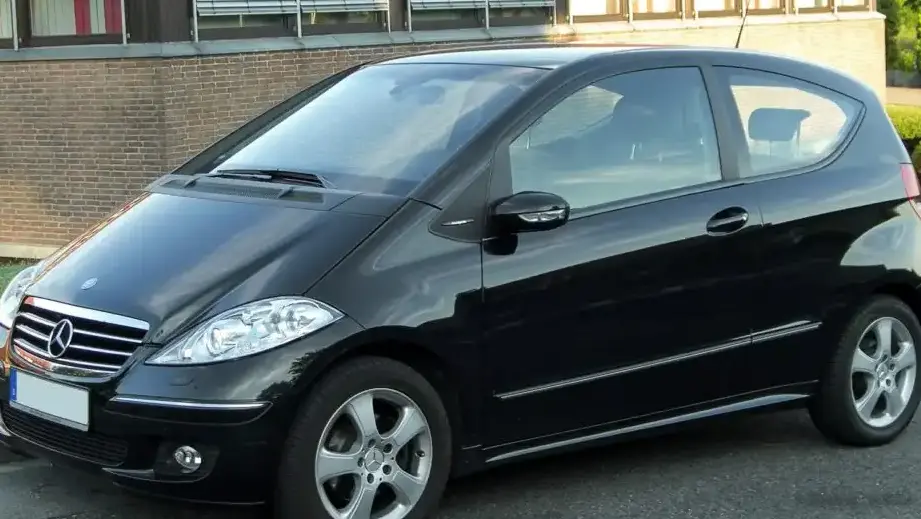
The Mercedes-Benz A-Class (W176) facelift A 200d, produced from 2015 to 2018, represented a significant offering in the premium compact hatchback segment. This variant, powered by a 2.1-liter turbocharged diesel engine producing 136 horsepower, was positioned as a fuel-efficient and practical option within the A-Class range. It sat between the lower-powered A 180d and the more performance-oriented A 220d, appealing to buyers prioritizing economy and refinement over outright speed. The W176 generation, launched in 2012, was a pivotal model for Mercedes-Benz, marking a shift towards a more youthful and contemporary design language, and the 2015 facelift further refined its aesthetics and technology.
Technical Specifications
| Brand | Mercedes-Benz |
| Model | A-Class |
| Generation | A-Class (W176, facelift 2015) |
| Type (Engine) | A 200d (136 Hp) |
| Start of production | 2015 |
| End of production | 2018 |
| Powertrain Architecture | Internal Combustion engine |
| Body type | Hatchback |
| Seats | 5 |
| Doors | 5 |
| Fuel consumption (urban) | 5.7-5.2 l/100 km (41.3 – 45.2 US mpg, 49.6 – 54.3 UK mpg, 17.5 – 19.2 km/l) |
| Fuel consumption (extra urban) | 3.8-3.4 l/100 km (61.9 – 69.2 US mpg, 74.3 – 83.1 UK mpg, 26.3 – 29.4 km/l) |
| Fuel consumption (combined) | 4.5-4.1 l/100 km (52.3 – 57.4 US mpg, 62.8 – 68.9 UK mpg, 22.2 – 24.4 km/l) |
| CO2 emissions | 116-106 g/km |
| Fuel Type | Diesel |
| Acceleration 0 – 100 km/h | 9.3 sec |
| Acceleration 0 – 62 mph | 9.3 sec |
| Acceleration 0 – 60 mph | 8.8 sec |
| Maximum speed | 210 km/h (130.49 mph) |
| Emission standard | Euro 6 |
| Weight-to-power ratio | 10.1 kg/Hp, 98.6 Hp/tonne |
| Weight-to-torque ratio | 4.6 kg/Nm, 217.4 Nm/tonne |
| Power | 136 Hp @ 3200-4000 rpm |
| Power per litre | 63.5 Hp/l |
| Torque | 300 Nm @ 1400-3000 rpm (221.27 lb.-ft. @ 1400-3000 rpm) |
| Engine layout | Front, Transverse |
| Engine Model/Code | OM 651.930 |
| Engine displacement | 2143 cm3 (130.77 cu. in.) |
| Number of cylinders | 4 |
| Engine configuration | Inline |
| Compression ratio | 16.2:1 |
| Number of valves per cylinder | 4 |
| Fuel injection system | Diesel Commonrail |
| Engine aspiration | Turbocharger, Intercooler |
| Engine oil capacity | 6.5 l (6.87 US qt | 5.72 UK qt) |
| Coolant | 9.6 l (10.14 US qt | 8.45 UK qt) |
| Kerb Weight | 1380 kg (3042.38 lbs.) |
| Max. weight | 2010 kg (4431.29 lbs.) |
| Max load | 630 kg (1388.91 lbs.) |
| Trunk (boot) space – minimum | 341 l (12.04 cu. ft.) |
| Trunk (boot) space – maximum | 1157 l (40.86 cu. ft.) |
| Fuel tank capacity | 50 l (13.21 US gal | 11 UK gal) |
| Max. roof load | 100 kg (220.46 lbs.) |
| Permitted trailer load with brakes (12%) | 1500 kg (3306.93 lbs.) |
| Permitted trailer load without brakes | 725 kg (1598.35 lbs.) |
| Length | 4299 mm (169.25 in.) |
| Width | 1780 mm (70.08 in.) |
| Width including mirrors | 2022 mm (79.61 in.) |
| Height | 1433 mm (56.42 in.) |
| Wheelbase | 2699 mm (106.26 in.) |
| Front track | 1553 mm (61.14 in.) |
| Rear (Back) track | 1552 mm (61.1 in.) |
| Front overhang | 913 mm (35.94 in.) |
| Rear overhang | 687 mm (27.05 in.) |
| Ride height (ground clearance) | 93 mm (3.66 in.) |
| Drag coefficient (Cd) | 0.29 |
| Minimum turning circle (turning diameter) | 11.00 m (36.09 ft.) |
| Approach angle | 13.7° |
| Departure angle | 17.3° |
| Ramp-over (brakeover) angle | 9.3° |
| Drivetrain Architecture | The Internal combustion engine (ICE) drives the front wheels of the vehicle. |
| Drive wheel | Front wheel drive |
| Number of gears and type of gearbox | 6 gears, manual transmission |
| Front suspension | Independent type McPherson |
| Rear suspension | Independent multi-link suspension |
| Front brakes | Ventilated discs |
| Rear brakes | Disc |
| Assisting systems | ABS (Anti-lock braking system) |
| Steering type | Steering rack and pinion |
| Power steering | Electric Steering |
| Tires size | 205/55 R16 |
| Wheel rims size | 16 |
Powertrain & Engine Architecture
The A 200d was powered by the OM651.930, a 2.1-liter inline-four cylinder diesel engine. This engine was a mainstay in the Mercedes-Benz lineup, known for its durability and efficiency. It featured a turbocharger with an intercooler to boost power output and improve combustion. The engine utilized a common rail direct injection system, delivering fuel directly into the cylinders at extremely high pressure for optimized fuel atomization and combustion. The OM651.930 also incorporated four valves per cylinder, enhancing volumetric efficiency. The 6-speed manual transmission was standard, providing a balance between fuel economy and driver engagement. The transmission’s gear ratios were tuned for efficient cruising and adequate acceleration, though it wasn’t designed for particularly sporty driving.
Driving Characteristics
The A 200d offered a comfortable and refined driving experience, prioritizing fuel economy and ease of use. With 136 horsepower and 300 Nm (221 lb-ft) of torque, acceleration was adequate for everyday driving, with a 0-60 mph time of around 8.8 seconds. The engine delivered strong low-end torque, making it easy to navigate city streets and execute overtaking maneuvers. However, it lacked the punch of the A 220d. The manual transmission, while precise, didn’t offer particularly short throws. The suspension was tuned for comfort, absorbing bumps and imperfections in the road well, but this came at the expense of ultimate handling sharpness. Compared to the A 180d, the A 200d offered a noticeable performance improvement, while remaining more economical than the A 220d.
Equipment & Trim Levels
The A 200d typically came equipped with a respectable level of standard features. These included air conditioning, a multi-function steering wheel, power windows, and a basic audio system. Higher trim levels, such as the Sport or AMG Line, added features like sport seats, alloy wheels, and upgraded interior trim. Optional extras included a panoramic sunroof, navigation system, leather upholstery, and advanced driver-assistance systems like lane keeping assist and blind spot monitoring. The interior design was modern and minimalist, reflecting Mercedes-Benz’s design philosophy at the time.
Chassis & Braking
The W176 A-Class featured an independent McPherson strut suspension at the front and an independent multi-link suspension at the rear. This setup provided a good balance of comfort and handling. The A 200d was equipped with ventilated disc brakes at the front and solid discs at the rear. Anti-lock Braking System (ABS) was standard, ensuring safe and controlled braking in various conditions. The steering was electrically assisted, providing light and precise steering feel. The chassis was relatively lightweight, contributing to the car’s agility and fuel efficiency.
Market Reception & Comparison
The A 200d was well-received by critics for its fuel efficiency, comfortable ride, and refined interior. It was seen as a practical and sensible choice for buyers looking for a premium compact hatchback. Compared to its siblings, the A 200d offered a sweet spot between performance and economy. The A 180d was more affordable but lacked the A 200d’s power, while the A 220d offered more performance but at a higher price and with slightly lower fuel economy. The A 200d also compared favorably to rivals like the Audi A3 and BMW 1 Series in terms of fuel efficiency and refinement.
Legacy
The OM651 engine, used in the A 200d, is known for its robustness and longevity, provided it receives regular maintenance. The W176 A-Class, including the A 200d variant, has proven to be a reliable and durable vehicle. On the used car market, the A 200d remains a popular choice, offering a good balance of value, economy, and practicality. Common issues are relatively minor, often related to wear and tear on components like the turbocharger and fuel injectors. Overall, the A 200d represents a well-engineered and well-built compact hatchback that continues to provide reliable transportation for many years.