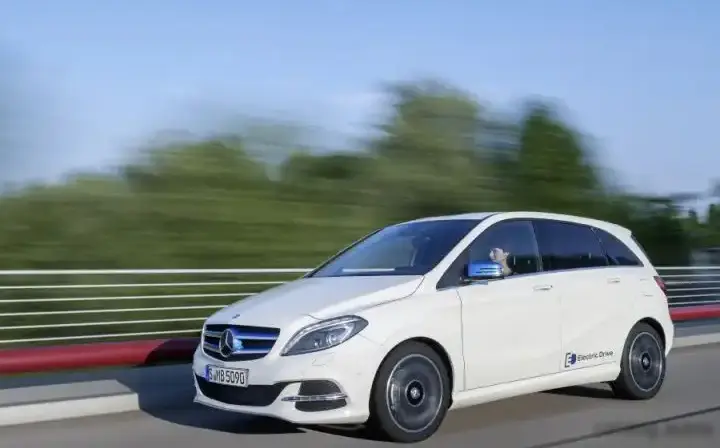
The Mercedes-Benz B 200 Turbo, produced between April 2005 and April 2008, was a key variant within the W245 series B-Class, a compact multi-purpose vehicle (MPV) designed to appeal to European buyers seeking a practical and relatively premium family car. Positioned as a mid-range offering, the B 200 Turbo bridged the gap between the entry-level B 170 and the more powerful B 230 models. It represented a significant step up in performance from the base model while offering a more accessible price point than the range-topping variant. The W245 B-Class, built on the A-Class (W169) platform, was notable for its sandwich floor construction, providing a high seating position and maximizing interior space.
Technical Specifications
| Brand | Mercedes-Benz |
| Model | B-class |
| Generation | B-class (W245) |
| Type (Engine) | B 200 Turbo (193 Hp) Autotronic |
| Start of production | April, 2005 |
| End of production | April, 2008 |
| Powertrain Architecture | Internal Combustion engine |
| Body type | MPV |
| Seats | 5 |
| Doors | 5 |
| Fuel consumption (urban) | 10.5-10.7 l/100 km (22.4 – 22 US mpg, 26.9 – 26.4 UK mpg, 9.5 – 9.3 km/l) |
| Fuel consumption (extra urban) | 6.7-6.8 l/100 km (35.1 – 34.6 US mpg, 42.2 – 41.5 UK mpg, 14.9 – 14.7 km/l) |
| Fuel consumption (combined) | 8.1-8.2 l/100 km (29 – 28.7 US mpg, 34.9 – 34.4 UK mpg, 12.3 – 12.2 km/l) |
| CO2 emissions | 195-197 g/km |
| Fuel Type | Petrol (Gasoline) |
| Acceleration 0 – 100 km/h | 7.4 sec |
| Acceleration 0 – 62 mph | 7.4 sec |
| Acceleration 0 – 60 mph | 7 sec |
| Maximum speed | 218 km/h (135.46 mph) |
| Emission standard | Euro 4 |
| Weight-to-power ratio | 6.9 kg/Hp, 145.1 Hp/tonne |
| Weight-to-torque ratio | 4.8 kg/Nm, 210.5 Nm/tonne |
| Power | 193 Hp @ 5000 rpm |
| Power per litre | 94.9 Hp/l |
| Torque | 280 Nm @ 1800-4850 rpm (206.52 lb.-ft. @ 1800-4850 rpm) |
| Engine layout | Front, Transverse |
| Engine Model/Code | M 266.980 |
| Engine displacement | 2034 cm3 (124.12 cu. in.) |
| Number of cylinders | 4 |
| Engine configuration | Inline |
| Cylinder Bore | 83 mm (3.27 in.) |
| Piston Stroke | 94 mm (3.7 in.) |
| Compression ratio | 9:1 |
| Number of valves per cylinder | 2 |
| Fuel injection system | Multi-port manifold injection |
| Engine aspiration | Turbocharger, Intercooler |
| Valvetrain | SOHC |
| Engine oil capacity | 5 l (5.28 US qt | 4.4 UK qt) |
| Coolant | 8.5 l (8.98 US qt | 7.48 UK qt) |
| Kerb Weight | 1330 kg (2932.15 lbs.) |
| Max. weight | 1880 kg (4144.69 lbs.) |
| Max load | 550 kg (1212.54 lbs.) |
| Trunk (boot) space – minimum | 544 l (19.21 cu. ft.) |
| Trunk (boot) space – maximum | 2245 l (79.28 cu. ft.) |
| Fuel tank capacity | 54 l (14.27 US gal | 11.88 UK gal) |
| Max. roof load | 75 kg (165.35 lbs.) |
| Permitted trailer load with brakes (12%) | 1500 kg (3306.93 lbs.) |
| Permitted trailer load without brakes | 645 kg (1421.98 lbs.) |
| Permitted towbar download | 75 kg (165.35 lbs.) |
| Length | 4270 mm (168.11 in.) |
| Width | 1777 mm (69.96 in.) |
| Width including mirrors | 1975 mm (77.76 in.) |
| Height | 1604 mm (63.15 in.) |
| Wheelbase | 2778 mm (109.37 in.) |
| Front track | 1552 mm (61.1 in.) |
| Rear (Back) track | 1547 mm (60.91 in.) |
| Drag coefficient (Cd) | 0.31 |
| Minimum turning circle | 11.95 m (39.21 ft.) |
| Drivetrain Architecture | The Internal combustion engine (ICE) drives the front wheels of the vehicle. |
| Drive wheel | Front wheel drive |
| Number of gears and type of gearbox | automatic transmission Autotronic |
| Front suspension | Independent type McPherson, Transverse stabilizer |
| Rear suspension | Transverse stabilizer, Coil spring |
| Front brakes | Ventilated discs, 288×25 mm |
| Rear brakes | Disc, 258×8 mm |
| Assisting systems | ABS (Anti-lock braking system) |
| Steering type | Steering rack and pinion |
| Power steering | Electric Steering |
| Tires size | 205/55 R16 |
| Wheel rims size | 6J x 16 |
Powertrain & Engine Architecture
The B 200 Turbo was powered by the M266.980, a 2.0-liter inline-four cylinder gasoline engine. This engine was part of Mercedes-Benz’s M266 family, known for its relatively compact design and use of a turbocharger and intercooler to boost power output. The engine featured multi-port fuel injection and a single overhead camshaft (SOHC) valvetrain. The turbocharger, a key component, provided significant improvements in power and torque compared to naturally aspirated engines of similar displacement. The engine produced 193 horsepower at 5000 rpm and 280 Nm (206.52 lb-ft) of torque between 1800 and 4850 rpm. The engine’s compression ratio was 9:1. Paired with the engine was the Autotronic continuously variable transmission (CVT), a seven-speed unit that offered smooth, stepless gear changes. This transmission was designed to optimize fuel efficiency and provide a comfortable driving experience.
Driving Characteristics
The B 200 Turbo with the Autotronic transmission offered a comfortable and refined driving experience. While not particularly sporty, the engine provided adequate power for everyday driving and highway cruising. The Autotronic transmission, while smooth, could sometimes feel less responsive than a traditional automatic or manual gearbox, particularly during quick acceleration. The CVT’s programming prioritized fuel economy, which meant that the engine often held lower RPMs, requiring the transmission to “downshift” (adjust its ratio) when more power was needed. Compared to the B 230, which featured a more powerful engine, the B 200 Turbo felt less eager to accelerate. However, it offered better fuel economy and a more relaxed driving experience. The front-wheel-drive configuration provided predictable handling, although it lacked the all-weather capability of an all-wheel-drive system.
Equipment & Trim Levels
The B 200 Turbo typically came equipped with a respectable level of standard features. These included air conditioning, power windows, power mirrors, a multi-function steering wheel, and an audio system. Interior upholstery was typically cloth, although leather options were available. Optional extras included a panoramic sunroof, upgraded audio systems, navigation, and parking sensors. The dashboard layout was functional and ergonomically designed, with a focus on ease of use. Trim levels varied slightly depending on the market, but generally, the B 200 Turbo offered a good balance of features and value.
Chassis & Braking
The W245 B-Class utilized an independent McPherson strut suspension at the front and a semi-independent torsion beam suspension at the rear. This setup provided a comfortable ride quality, although it wasn’t particularly sporty. A transverse stabilizer bar was fitted to both the front and rear axles to reduce body roll during cornering. The braking system consisted of ventilated discs at the front and solid discs at the rear. Anti-lock braking system (ABS) was standard. The B 200 Turbo’s curb weight of 1330 kg (2932.15 lbs) influenced the suspension tuning and braking performance.
Market Reception & Comparison
The B 200 Turbo was generally well-received by automotive critics as a practical and comfortable family car. It was praised for its spacious interior, comfortable ride, and relatively fuel-efficient engine. However, some critics found the Autotronic transmission to be less engaging than traditional gearboxes. Compared to the B 170, the B 200 Turbo offered a significant performance upgrade, while remaining more affordable than the B 230. Fuel economy figures were competitive for its class, averaging around 8.1-8.2 l/100 km (29-28.7 US mpg). Reliability was generally good, although some owners reported minor issues with the Autotronic transmission.
Legacy
The W245 B-Class, including the B 200 Turbo variant, established Mercedes-Benz as a player in the compact MPV segment. While the Autotronic transmission has had some reported issues over time, the M266 engine itself is generally considered to be a reliable unit when properly maintained. Today, the B 200 Turbo can be found on the used car market at relatively affordable prices. It remains a practical and comfortable option for buyers seeking a spacious and fuel-efficient family car, although potential buyers should be aware of the potential for transmission issues and ensure a thorough inspection before purchase.