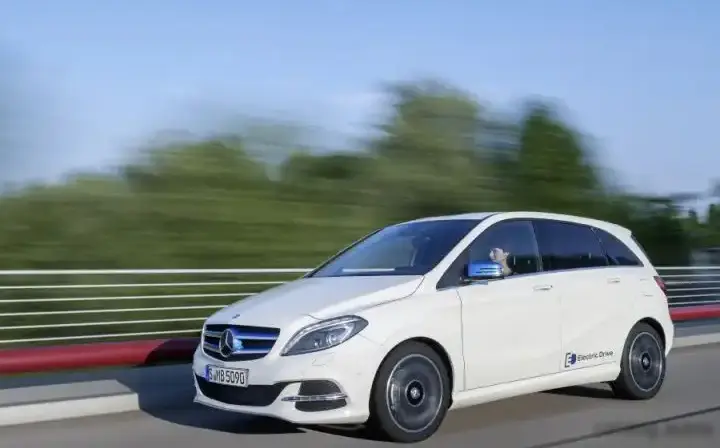
The Mercedes-Benz B 170, part of the W245 facelifted B-Class range produced from April 2008 to January 2009, represented an entry-level offering within the compact multi-purpose vehicle (MPV) segment. Positioned as a practical and relatively affordable option, the B 170 aimed to attract buyers seeking a spacious and versatile vehicle with the prestige of the Mercedes-Benz brand. It was a key component of the second-generation B-Class, built on the W245 platform, which introduced a sandwich floor design for improved crash safety and packaging efficiency. This facelift brought styling updates and refinements to the original W245, enhancing its appeal in a competitive market.
Technical Specifications
| Brand | Mercedes-Benz |
| Model | B-class |
| Generation | B-class (W245 facelift 2008) |
| Type (Engine) | B 170 (116 Hp) |
| Start of production | April, 2008 |
| End of production | January, 2009 |
| Powertrain Architecture | Internal Combustion engine |
| Body type | MPV |
| Seats | 5 |
| Doors | 5 |
| Fuel consumption (urban) | 8.6-9 l/100 km (27.4 – 26.1 US mpg) |
| Fuel consumption (extra urban) | 5.8-6 l/100 km (40.6 – 39.2 US mpg) |
| Fuel consumption (combined) | 6.8-7.1 l/100 km (34.6 – 33.1 US mpg) |
| CO2 emissions | 163-171 g/km |
| Fuel Type | Petrol (Gasoline) |
| Acceleration 0 – 100 km/h | 11.3 sec |
| Acceleration 0 – 62 mph | 11.3 sec |
| Acceleration 0 – 60 mph | 10.7 sec |
| Maximum speed | 184 km/h (114.33 mph) |
| Emission standard | Euro 4 |
| Weight-to-power ratio | 10.6 kg/Hp |
| Weight-to-torque ratio | 8 kg/Nm |
| Power | 116 Hp @ 5500 rpm |
| Torque | 155 Nm @ 3500-4000 rpm (114.32 lb.-ft. @ 3500-4000 rpm) |
| Engine layout | Front, Transverse |
| Engine Model/Code | M 266.940 |
| Engine displacement | 1699 cm3 (103.68 cu. in.) |
| Number of cylinders | 4 |
| Engine configuration | Inline |
| Cylinder Bore | 83 mm (3.27 in.) |
| Piston Stroke | 78.5 mm (3.09 in.) |
| Compression ratio | 11:1 |
| Number of valves per cylinder | 2 |
| Fuel injection system | Multi-port manifold injection |
| Engine aspiration | Naturally aspirated engine |
| Valvetrain | SOHC |
| Engine oil capacity | 5 l (5.28 US qt | 4.4 UK qt) |
| Coolant capacity | 6.3 l (6.66 US qt | 5.54 UK qt) |
| Kerb Weight | 1235 kg (2722.71 lbs.) |
| Max. weight | 1830 kg (4034.46 lbs.) |
| Max load | 595 kg (1311.75 lbs.) |
| Trunk (boot) space – minimum | 544 l (19.21 cu. ft.) |
| Trunk (boot) space – maximum | 2245 l (79.28 cu. ft.) |
| Fuel tank capacity | 54 l (14.27 US gal | 11.88 UK gal) |
| Max. roof load | 75 kg (165.35 lbs.) |
| Permitted trailer load with brakes (12%) | 1300 kg (2866.01 lbs.) |
| Permitted trailer load without brakes | 645 kg (1421.98 lbs.) |
| Permitted towbar download | 75 kg (165.35 lbs.) |
| Length | 4273 mm (168.23 in.) |
| Width | 1777 mm (69.96 in.) |
| Width including mirrors | 2035 mm (80.12 in.) |
| Height | 1603 mm (63.11 in.) |
| Wheelbase | 2778 mm (109.37 in.) |
| Front track | 1556 mm (61.26 in.) |
| Rear track | 1551 mm (61.06 in.) |
| Drag coefficient (Cd) | 0.30 |
| Minimum turning circle | 11.95 m (39.21 ft.) |
| Drivetrain | Front wheel drive |
| Number of gears | 5 |
| Gearbox type | manual transmission |
| Front suspension | Independent type McPherson, Transverse stabilizer |
| Rear suspension | Transverse stabilizer, Coil spring |
| Front brakes | Ventilated discs |
| Rear brakes | Disc |
| Assisting systems | ABS (Anti-lock braking system) |
| Steering type | Steering rack and pinion |
| Power steering | Electric Steering |
| Tires size | 195/65 R15 |
| Wheel rims size | 6J x 15 |
Powertrain & Engine Architecture
The B 170 was powered by the M 266.940, a 1.7-liter inline-four cylinder gasoline engine. This engine, a member of Mercedes-Benz’s M 266 family, featured a single overhead camshaft (SOHC) valvetrain with two valves per cylinder. Fuel delivery was managed by a multi-port fuel injection system. The engine produced 116 horsepower at 5500 rpm and 155 Nm (114.32 lb.-ft.) of torque between 3500 and 4000 rpm. The engine’s relatively modest output was intended for fuel efficiency rather than outright performance. The B 170 was equipped with a five-speed manual transmission as standard, delivering power to the front wheels. This transmission was chosen for its simplicity and cost-effectiveness, aligning with the B 170’s positioning as an entry-level model.
Driving Characteristics
The B 170’s driving experience was characterized by its focus on comfort and practicality. Acceleration from 0 to 60 mph took approximately 10.7 seconds, and it had a top speed of 114.33 mph. While not particularly quick, the engine provided adequate power for everyday driving situations. The five-speed manual transmission offered a reasonable level of control, but the engine’s limited torque meant frequent downshifts were often necessary, especially when overtaking or climbing hills. Compared to higher-output B-Class variants, such as the B 200, the B 170 felt noticeably less responsive. However, its lighter weight and efficient engine contributed to better fuel economy.
Equipment & Trim Levels
The B 170 typically came equipped with a standard set of features designed to provide a comfortable and functional driving experience. These included air conditioning, power windows, central locking, and an audio system. Interior upholstery was typically cloth, and the dashboard featured a straightforward layout with easy-to-use controls. Optional extras included alloy wheels, a sunroof, and upgraded audio systems. The B 170’s trim level was generally considered the base model, offering a more affordable entry point into the B-Class range.
Chassis & Braking
The B 170 utilized a McPherson strut front suspension and a multi-link rear suspension, providing a comfortable ride quality. The front brakes were ventilated discs, while the rear brakes were solid discs. Anti-lock Braking System (ABS) was standard, enhancing safety and control during emergency braking. The chassis was tuned to prioritize ride comfort over sporty handling, making it well-suited for everyday driving and long journeys. The relatively lightweight construction of the B 170 contributed to its nimble handling characteristics.
Market Reception & Comparison
The B 170 received mixed reviews from automotive critics. While praised for its practicality, spaciousness, and fuel efficiency, it was often criticized for its lack of performance. Compared to other B-Class variants, such as the B 200, the B 170 offered a more affordable price point but at the expense of driving enjoyment. Its fuel economy figures of 34.6 – 33.1 US mpg combined were competitive for its class, and its reliability was generally considered good. However, some owners reported issues with the engine’s timing chain and fuel injectors.
Legacy
The B 170, while not the most powerful or exciting variant of the W245 B-Class, remains a popular choice in the used car market due to its affordability and practicality. The M 266.940 engine, while not known for its longevity, is generally reliable if properly maintained. Regular oil changes and timely replacement of wear items are crucial for ensuring its long-term health. Today, the B 170 represents a relatively inexpensive way to experience the comfort and versatility of a Mercedes-Benz MPV.