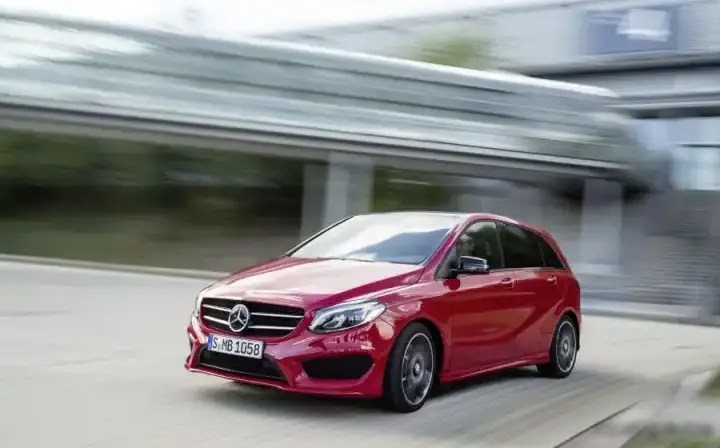
Technical Specifications
| Brand | Mercedes-Benz |
| Model | B-class |
| Generation | B-class (W246 facelift 2014) |
| Type (Engine) | B 180 CDI (109 Hp) DCT |
| Start of production | 2014 |
| End of production | 2018 |
| Powertrain Architecture | Internal Combustion engine |
| Body type | Hatchback |
| Seats | 5 |
| Doors | 5 |
| Fuel consumption (urban) | 4.5-4.0 l/100 km (52.3 – 58.8 US mpg, 62.8 – 70.6 UK mpg, 22.2 – 25 km/l) |
| Fuel consumption (extra urban) | 4.0-3.7 l/100 km (58.8 – 63.6 US mpg, 70.6 – 76.3 UK mpg, 25 – 27 km/l) |
| Fuel consumption (combined) | 4.2-4.0 l/100 km (56 – 58.8 US mpg, 67.3 – 70.6 UK mpg, 23.8 – 25 km/l) |
| CO2 emissions | 111-104 g/km |
| Fuel Type | Diesel |
| Acceleration 0 – 100 km/h | 11.9 sec |
| Acceleration 0 – 62 mph | 11.9 sec |
| Acceleration 0 – 60 mph | 11.3 sec |
| Maximum speed | 190 km/h (118.06 mph) |
| Emission standard | Euro 6 |
| Weight-to-power ratio | 13.3 kg/Hp, 75.2 Hp/tonne |
| Weight-to-torque ratio | 5.6 kg/Nm, 179.3 Nm/tonne |
| Power | 109 Hp @ 4000 rpm |
| Power per litre | 74.6 Hp/l |
| Torque | 260 Nm @ 1750-2500 rpm (191.77 lb.-ft. @ 1750-2500 rpm) |
| Engine layout | Front, Transverse |
| Engine Model/Code | OM 607.951 |
| Engine displacement | 1461 cm3 (89.16 cu. in.) |
| Number of cylinders | 4 |
| Engine configuration | Inline |
| Compression ratio | 15.5:1 |
| Fuel injection system | Diesel Commonrail |
| Engine aspiration | Turbocharger, Intercooler |
| Engine oil capacity | 4.5 l (4.76 US qt | 3.96 UK qt) |
| Coolant | 6.3 l (6.66 US qt | 5.54 UK qt) |
| Kerb Weight | 1450 kg (3196.7 lbs.) |
| Max. weight | 1985 kg (4376.18 lbs.) |
| Max load | 535 kg (1179.47 lbs.) |
| Trunk (boot) space – minimum | 488 l (17.23 cu. ft.) |
| Trunk (boot) space – maximum | 1547 l (54.63 cu. ft.) |
| Fuel tank capacity | 50 l (13.21 US gal | 11 UK gal) |
| Length | 4393 mm (172.95 in.) |
| Width | 1786 mm (70.31 in.) |
| Height | 1557 mm (61.3 in.) |
| Wheelbase | 2699 mm (106.26 in.) |
| Front track | 1552 mm (61.1 in.) |
| Rear (Back) track | 1549 mm (60.98 in.) |
| Ride height (ground clearance) | 98 mm (3.86 in.) |
| Minimum turning circle | 11 m (36.09 ft.) |
| Drivetrain Architecture | Front wheel drive |
| Number of gears and type of gearbox | 7 gears, automatic transmission G-DCT |
| Front suspension | Independent, type McPherson with coil spring and anti-roll bar |
| Rear suspension | Independent coil spring |
| Front brakes | Ventilated discs |
| Rear brakes | Disc |
The W246 B-Class, launched in 2011 and facelifted in 2014, represented a departure from the sandwich-floor design of its predecessor. The facelift brought a more conventional platform, improved interior quality, and a wider range of engine options. The B 180 CDI with the 7-speed DCT was introduced as a fuel-efficient and accessible entry point into the B-Class lineup. It targeted buyers who prioritized practicality, economy, and a comfortable driving experience over outright performance. This variant was particularly popular in European markets where diesel engines and compact hatchbacks are highly favored.
Powertrain & Engine Architecture
The B 180 CDI utilizes the OM607.951 engine, a 1.5-liter inline-four cylinder diesel engine. This engine is part of Mercedes-Benz’s modular engine family and features a turbocharger with an intercooler to enhance power and efficiency. The engine employs a common-rail direct injection system, delivering fuel directly into the combustion chamber at extremely high pressure for optimized combustion. The 7-speed G-DCT (Dual Clutch Transmission) is a crucial component of this variant. This transmission offers quick and smooth gear changes, contributing to both fuel efficiency and a more engaging driving experience compared to a traditional automatic. The DCT utilizes two separate clutches, one for odd-numbered gears and one for even-numbered gears, allowing for pre-selection of the next gear and seamless shifts.
Driving Characteristics
The B 180 CDI, with its 109 horsepower and 260 Nm (192 lb-ft) of torque, provides adequate performance for everyday driving. Acceleration from 0 to 62 mph takes around 11.9 seconds, and the top speed is 190 km/h (118 mph). While not a sporty performer, the engine delivers a usable amount of torque from low engine speeds, making it well-suited for urban driving and highway cruising. The DCT transmission contributes to a responsive feel, although some drivers may notice slight hesitation at low speeds. Compared to the more powerful B 200 CDI or petrol-powered variants, the B 180 CDI prioritizes fuel economy over outright speed. The gear ratios are tuned for efficiency, and the engine operates smoothly and quietly at cruising speeds.
Equipment & Trim Levels
The B 180 CDI typically came equipped with a respectable level of standard features. These included air conditioning, a multi-function steering wheel, power windows, and a basic audio system. Higher trim levels, often available as optional packages, added features such as automatic climate control, a larger infotainment screen with navigation, parking sensors, and upgraded interior upholstery. Interior materials were generally of good quality, reflecting Mercedes-Benz’s standards. The B-Class offered a spacious and practical interior, with comfortable seating for five passengers and a versatile cargo area that could be expanded by folding down the rear seats.
Chassis & Braking
The W246 B-Class features a McPherson strut front suspension and an independent coil spring rear suspension. This setup provides a comfortable ride quality, absorbing bumps and imperfections in the road effectively. The steering is precise and well-weighted, offering a good balance between responsiveness and ease of use. Braking duties are handled by ventilated discs at the front and solid discs at the rear. The B 180 CDI is equipped with ABS (Anti-lock Braking System) and other electronic stability control systems to enhance safety. The relatively low weight of the B 180 CDI, compared to some of its more powerful siblings, contributes to its balanced handling characteristics.
Market Reception & Comparison
The B 180 CDI was generally well-received by automotive critics as a practical and economical option within the B-Class range. Its fuel efficiency was a major selling point, and the DCT transmission was praised for its smooth and quick shifts. However, some reviewers noted that the engine lacked the punch of the more powerful diesel variants. Compared to the B 200 CDI, the B 180 CDI offered lower running costs but sacrificed some performance. Against petrol-powered B-Class models, the B 180 CDI provided superior fuel economy and torque, making it a more suitable choice for drivers who frequently cover long distances or carry heavy loads.
Legacy
The OM607.951 engine, used in the B 180 CDI, has proven to be a relatively reliable unit when properly maintained. Common issues include diesel particulate filter (DPF) clogging, particularly on vehicles used primarily for short journeys, and occasional turbocharger problems. The 7-speed G-DCT transmission is generally robust, but regular servicing with the correct fluid is essential to prevent issues. On the used car market, the B 180 CDI represents a good value proposition for buyers seeking a practical, economical, and well-equipped compact hatchback. Its relatively low running costs and proven reliability make it an attractive option for those looking for a dependable and affordable vehicle.