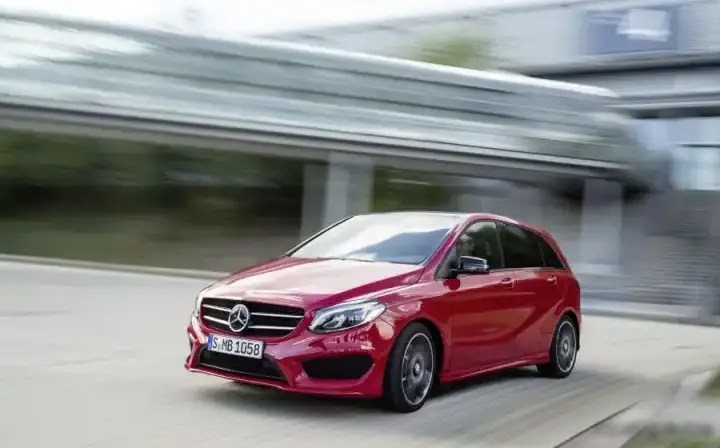
The Mercedes-Benz B 200 CDI 4MATIC, produced from 2014 to 2018 as part of the W246 facelift generation, represented a compelling entry point into the premium compact hatchback segment with all-wheel drive. This variant combined a fuel-efficient diesel engine with a dual-clutch transmission (DCT) and the added security of 4MATIC all-wheel drive, appealing to buyers seeking practicality, economy, and all-weather capability. Positioned as a mid-range offering within the B-Class lineup, it sat between the lower-powered B 180 CDI and the more potent B 220 CDI models.
Technical Specifications
| Brand | Mercedes-Benz |
| Model | B-class |
| Generation | B-class (W246 facelift 2014) |
| Type (Engine) | B 200 CDI (136 Hp) 4MATIC DCT |
| Start of production | 2014 |
| End of production | 2018 |
| Powertrain Architecture | Internal Combustion engine |
| Body type | Hatchback |
| Seats | 5 |
| Doors | 5 |
| Fuel consumption (urban) | 5.9-5.8 l/100 km (39.9 – 40.6 US mpg, 47.9 – 48.7 UK mpg, 16.9 – 17.2 km/l) |
| Fuel consumption (extra urban) | 4.5 l/100 km (52.3 US mpg, 62.8 UK mpg, 22.2 km/l) |
| Fuel consumption (combined) | 5 l/100 km (47 US mpg, 56.5 UK mpg, 20 km/l) |
| CO2 emissions | 131-130 g/km |
| Fuel Type | Diesel |
| Acceleration 0 – 100 km/h | 9.8 sec |
| Acceleration 0 – 62 mph | 9.8 sec |
| Acceleration 0 – 60 mph | 9.3 sec |
| Maximum speed | 207 km/h (128.62 mph) |
| Emission standard | Euro 6 |
| Weight-to-power ratio | 11.6 kg/Hp, 86.3 Hp/tonne |
| Weight-to-torque ratio | 5.3 kg/Nm, 190.5 Nm/tonne |
| Power | 136 Hp @ 3400-4400 rpm |
| Power per litre | 63.5 Hp/l |
| Torque | 300 Nm @ 1400-3000 rpm (221.27 lb.-ft. @ 1400-3000 rpm) |
| Engine layout | Front, Transverse |
| Engine Model/Code | OM 651.930 |
| Engine displacement | 2143 cm3 (130.77 cu. in.) |
| Number of cylinders | 4 |
| Engine configuration | Inline |
| Compression ratio | 16.2:1 |
| Fuel injection system | Diesel Commonrail |
| Engine aspiration | Turbocharger, Intercooler |
| Engine oil capacity | 7 l (7.4 US qt | 6.16 UK qt) |
| Coolant capacity | 9.5 l (10.04 US qt | 8.36 UK qt) |
| Kerb Weight | 1575 kg (3472.28 lbs.) |
| Max. weight | 2095 kg (4618.68 lbs.) |
| Max load | 520 kg (1146.4 lbs.) |
| Trunk (boot) space – minimum | 488 l (17.23 cu. ft.) |
| Trunk (boot) space – maximum | 1547 l (54.63 cu. ft.) |
| Fuel tank capacity | 56 l (14.79 US gal | 12.32 UK gal) |
| Length | 4393 mm (172.95 in.) |
| Width | 1786 mm (70.31 in.) |
| Height | 1557 mm (61.3 in.) |
| Wheelbase | 2699 mm (106.26 in.) |
| Front track | 1552 mm (61.1 in.) |
| Rear track | 1549 mm (60.98 in.) |
| Ride height (ground clearance) | 98 mm (3.86 in.) |
| Minimum turning circle | 11 m (36.09 ft.) |
| Drive wheel | All wheel drive (4×4) |
| Number of gears | 7 |
| Gearbox type | automatic transmission G-DCT |
| Front suspension | Independent, type McPherson with coil spring and anti-roll bar |
| Rear suspension | Independent coil spring |
| Front brakes | Ventilated discs |
| Rear brakes | Disc |
| Assisting systems | ABS (Anti-lock braking system) |
| Steering type | Steering rack and pinion |
| Tires size | 225/45 R17 |
| Wheel rims size | 17 |
Powertrain & Engine Architecture
The B 200 CDI 4MATIC utilized the OM651.930 2.1-liter inline-four cylinder diesel engine. This engine was a mainstay in the Mercedes-Benz lineup, known for its robust construction and fuel efficiency. It featured a common rail direct injection system, delivering fuel at extremely high pressures for optimized combustion. A turbocharger with an intercooler further enhanced performance, providing increased air intake for greater power output. The engine produced 136 horsepower at 3400-4400 rpm and a substantial 300 Nm (221 lb-ft) of torque between 1400-3000 rpm. This broad torque curve was a key characteristic, providing strong pulling power from low engine speeds. The engine also incorporated a diesel particulate filter (DPF) to meet stringent Euro 6 emission standards.
Power was transmitted to all four wheels via a 7G-DCT (7-speed dual-clutch transmission). This transmission offered quick and smooth gear changes, contributing to both performance and fuel economy. The DCT operates by utilizing two separate clutches for odd and even gears, allowing for pre-selection of the next gear and virtually seamless shifts. The 4MATIC all-wheel-drive system employed a multi-plate clutch to distribute torque between the front and rear axles, providing enhanced traction and stability, particularly in adverse weather conditions.
Driving Characteristics
The B 200 CDI 4MATIC offered a comfortable and refined driving experience. While not a performance-oriented model, the engine’s torque output provided adequate acceleration for everyday driving situations. The 0-60 mph sprint took approximately 9.3 seconds, and the car had a top speed of 128.62 mph. The DCT transmission contributed to responsive acceleration, and the 4MATIC system instilled confidence in slippery conditions. Compared to the front-wheel-drive B 200 CDI, the 4MATIC version offered noticeably improved grip and handling. However, it wasn’t as nimble as the lighter, rear-wheel-drive focused models like the CLA 200. The automatic transmission was well-tuned for smooth operation, but some drivers might have preferred the more engaging experience of a manual gearbox, which wasn’t offered with this engine and drivetrain combination.
Equipment & Trim Levels
The B 200 CDI 4MATIC typically came equipped with a respectable level of standard features. These included automatic climate control, a multi-function steering wheel, power windows and mirrors, and an audio system with Bluetooth connectivity. Upholstery was generally a fabric material, although leather options were available as upgrades. Optional extras included a panoramic sunroof, navigation system, parking sensors, and various driver assistance systems such as collision prevention assist and lane keeping assist. Trim levels varied depending on the market, but generally offered packages that bundled together popular options for convenience and enhanced comfort.
Chassis & Braking
The W246 B-Class featured an independent suspension setup at all four corners. The front utilized a McPherson strut design with coil springs and an anti-roll bar, while the rear employed a multi-link suspension. This configuration provided a good balance between ride comfort and handling. The B 200 CDI 4MATIC was equipped with ventilated disc brakes at the front and solid disc brakes at the rear. Anti-lock braking system (ABS) was standard, ensuring safe and controlled stopping power. The steering system was a rack and pinion type, providing precise and responsive steering feel.
Market Reception & Comparison
The B 200 CDI 4MATIC was generally well-received by automotive critics. It was praised for its fuel efficiency, comfortable ride, and the added security of all-wheel drive. However, some reviewers noted that the interior design was somewhat conservative and that the driving experience wasn’t as engaging as some of its rivals. Compared to the B 180 CDI, the B 200 CDI offered a noticeable performance upgrade, while the B 220 CDI provided even more power but at a higher price point. Fuel economy was comparable across the range, with the B 200 CDI striking a good balance between performance and efficiency.
Legacy
The OM651 engine family, including the version used in the B 200 CDI 4MATIC, has proven to be remarkably durable and reliable. With proper maintenance, these engines can easily exceed 200,000 miles. The 7G-DCT transmission is also generally considered to be a robust unit, although regular fluid changes are essential for long-term reliability. On the used car market, the B 200 CDI 4MATIC remains a popular choice for buyers seeking a practical, fuel-efficient, and well-equipped compact hatchback. Its all-wheel-drive system adds a layer of versatility that makes it particularly appealing in regions with inclement weather. While newer models offer more advanced technology and features, the W246 B-Class continues to represent a solid value proposition.