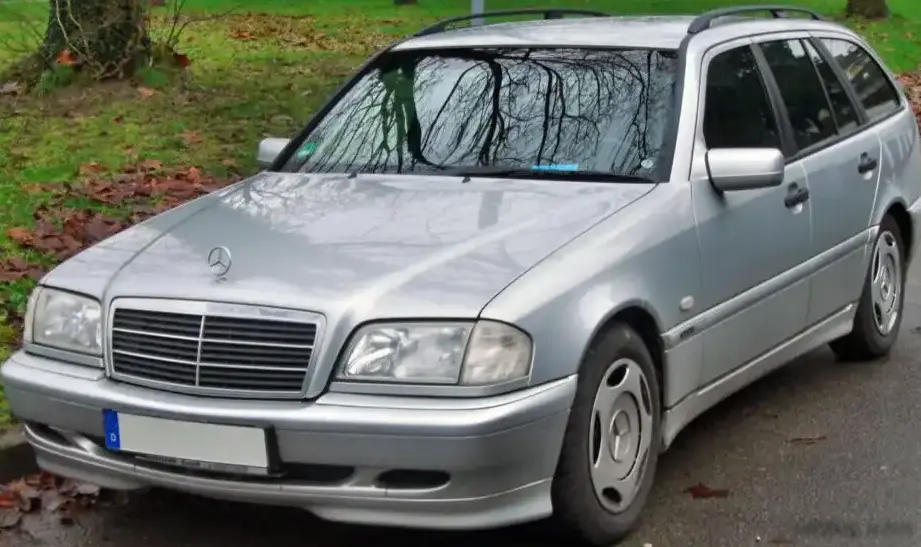
The Mercedes-Benz C-Class T-modell C 200, equipped with the 5G-TRONIC automatic transmission, was a key variant within the S202 series produced from June 1997 to June 2000. This facelifted model, representing the estate (wagon) version of the C-Class, aimed to provide a practical and comfortable option for families and those requiring additional cargo space. Positioned as a mid-range offering, the C 200 Automatic bridged the gap between the more economical C 180 and the higher-performance C 230 Kompressor models. It represented a balance of affordability, reasonable performance, and the convenience of an automatic gearbox, making it a popular choice in European markets.
Technical Specifications
| Brand | Mercedes-Benz |
| Model | C-Class |
| Generation | C-Class T-modell (S202, facelift 1997) |
| Type (Engine) | C 200 (136 Hp) 5G-TRONIC |
| Start of production | June, 1997 |
| End of production | June, 2000 |
| Powertrain Architecture | Internal Combustion engine |
| Body type | Station wagon (estate) |
| Seats | 5 |
| Doors | 5 |
| Fuel consumption (urban) | 11 l/100 km (21.4 US mpg) |
| Fuel consumption (extra urban) | 6.4 l/100 km (36.8 US mpg) |
| Fuel Type | Petrol (Gasoline) |
| Acceleration 0 – 100 km/h | 12.1 sec |
| Acceleration 0 – 62 mph | 12.1 sec |
| Acceleration 0 – 60 mph | 11.5 sec |
| Maximum speed | 197 km/h (122.41 mph) |
| Weight-to-power ratio | 10.4 kg/Hp |
| Weight-to-torque ratio | 7.5 kg/Nm |
| Power | 136 Hp @ 5500 rpm |
| Power per litre | 68.1 Hp/l |
| Torque | 190 Nm @ 4000 rpm (140.14 lb.-ft. @ 4000 rpm) |
| Engine layout | Front, Longitudinal |
| Engine Model/Code | M 111 E 20 / 111.945 |
| Engine displacement | 1998 cm3 (121.93 cu. in.) |
| Number of cylinders | 4 |
| Engine configuration | Inline |
| Cylinder Bore | 89.9 mm (3.54 in.) |
| Piston Stroke | 78.7 mm (3.1 in.) |
| Compression ratio | 9.6:1 |
| Number of valves per cylinder | 4 |
| Fuel injection system | Multi-port manifold injection |
| Engine aspiration | Naturally aspirated engine |
| Valvetrain | DOHC |
| Engine oil capacity | 5.5 l (5.81 US qt | 4.84 UK qt) |
| Coolant | 8.5 l (8.98 US qt | 7.48 UK qt) |
| Kerb Weight | 1420 kg (3130.56 lbs.) |
| Max. weight | 1930 kg (4254.92 lbs.) |
| Max load | 510 kg (1124.36 lbs.) |
| Trunk (boot) space – minimum | 465 l (16.42 cu. ft.) |
| Trunk (boot) space – maximum | 1510 l (53.33 cu. ft.) |
| Fuel tank capacity | 62 l (16.38 US gal | 13.64 UK gal) |
| Length | 4516 mm (177.8 in.) |
| Width | 1723 mm (67.83 in.) |
| Height | 1460 mm (57.48 in.) |
| Wheelbase | 2690 mm (105.91 in.) |
| Front track | 1499 mm (59.02 in.) |
| Rear (Back) track | 1464 mm (57.64 in.) |
| Drivetrain Architecture | Rear wheel drive |
| Number of gears and type of gearbox | 5 gears, automatic transmission G-TRONIC |
| Front suspension | Double wishbone |
| Rear suspension | Independent multi-link spring suspension with stabilizer |
| Front brakes | Ventilated discs |
| Rear brakes | Disc |
| Assisting systems | ABS (Anti-lock braking system) |
| Steering type | Cone worm with recirculation balls |
| Power steering | Hydraulic Steering |
| Tires size | 195/65 R15 |
| Wheel rims size | 6.5J x 15 |
Powertrain & Engine Architecture
The C 200 T-modell utilized the M111 E 20 engine, a 1.998-liter inline-four cylinder powerplant. This engine, identifiable by its code 111.945, was a cornerstone of Mercedes-Benz’s mid-size offerings during the late 1990s. It featured a cast iron block with an aluminum cylinder head, incorporating a double overhead camshaft (DOHC) valvetrain with four valves per cylinder. Fuel delivery was managed by a Bosch multi-port fuel injection system, providing precise fuel metering for optimal combustion. The engine’s 9.6:1 compression ratio contributed to its respectable power output of 136 horsepower at 5500 rpm and 190 Nm (140 lb-ft) of torque at 4000 rpm. Paired with the engine was the 5G-TRONIC automatic transmission, a five-speed unit known for its smooth shifting and relatively quick response. This transmission was electronically controlled, adapting shift points based on driving conditions and throttle input.
Driving Characteristics
The C 200 Automatic offered a comfortable and refined driving experience, prioritizing ease of use over outright performance. Acceleration from 0-60 mph took approximately 11.5 seconds, and top speed was limited to 197 km/h (122 mph). Compared to the manual transmission version of the C 200, the automatic resulted in a slight performance decrease due to inherent transmission losses. However, the 5G-TRONIC’s well-chosen gear ratios helped to keep the engine within its optimal power band during typical driving situations. The automatic transmission also provided a smoother driving experience, particularly in urban environments. Compared to the more powerful C 230 Kompressor, the C 200 felt less urgent, but it offered a more fuel-efficient and relaxed driving experience. The rear-wheel drive configuration provided balanced handling, although it wasn’t particularly sporty.
Equipment & Trim Levels
The C 200 T-modell came standard with a respectable level of equipment, including power windows, central locking, and an AM/FM radio. Interior upholstery typically consisted of fabric seats, although leather options were available as an upgrade. Air conditioning was a common feature, and many examples were equipped with a sunroof. Optional extras included automatic climate control, a premium sound system, and heated front seats. The dashboard layout was typical of Mercedes-Benz at the time, featuring a classic analog instrument cluster and a straightforward control layout. The estate body style itself added to the practicality, with a spacious cargo area that could be expanded by folding down the rear seats.
Chassis & Braking
The S202 C-Class T-modell featured a robust chassis with a double wishbone front suspension and an independent multi-link rear suspension, incorporating a stabilizer bar for improved handling. This suspension setup provided a comfortable ride while maintaining reasonable control. Braking duties were handled by ventilated discs at the front and solid discs at the rear, assisted by an Anti-lock Braking System (ABS). The steering was a recirculating ball system with hydraulic power assistance, offering a good balance of feel and ease of use. The C 200’s weight of approximately 1420 kg (3130 lbs) was typical for a vehicle of its size and class.
Market Reception & Comparison
The C 200 Automatic was generally well-received by automotive critics as a practical and comfortable family car. It was praised for its smooth ride, refined interior, and the convenience of the automatic transmission. However, some critics noted that its performance was not particularly exciting, and it lacked the sporty character of some of its rivals. In terms of fuel economy, the C 200 Automatic offered a reasonable compromise between performance and efficiency, achieving around 21.4 mpg in urban driving and 36.8 mpg on the highway. Compared to the C 180, the C 200 offered a noticeable performance improvement, while the C 230 Kompressor provided significantly more power but at the cost of increased fuel consumption.
Legacy
The M111 engine, found in the C 200, is generally considered a reliable and durable unit. With proper maintenance, these engines can accumulate high mileage without major issues. The 5G-TRONIC transmission is also known for its longevity, although regular fluid changes are essential. Today, the S202 C-Class T-modell C 200 Automatic represents an affordable entry point into Mercedes-Benz ownership. Well-maintained examples are sought after by enthusiasts and those looking for a practical and reliable estate car. While not a performance icon, the C 200 T-modell remains a testament to Mercedes-Benz’s commitment to quality, comfort, and practicality.