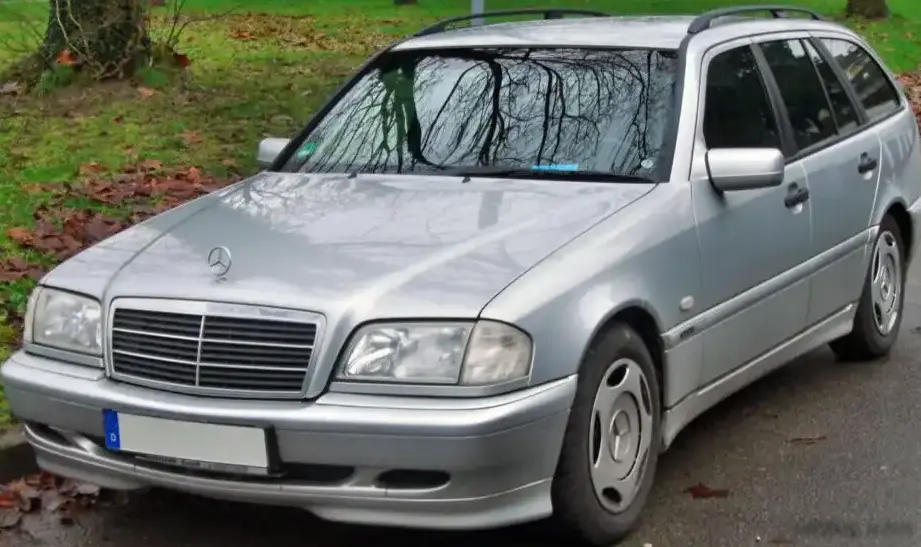
The Mercedes-Benz C-Class T-modell C 200 CDI, produced from June 1998 to January 2001, represents a significant entry point into the premium compact estate (wagon) market. Part of the S202 series, which received a facelift in 1997, this variant combined a fuel-efficient diesel engine with the convenience of a five-speed automatic transmission. Positioned as a practical and economical option within the C-Class range, it catered to buyers prioritizing space, fuel economy, and the prestige of the Mercedes-Benz brand. This model occupied the lower-mid range of the T-modell lineup, sitting below the more powerful C 220 CDI and C 250 Turbo Diesel, and above the base C 180 models.
Technical Specifications
| Brand | Mercedes-Benz |
| Model | C-Class |
| Generation | C-Class T-modell (S202, facelift 1997) |
| Type (Engine) | C 200 CDI (102 Hp) 5G-TRONIC |
| Start of production | June, 1998 |
| End of production | January, 2001 |
| Powertrain Architecture | Internal Combustion engine |
| Body type | Station wagon (estate) |
| Seats | 5 |
| Doors | 5 |
| Fuel consumption (urban) | 9.4 l/100 km (25 US mpg, 30.1 UK mpg, 10.6 km/l) |
| Fuel consumption (extra urban) | 5.3 l/100 km (44.4 US mpg, 53.3 UK mpg, 18.9 km/l) |
| Fuel consumption (combined) | 6.8 l/100 km (34.6 US mpg, 41.5 UK mpg, 14.7 km/l) |
| Fuel Type | Diesel |
| Acceleration 0 – 100 km/h | 13.9 sec |
| Acceleration 0 – 62 mph | 13.9 sec |
| Acceleration 0 – 60 mph | 13.2 sec (Calculated) |
| Maximum speed | 179 km/h (111.23 mph) |
| Weight-to-power ratio | 14.3 kg/Hp, 69.9 Hp/tonne |
| Weight-to-torque ratio | 6.2 kg/Nm, 161 Nm/tonne |
| Power | 102 Hp @ 4200 rpm |
| Power per litre | 47.5 Hp/l |
| Torque | 235 Nm @ 1500-2600 rpm (173.33 lb.-ft.) |
| Engine layout | Front, Longitudinal |
| Engine Model/Code | OM 611 DE 22 LA red./ 611.960 red. |
| Engine displacement | 2148 cm3 (131.08 cu. in.) |
| Number of cylinders | 4 |
| Engine configuration | Inline |
| Cylinder Bore | 88 mm (3.46 in.) |
| Piston Stroke | 88.4 mm (3.48 in.) |
| Compression ratio | 19:1 |
| Number of valves per cylinder | 4 |
| Fuel injection system | Diesel Commonrail |
| Engine aspiration | Turbocharger, Intercooler |
| Valvetrain | DOHC |
| Engine oil capacity | 6 l (6.34 US qt | 5.28 UK qt) |
| Coolant capacity | 8 l (8.45 US qt | 7.04 UK qt) |
| Kerb Weight | 1460 kg (3218.75 lbs.) |
| Max. weight | 1970 kg (4343.11 lbs.) |
| Max load | 510 kg (1124.36 lbs.) |
| Trunk (boot) space – minimum | 465 l (16.42 cu. ft.) |
| Trunk (boot) space – maximum | 1510 l (53.33 cu. ft.) |
| Fuel tank capacity | 62 l (16.38 US gal | 13.64 UK gal) |
| Length | 4516 mm (177.8 in.) |
| Width | 1723 mm (67.83 in.) |
| Height | 1460 mm (57.48 in.) |
| Wheelbase | 2690 mm (105.91 in.) |
| Front track | 1499 mm (59.02 in.) |
| Rear track | 1464 mm (57.64 in.) |
| Drag coefficient (Cd) | 0.33 |
| Drivetrain Architecture | Rear wheel drive |
| Number of gears | 5 |
| Gearbox type | Automatic transmission G-TRONIC |
| Front suspension | Double wishbone |
| Rear suspension | Independent multi-link spring suspension with stabilizer |
| Front brakes | Ventilated discs |
| Rear brakes | Disc |
| Assisting systems | ABS (Anti-lock braking system) |
| Steering type | Cone worm with recirculation balls |
| Power steering | Hydraulic |
| Tires size | 195/65 R15 |
| Wheel rims size | 6.5J x 15 |
Powertrain & Engine Architecture
The C 200 CDI T-modell was powered by the OM 611 DE 22 LA engine, a 2.2-liter inline four-cylinder diesel. This engine was a cornerstone of Mercedes-Benz’s diesel offerings in the late 1990s and early 2000s. It featured a cast iron block and aluminum cylinder head, incorporating a turbocharger with an intercooler to boost power and efficiency. The engine utilized a second-generation common rail direct injection system, delivering fuel at extremely high pressures for improved combustion and reduced emissions. The DOHC valvetrain, with four valves per cylinder, further enhanced breathing and performance. The 5G-TRONIC automatic transmission, a five-speed unit, was specifically tuned to complement the engine’s torque characteristics, providing smooth and relatively quick shifts. This transmission was known for its reliability and comfort, though it wasn’t particularly sporty in its shift programming.
Driving Characteristics
The C 200 CDI Automatic offered a comfortable and relaxed driving experience. With 102 horsepower and 235 Nm (173 lb-ft) of torque, acceleration was adequate for everyday driving, but not particularly brisk. The 0-60 mph time of around 13.2 seconds reflects this. The automatic transmission, while smooth, did contribute to a slight reduction in performance compared to the available manual transmission. The engine’s peak torque was available from a low 1500 rpm, providing good responsiveness in city driving and making overtaking at highway speeds manageable. The gear ratios were optimized for fuel efficiency rather than outright performance. The rear-wheel drive configuration provided a balanced feel, but lacked the all-weather capability of all-wheel drive systems offered on other C-Class variants.
Equipment & Trim Levels
The C 200 CDI T-modell typically came standard with features such as power windows, central locking, air conditioning, and an AM/FM radio. Interior upholstery was generally cloth, though leather options were available. Dashboard trim was typically wood or metallic finish. Optional extras included a sunroof, upgraded audio system, automatic climate control, and heated front seats. Safety features included ABS brakes and driver and passenger airbags. The trim level was generally considered to be mid-range, offering a good balance of features and affordability.
Chassis & Braking
The S202 C-Class T-modell utilized a double wishbone front suspension and an independent multi-link rear suspension, providing a comfortable ride and good handling characteristics. Stabilizer bars were fitted to both axles to reduce body roll. The C 200 CDI was equipped with ventilated disc brakes at the front and solid disc brakes at the rear. The braking system, coupled with ABS, provided adequate stopping power for the vehicle’s weight and performance. The steering was a hydraulic power-assisted recirculating ball system, offering a reasonably direct feel.
Market Reception & Comparison
The C 200 CDI T-modell was generally well-received by critics as a practical and economical estate car. It was praised for its fuel efficiency, comfortable ride, and spacious interior. However, some reviewers noted that the engine lacked the refinement and performance of some of its competitors. Compared to the C 220 CDI, the C 200 CDI offered lower running costs but sacrificed some performance. Against the petrol-powered C 180, the C 200 CDI provided significantly better fuel economy and more torque, making it a more practical choice for long-distance driving.
Legacy
The OM 611 engine, found in the C 200 CDI, proved to be a durable and reliable powerplant. With proper maintenance, these engines can accumulate high mileage. The 5G-TRONIC transmission is also generally considered reliable, although some units may require servicing over time. Today, the C 200 CDI T-modell represents an affordable entry point into Mercedes-Benz ownership. While not a performance icon, it remains a practical and comfortable estate car, valued for its fuel efficiency and relatively low maintenance costs. Finding well-maintained examples is becoming increasingly difficult, but those that remain offer a glimpse into a period when Mercedes-Benz prioritized practicality and durability alongside luxury and prestige.