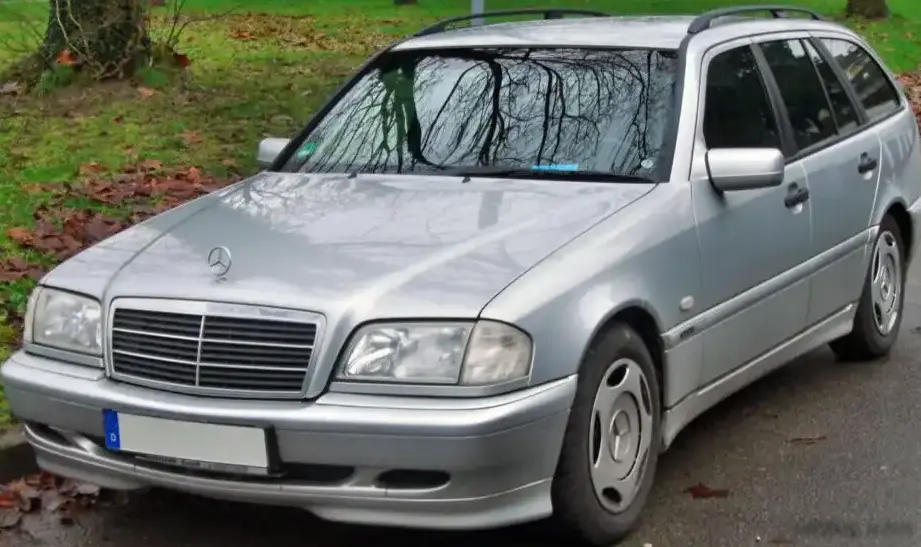
The Mercedes-Benz C-Class T-modell (S202) C 200 D with the 5G-TRONIC automatic transmission was a variant produced between June 1997 and June 1998. This model represented an entry-level offering within the S202 estate range, positioned below the more powerful C 220 D and C 250 Turbo Diesel. The S202 series, introduced in 1996, was the first factory-built estate version of the C-Class, expanding the model line to cater to buyers needing increased practicality. The facelift in 1997 brought cosmetic and some mechanical updates, including refinements to the engine and transmission options. This C 200 D aimed to provide a balance of fuel efficiency, reasonable performance, and the prestige associated with the Mercedes-Benz brand.
Technical Specifications
| Brand | Mercedes-Benz |
| Model | C-Class |
| Generation | C-Class T-modell (S202, facelift 1997) |
| Type (Engine) | C 200 D (88 Hp) 5G-TRONIC |
| Start of production | June, 1997 |
| End of production | June, 1998 |
| Powertrain Architecture | Internal Combustion engine |
| Body type | Station wagon (estate) |
| Seats | 5 |
| Doors | 5 |
| Fuel consumption (urban) | 10.6 l/100 km (22.2 US mpg, 26.6 UK mpg, 9.4 km/l) |
| Fuel consumption (extra urban) | 6 l/100 km (39.2 US mpg, 47.1 UK mpg, 16.7 km/l) |
| Fuel consumption (combined) | 7.7 l/100 km (30.5 US mpg, 36.7 UK mpg, 13 km/l) |
| Fuel Type | Diesel |
| Maximum speed | 166 km/h (103.15 mph) |
| Weight-to-power ratio | 16.4 kg/Hp, 61.1 Hp/tonne |
| Weight-to-torque ratio | 10.7 kg/Nm, 93.8 Nm/tonne |
| Power | 88 Hp @ 5000 rpm |
| Power per litre | 44.1 Hp/l |
| Torque | 135 Nm @ 2000-4650 rpm (99.57 lb.-ft. @ 2000-4650 rpm) |
| Engine layout | Front, Longitudinal |
| Engine Model/Code | OM 604 D 20 / 604.915 |
| Engine displacement | 1997 cm3 (121.86 cu. in.) |
| Number of cylinders | 4 |
| Engine configuration | Inline |
| Cylinder Bore | 86.99 mm (3.42 in.) |
| Piston Stroke | 84 mm (3.31 in.) |
| Compression ratio | 22:1 |
| Number of valves per cylinder | 4 |
| Fuel injection system | Precombustion chamber injection |
| Engine aspiration | Naturally aspirated engine |
| Valvetrain | DOHC |
| Engine oil capacity | 6.5 l (6.87 US qt | 5.72 UK qt) |
| Coolant | 7 l (7.4 US qt | 6.16 UK qt) |
| Kerb Weight | 1440 kg (3174.66 lbs.) |
| Max. weight | 1950 kg (4299.01 lbs.) |
| Max load | 510 kg (1124.36 lbs.) |
| Fuel tank capacity | 62 l (16.38 US gal | 13.64 UK gal) |
| Length | 4516 mm (177.8 in.) |
| Width | 1723 mm (67.83 in.) |
| Height | 1460 mm (57.48 in.) |
| Wheelbase | 2690 mm (105.91 in.) |
| Front track | 1499 mm (59.02 in.) |
| Rear track | 1464 mm (57.64 in.) |
| Drivetrain Architecture | Rear wheel drive |
| Drive wheel | Rear wheel drive |
| Number of gears | 5 |
| Gearbox type | automatic transmission 5G-TRONIC |
| Front suspension | Double wishbone |
| Rear suspension | Independent multi-link spring suspension with stabilizer |
| Front brakes | Disc |
| Rear brakes | Disc |
| Assisting systems | ABS (Anti-lock braking system) |
| Steering type | Cone worm with recirculation balls |
| Power steering | Hydraulic Steering |
| Tires size | 195/65 R15 |
| Wheel rims size | 6.5J x 15 |
Powertrain & Engine Architecture
The C 200 D was powered by the OM 604 D 20 engine, a 2.0-liter inline-four cylinder diesel. This engine utilized precombustion chamber injection, a system common in Mercedes-Benz diesels of the era. This system involved injecting fuel into a small precombustion chamber connected to the main cylinder, promoting more complete combustion and reducing engine noise. The engine produced 88 horsepower at 5000 rpm and 135 Nm (99.57 lb-ft) of torque between 2000 and 4650 rpm. The 5G-TRONIC automatic transmission was a five-speed unit, offering smooth shifts but prioritizing fuel economy over outright performance. The engine’s longitudinal mounting and rear-wheel drive configuration were typical for Mercedes-Benz passenger cars at the time.
Driving Characteristics
The C 200 D Automatic offered a comfortable, albeit unhurried, driving experience. Acceleration was modest, with a 0-60 mph time estimated around 12-13 seconds. The 5G-TRONIC transmission was programmed for economy, meaning it would upshift quickly to maintain fuel efficiency. This resulted in a relaxed cruising experience but could feel sluggish when needing to overtake or climb hills. Compared to the manual transmission versions of the C 200 D, the automatic offered less driver engagement but greater convenience. The higher-output C 220 D and C 250 Turbo Diesel provided significantly more power and quicker acceleration, but at the expense of fuel economy. The automatic transmission’s gear ratios were optimized for fuel efficiency, with a relatively tall final drive.
Equipment & Trim Levels
The C 200 D Automatic typically came equipped with standard features such as power windows, central locking, and an AM/FM radio. Interior upholstery was usually cloth, although leather was available as an option. Air conditioning was a common optional extra. The dashboard layout was typical of Mercedes-Benz in the 1990s, with a functional and understated design. Optional extras included a sunroof, upgraded audio systems, and alloy wheels. The trim level was generally considered to be entry-level within the C-Class range, focusing on providing essential comfort and convenience features.
Chassis & Braking
The S202 C-Class featured a double wishbone front suspension and an independent multi-link rear suspension, providing a comfortable ride and good handling characteristics. The C 200 D was equipped with disc brakes on all four wheels, along with ABS (Anti-lock Braking System) as standard. Stabilizer bars were fitted to both the front and rear axles to reduce body roll during cornering. The suspension was tuned for comfort rather than outright sportiness, reflecting the car’s intended role as a practical and refined estate car. The rear suspension design aimed to minimize intrusion into the cargo area.
Market Reception & Comparison
The C 200 D Automatic was generally well-received as a fuel-efficient and practical estate car. Critics praised its comfortable ride and spacious interior. However, some reviewers noted its lack of outright performance. Compared to the C 220 D, the C 200 D offered lower running costs but less power. The C 250 Turbo Diesel provided the best performance but was significantly more expensive to purchase and operate. Fuel economy was a key selling point for the C 200 D, with combined fuel consumption figures around 7.7 l/100 km (30.5 US mpg). Reliability was generally good, typical of Mercedes-Benz vehicles of the era.
Legacy
The OM 604 engine family, including the D 20 variant, is known for its durability and longevity. Well-maintained examples of the C 200 D can still be found on the road today. The 5G-TRONIC transmission, while not as sophisticated as modern automatic gearboxes, is generally reliable if serviced regularly. In the used car market, the C 200 D Automatic represents an affordable entry point into Mercedes-Benz ownership, offering a blend of practicality, comfort, and reliability. However, potential buyers should be aware of the age-related issues common to vehicles of this era, such as corrosion and wear and tear on suspension components.