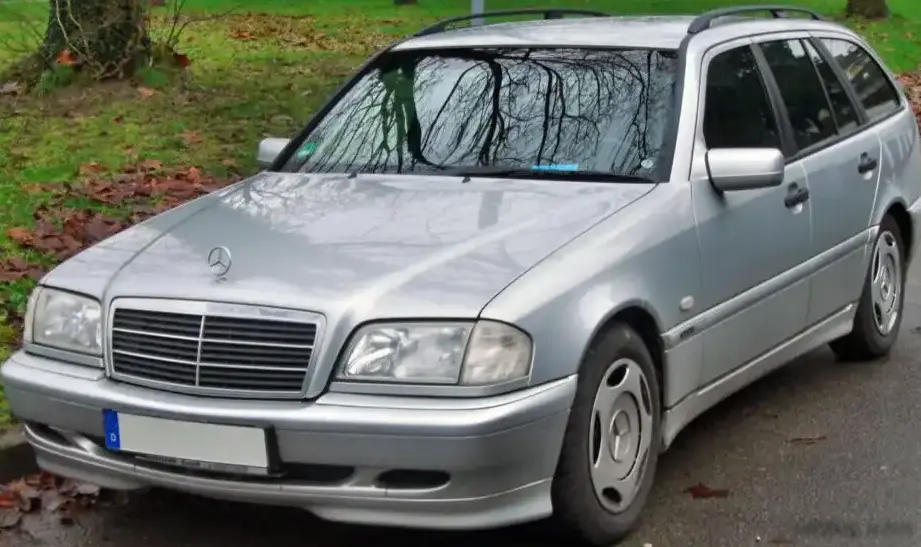
The Mercedes-Benz C-Class T-modell (S202) facelift C 220 CDI, produced from May 1997 to January 2001, represented a significant step forward in the compact executive estate segment. This variant, powered by a 2.2-liter turbocharged diesel engine producing 125 horsepower, occupied a middle ground within the S202 range, offering a balance between fuel efficiency, practicality, and reasonable performance. It was positioned as a more economical alternative to the gasoline-powered C 220 and C 280 models, while offering more power and refinement than the base C 200 CDI. The S202 series, the first factory-built estate version of the C-Class, aimed to provide a premium, versatile vehicle for families and those requiring substantial cargo space without sacrificing the Mercedes-Benz brand experience.
Technical Specifications
| Brand | Mercedes-Benz |
| Model | C-Class |
| Generation | C-Class T-modell (S202, facelift 1997) |
| Type (Engine) | C 220 CDI (125 Hp) |
| Start of production | May, 1997 |
| End of production | January, 2001 |
| Powertrain Architecture | Internal Combustion engine |
| Body type | Station wagon (estate) |
| Seats | 5 |
| Doors | 5 |
| Fuel consumption (urban) | 8.2 l/100 km (28.7 US mpg, 34.4 UK mpg, 12.2 km/l) |
| Fuel consumption (extra urban) | 5.1 l/100 km (46.1 US mpg, 55.4 UK mpg, 19.6 km/l) |
| Fuel consumption (combined) | 6.2 l/100 km (37.9 US mpg, 45.6 UK mpg, 16.1 km/l) |
| Fuel Type | Diesel |
| Acceleration 0 – 100 km/h | 10.1 sec |
| Acceleration 0 – 62 mph | 10.1 sec |
| Acceleration 0 – 60 mph | 9.6 sec |
| Maximum speed | 195 km/h (121.17 mph) |
| Weight-to-power ratio | 11.7 kg/Hp, 85.6 Hp/tonne |
| Weight-to-torque ratio | 4.9 kg/Nm, 205.5 Nm/tonne |
| Power | 125 Hp @ 4200 rpm |
| Power per litre | 58.1 Hp/l |
| Torque | 300 Nm @ 1800-2600 rpm (221.27 lb.-ft. @ 1800-2600 rpm) |
| Engine layout | Front, Longitudinal |
| Engine Model/Code | OM 611 DE 22 LA/611.960 |
| Engine displacement | 2151 cm3 (131.26 cu. in.) |
| Number of cylinders | 4 |
| Engine configuration | Inline |
| Cylinder Bore | 88 mm (3.46 in.) |
| Piston Stroke | 88.4 mm (3.48 in.) |
| Compression ratio | 19:1 |
| Number of valves per cylinder | 4 |
| Fuel injection system | Diesel Commonrail |
| Engine aspiration | Turbocharger, Intercooler |
| Valvetrain | DOHC |
| Engine oil capacity | 6 l (6.34 US qt | 5.28 UK qt) |
| Coolant | 8 l (8.45 US qt | 7.04 UK qt) |
| Kerb Weight | 1460 kg (3218.75 lbs.) |
| Max. weight | 1970 kg (4343.11 lbs.) |
| Max load | 510 kg (1124.36 lbs.) |
| Trunk (boot) space – minimum | 465 l (16.42 cu. ft.) |
| Trunk (boot) space – maximum | 1510 l (53.33 cu. ft.) |
| Fuel tank capacity | 65 l (17.17 US gal | 14.3 UK gal) |
| Length | 4516 mm (177.8 in.) |
| Width | 1723 mm (67.83 in.) |
| Height | 1460 mm (57.48 in.) |
| Wheelbase | 2690 mm (105.91 in.) |
| Front track | 1499 mm (59.02 in.) |
| Rear (Back) track | 1464 mm (57.64 in.) |
| Drag coefficient (Cd) | 0.33 |
| Drivetrain Architecture | The Internal combustion engine (ICE) drives the rear wheels of the vehicle. |
| Drive wheel | Rear wheel drive |
| Number of gears and type of gearbox | 5 gears, manual transmission |
| Front suspension | Double wishbone |
| Rear suspension | Independent multi-link spring suspension with stabilizer |
| Front brakes | Ventilated discs |
| Rear brakes | Disc |
| Assisting systems | ABS (Anti-lock braking system) |
| Steering type | Cone worm with recirculation balls |
| Power steering | Hydraulic Steering |
| Tires size | 195/65 R15 |
| Wheel rims size | 6.5J x 15 |
Powertrain & Engine Architecture
The heart of the C 220 CDI T-modell was the OM 611 DE 22 LA engine, a 2.2-liter inline-four cylinder diesel. This engine was a key component of Mercedes-Benz’s move towards more efficient and refined diesel technology. The OM611 featured a cast iron block and aluminum cylinder head, a configuration chosen for its durability and weight balance. Crucially, this engine utilized a second-generation common rail direct injection system, allowing for precise fuel delivery and optimized combustion. This system, operating at extremely high pressures, contributed to the engine’s relatively quiet operation for a diesel and improved fuel economy. A turbocharger with an intercooler further enhanced performance, boosting power output to 125 hp and torque to 300 Nm (221 lb-ft). The engine’s DOHC (Double Overhead Camshaft) valvetrain, with four valves per cylinder, aided in efficient gas exchange. The five-speed manual transmission was standard, providing a balance between fuel efficiency and driver control.
Driving Characteristics
The C 220 CDI T-modell offered a composed and comfortable driving experience. While not a performance-oriented variant, the 125 hp engine and 300 Nm of torque provided adequate power for everyday driving and even for carrying a full load. Acceleration from 0-60 mph took around 9.6 seconds, and top speed was rated at 195 km/h (121 mph). The manual transmission, while not particularly sporty, was precise and easy to use. The gear ratios were tuned for fuel efficiency, meaning the engine needed to be revved somewhat to access its full potential. Compared to the more powerful C 280, the C 220 CDI lacked outright acceleration, but it offered significantly better fuel economy. Against the base C 200 CDI, the C 220 CDI provided a noticeable improvement in both power and refinement.
Equipment & Trim Levels
The C 220 CDI T-modell typically came equipped with a respectable level of standard features. These included power windows, central locking, an anti-lock braking system (ABS), and a basic audio system. Interior upholstery was typically cloth, although leather options were available. The dashboard layout was typical of the S202 C-Class, with a functional and understated design. Optional extras included automatic climate control, a sunroof, upgraded audio systems, and alloy wheels. The estate body style itself added to the practicality, with a spacious cargo area that could be expanded by folding down the rear seats.
Chassis & Braking
The S202 C-Class featured a robust chassis with a double wishbone front suspension and an independent multi-link rear suspension. This setup provided a comfortable ride and good handling characteristics. The C 220 CDI, being a mid-range variant, typically came equipped with ventilated disc brakes at the front and solid discs at the rear. ABS was standard, enhancing braking safety. Stabilizer bars were fitted to both the front and rear axles to reduce body roll during cornering. The steering was a hydraulic power-assisted system, providing a good balance between assistance and feedback.
Market Reception & Comparison
The C 220 CDI T-modell was generally well-received by automotive critics. It was praised for its fuel efficiency, comfortable ride, and spacious interior. However, some critics noted that the engine could be somewhat noisy compared to gasoline alternatives. Compared to other estate cars in its class, such as the Audi A4 Avant and BMW 3 Series Touring, the C 220 CDI offered a compelling combination of practicality, refinement, and value. Its fuel economy was particularly competitive, making it an attractive option for drivers covering long distances. Reliability was generally good, although like all cars of this era, regular maintenance was essential.
Legacy
The OM 611 engine family, including the 2.2-liter unit found in the C 220 CDI, proved to be remarkably durable. Many examples are still on the road today, testament to their robust construction. The C 220 CDI T-modell has become a popular choice among enthusiasts seeking a practical and reliable classic estate car. On the used car market, these models are generally affordable, but well-maintained examples are becoming increasingly sought after. The S202 C-Class T-modell, and the C 220 CDI variant in particular, represents a significant milestone in the evolution of the Mercedes-Benz estate car, offering a blend of luxury, practicality, and efficiency that continues to appeal to drivers today.