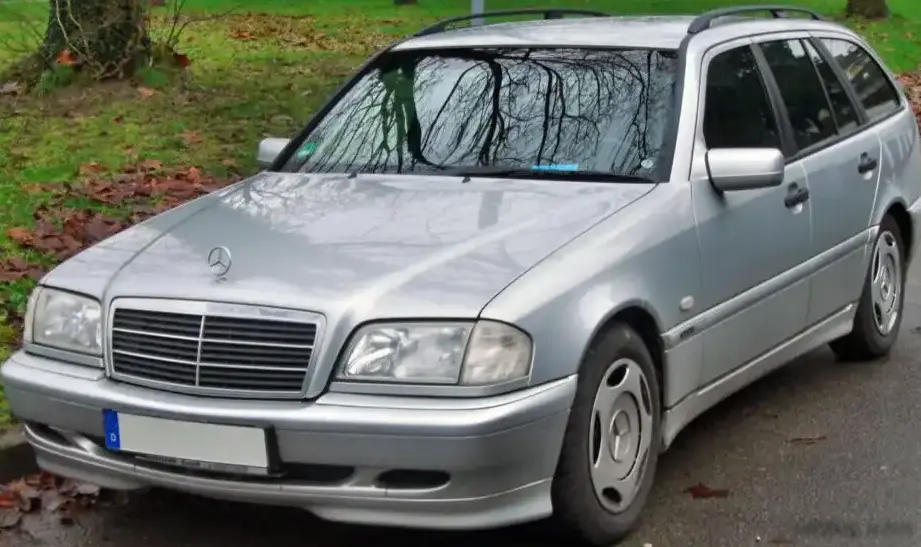
The Mercedes-Benz C-Class T-modell C 220 CDI, produced from May 1997 to January 2001, represents a significant iteration of the S202 series, specifically the facelifted version. This variant combined the practicality of a station wagon (estate) body style with a fuel-efficient and torquey diesel engine, paired with a five-speed automatic transmission. Positioned as a mid-range offering within the C-Class T-modell lineup, it catered to buyers seeking a balance between economy, comfort, and cargo capacity. The C 220 CDI was a key model in the European market, where diesel engines were – and continue to be – highly favored for their efficiency and suitability for long-distance driving.
| Brand | Mercedes-Benz |
| Model | C-Class |
| Generation | C-Class T-modell (S202, facelift 1997) |
| Type (Engine) | C 220 CDI (125 Hp) 5G-TRONIC |
| Start of production | May, 1997 |
| End of production | January, 2001 |
| Powertrain Architecture | Internal Combustion engine |
| Body type | Station wagon (estate) |
| Seats | 5 |
| Doors | 5 |
| Fuel consumption (urban) | 9.4 l/100 km (25 US mpg, 30.1 UK mpg, 10.6 km/l) |
| Fuel consumption (extra urban) | 5.3 l/100 km (44.4 US mpg, 53.3 UK mpg, 18.9 km/l) |
| Fuel consumption (combined) | 6.8 l/100 km (34.6 US mpg, 41.5 UK mpg, 14.7 km/l) |
| Fuel Type | Diesel |
| Acceleration 0 – 100 km/h | 11.3 sec |
| Acceleration 0 – 62 mph | 11.3 sec |
| Acceleration 0 – 60 mph | 10.7 sec |
| Maximum speed | 192 km/h (119.3 mph) |
| Weight-to-power ratio | 11.7 kg/Hp, 85.6 Hp/tonne |
| Weight-to-torque ratio | 4.9 kg/Nm, 205.5 Nm/tonne |
| Power | 125 Hp @ 4200 rpm |
| Power per litre | 58.2 Hp/l |
| Torque | 300 Nm @ 1800-2600 rpm (221.27 lb.-ft. @ 1800-2600 rpm) |
| Engine layout | Front, Longitudinal |
| Engine Model/Code | OM 611 DE 22 LA/611.960 |
| Engine displacement | 2148 cm3 (131.08 cu. in.) |
| Number of cylinders | 4 |
| Engine configuration | Inline |
| Cylinder Bore | 88 mm (3.46 in.) |
| Piston Stroke | 88.4 mm (3.48 in.) |
| Compression ratio | 19:1 |
| Number of valves per cylinder | 4 |
| Fuel injection system | Diesel Commonrail |
| Engine aspiration | Turbocharger, Intercooler |
| Valvetrain | DOHC |
| Engine oil capacity | 6 l (6.34 US qt | 5.28 UK qt) |
| Coolant | 8 l (8.45 US qt | 7.04 UK qt) |
| Kerb Weight | 1460 kg (3218.75 lbs.) |
| Max. weight | 1970 kg (4343.11 lbs.) |
| Max load | 510 kg (1124.36 lbs.) |
| Trunk (boot) space – minimum | 465 l (16.42 cu. ft.) |
| Trunk (boot) space – maximum | 1510 l (53.33 cu. ft.) |
| Fuel tank capacity | 65 l (17.17 US gal | 14.3 UK gal) |
| Length | 4516 mm (177.8 in.) |
| Width | 1723 mm (67.83 in.) |
| Height | 1460 mm (57.48 in.) |
| Wheelbase | 2690 mm (105.91 in.) |
| Front track | 1499 mm (59.02 in.) |
| Rear (Back) track | 1464 mm (57.64 in.) |
| Drag coefficient (Cd) | 0.33 |
| Drivetrain Architecture | The Internal combustion engine (ICE) drives the rear wheels of the vehicle. |
| Drive wheel | Rear wheel drive |
| Number of gears and type of gearbox | 5 gears, automatic transmission |
| Front suspension | Double wishbone |
| Rear suspension | Independent multi-link spring suspension with stabilizer |
| Front brakes | Ventilated discs |
| Rear brakes | Disc |
| Assisting systems | ABS (Anti-lock braking system) |
| Steering type | Steering rack and pinion |
| Power steering | Hydraulic Steering |
| Tires size | 195/65 R15 |
| Wheel rims size | 6.5J x 15 |
Powertrain & Engine Architecture
The C 220 CDI was powered by the OM 611 DE 22 LA engine, a 2.2-liter inline-four cylinder diesel. This engine was a cornerstone of Mercedes-Benz’s diesel offerings during the late 1990s and early 2000s. The ‘DE’ designation indicated a direct-injection diesel engine, while the ‘22’ signified its approximate displacement in tenths of a liter. The OM 611 featured a robust cast iron block and aluminum cylinder head, a common configuration for durability. Crucially, this engine utilized a second-generation common rail direct injection system, delivering fuel at extremely high pressures for improved combustion efficiency and reduced noise. A turbocharger with an intercooler further enhanced performance, boosting power output to 125 horsepower and 300 Nm (221 lb-ft) of torque. The 5G-TRONIC automatic transmission, a five-speed unit, was specifically tuned to complement the engine’s torque curve, providing smooth and relatively quick shifts. This transmission was known for its adaptability and contributed to the C 220 CDI’s comfortable driving experience.
Driving Characteristics
The C 220 CDI Automatic offered a distinctly different driving experience compared to its gasoline-powered siblings or even the manual diesel variants. While not a performance-oriented model, the 300 Nm of torque available from 1800-2600 rpm provided ample pulling power for everyday driving and overtaking maneuvers. The automatic transmission, while smooth, did result in a slight reduction in acceleration compared to the manual version (0-60 mph in approximately 10.7 seconds). The gear ratios were optimized for fuel efficiency and relaxed cruising, rather than outright speed. The rear-wheel drive configuration provided a balanced feel, although it could be less forgiving in slippery conditions compared to all-wheel drive options available on other C-Class models. Overall, the C 220 CDI prioritized comfort and fuel economy, making it an ideal choice for long-distance travel.
Equipment & Trim Levels
The C 220 CDI T-modell typically came equipped with a respectable level of standard features. These included power windows, central locking, air conditioning, and an AM/FM radio. Interior upholstery was generally cloth, although leather options were available as upgrades. The dashboard layout was typical of Mercedes-Benz at the time, featuring a functional and understated design. Optional extras included a sunroof, upgraded audio systems, heated seats, and automatic climate control. The wood trim was a popular option, adding a touch of luxury to the interior. Safety features such as ABS (Anti-lock Braking System) and airbags were standard.
Chassis & Braking
The S202 C-Class T-modell utilized a double wishbone front suspension and an independent multi-link rear suspension, providing a comfortable and controlled ride. Stabilizer bars were fitted to both axles to reduce body roll during cornering. The C 220 CDI, being a mid-range model, typically featured ventilated disc brakes at the front and solid disc brakes at the rear. The braking system was effective, aided by the ABS system. The suspension was tuned to prioritize comfort, but it still offered reasonable handling characteristics for a station wagon.
Market Reception & Comparison
The C 220 CDI T-modell was generally well-received by automotive critics, particularly for its fuel efficiency and practicality. It was often praised for its comfortable ride and spacious interior. Compared to the higher-performance C 280 or C 36 AMG models, the C 220 CDI offered significantly better fuel economy, making it a more sensible choice for drivers covering long distances. Against other diesel-powered station wagons of the era, such as the BMW 3 Series Touring and Audi A4 Avant, the C 220 CDI held its own in terms of refinement and build quality. However, some critics noted that the automatic transmission could feel slightly sluggish at times. Reliability was generally good, although preventative maintenance was crucial to ensure the longevity of the diesel engine and fuel injection system.
Legacy
The OM 611 engine family, including the version found in the C 220 CDI, proved to be remarkably durable. Many examples have surpassed 200,000 miles with proper maintenance. Today, the C 220 CDI T-modell is a relatively affordable and practical classic car. While not a collector’s item, it remains a popular choice for those seeking a comfortable, fuel-efficient, and reliable station wagon. The availability of spare parts is generally good, and the relatively simple mechanical design makes it accessible to home mechanics. The C 220 CDI represents a significant step forward in diesel technology, showcasing Mercedes-Benz’s commitment to efficiency and refinement.