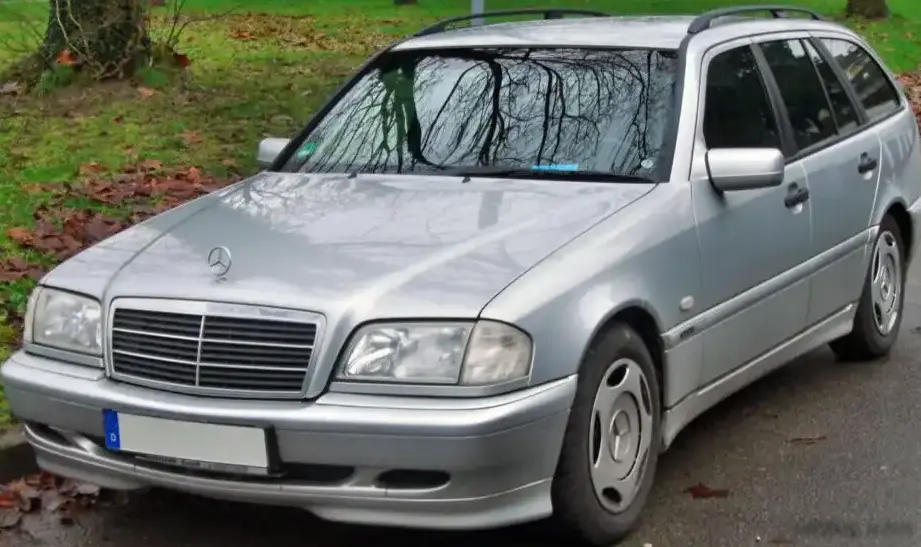
The Mercedes-Benz C-Class T-modell (S202) facelift C 230 Kompressor, produced from June 1997 to June 2000, represented a significant step forward in the compact executive estate segment. Positioned as a mid-range offering within the S202 series, it combined practicality with a performance edge thanks to its supercharged engine. This variant aimed to appeal to buyers seeking a versatile vehicle capable of both family duties and spirited driving. The S202 platform, a successor to the W202, offered improved refinement and space compared to its predecessor, and the C 230 Kompressor capitalized on these improvements with added power and a more sophisticated driving experience.
Technical Specifications
| Brand | Mercedes-Benz |
| Model | C-Class |
| Generation | C-Class T-modell (S202, facelift 1997) |
| Type (Engine) | C 230 Kompressor (193 Hp) |
| Start of production | June, 1997 |
| End of production | June, 2000 |
| Powertrain Architecture | Internal Combustion engine |
| Body type | Station wagon (estate) |
| Seats | 5 |
| Doors | 5 |
| Fuel consumption (urban) | 11.2 l/100 km (21 US mpg, 25.2 UK mpg, 8.9 km/l) |
| Fuel consumption (extra urban) | 6.1 l/100 km (38.6 US mpg, 46.3 UK mpg, 16.4 km/l) |
| Fuel Type | Petrol (Gasoline) |
| Acceleration 0 – 100 km/h | 8.5 sec |
| Acceleration 0 – 62 mph | 8.5 sec |
| Acceleration 0 – 60 mph | 8.1 sec |
| Maximum speed | 226 km/h (140.43 mph) |
| Weight-to-power ratio | 7.8 kg/Hp, 128.7 Hp/tonne |
| Weight-to-torque ratio | 5.4 kg/Nm, 186.7 Nm/tonne |
| Power | 193 Hp @ 5300 rpm |
| Power per litre | 84.1 Hp/l |
| Torque | 280 Nm @ 2500-4800 rpm (206.52 lb.-ft. @ 2500-4800 rpm) |
| Engine layout | Front, Longitudinal |
| Engine Model/Code | M 111 E 23/111.974 |
| Engine displacement | 2295 cm3 (140.05 cu. in.) |
| Number of cylinders | 4 |
| Engine configuration | Inline |
| Cylinder Bore | 90.9 mm (3.58 in.) |
| Piston Stroke | 88.4 mm (3.48 in.) |
| Compression ratio | 8.8:1 |
| Number of valves per cylinder | 4 |
| Fuel injection system | Multi-port manifold injection |
| Engine aspiration | Supercharger, Intercooler |
| Valvetrain | DOHC |
| Engine oil capacity | 5.5 l (5.81 US qt | 4.84 UK qt) |
| Coolant | 8.5 l (8.98 US qt | 7.48 UK qt) |
| Kerb Weight | 1500 kg (3306.93 lbs.) |
| Max. weight | 1980 kg (4365.15 lbs.) |
| Max load | 480 kg (1058.22 lbs.) |
| Trunk (boot) space – minimum | 465 l (16.42 cu. ft.) |
| Trunk (boot) space – maximum | 1510 l (53.33 cu. ft.) |
| Fuel tank capacity | 62 l (16.38 US gal | 13.64 UK gal) |
| Length | 4516 mm (177.8 in.) |
| Width | 1723 mm (67.83 in.) |
| Height | 1460 mm (57.48 in.) |
| Wheelbase | 2690 mm (105.91 in.) |
| Front track | 1499 mm (59.02 in.) |
| Rear (Back) track | 1464 mm (57.64 in.) |
| Drivetrain Architecture | The Internal combustion engine (ICE) drives the rear wheels of the vehicle. |
| Drive wheel | Rear wheel drive |
| Number of gears and type of gearbox | 5 gears, manual transmission |
| Front suspension | Double wishbone |
| Rear suspension | Independent multi-link spring suspension with stabilizer |
| Front brakes | Ventilated discs |
| Rear brakes | Disc |
| Assisting systems | ABS (Anti-lock braking system) |
| Steering type | Cone worm with recirculation balls |
| Power steering | Hydraulic Steering |
| Tires size | 195/65 R15 |
| Wheel rims size | 6.5J x 15 |
Powertrain & Engine Architecture
The heart of the C 230 Kompressor was the M111 E 23 engine, a 2.3-liter inline-four cylinder powerplant. This engine was notable for its mechanically driven supercharger (Kompressor in Mercedes terminology), which provided a significant boost in power and torque compared to naturally aspirated alternatives. The M111 featured multi-port fuel injection and a double overhead camshaft (DOHC) valvetrain, contributing to its efficient operation. The supercharger, an Eaton Roots-type unit, was electronically controlled and engaged at lower engine speeds to provide instant throttle response and eliminate turbo lag. The engine produced 193 horsepower at 5300 rpm and 280 Nm (206.52 lb-ft) of torque between 2500 and 4800 rpm. The standard transmission was a 5-speed manual, although a 5-speed automatic transmission was also available, albeit with a slight reduction in performance and fuel economy. The engine’s longitudinal mounting and rear-wheel drive configuration were typical of Mercedes-Benz vehicles of this era.
Driving Characteristics
The C 230 Kompressor offered a noticeably more engaging driving experience than its naturally aspirated counterparts. The supercharger delivered strong acceleration from low engine speeds, making it well-suited for both city driving and highway overtaking. While not a sports car, the C 230 Kompressor provided a good balance of performance and comfort. The 5-speed manual transmission allowed for precise control, while the automatic offered convenience. Compared to the C 280, the C 230 Kompressor offered similar performance, but with improved fuel efficiency. The C 230 Kompressor was quicker and more responsive than the base C 220 or C 180 models, making it a popular choice for drivers who wanted a bit more power without sacrificing practicality.
Equipment & Trim Levels
The C 230 Kompressor T-modell typically came equipped with a respectable level of standard features, including power windows, central locking, air conditioning, and an upgraded audio system. Interior upholstery was generally cloth, but leather options were available. Optional extras included a sunroof, heated seats, automatic climate control, and upgraded wheels. The facelifted S202 models (post-1997) featured revised interior trim and updated exterior styling cues, including new headlights and taillights. The dashboard layout was typical of Mercedes-Benz, with a focus on functionality and build quality.
Chassis & Braking
The S202 C-Class featured a double wishbone front suspension and an independent multi-link rear suspension, providing a comfortable and controlled ride. The C 230 Kompressor typically came equipped with ventilated disc brakes at the front and solid disc brakes at the rear. Anti-lock braking system (ABS) was standard. The steering was a recirculating ball system with hydraulic power assistance. The suspension was tuned to provide a balance between comfort and handling, and the chassis felt stable and well-planted in most driving situations.
Market Reception & Comparison
The C 230 Kompressor T-modell was generally well-received by automotive critics. It was praised for its strong performance, comfortable ride, and practical estate car body style. However, some critics noted that the interior, while well-built, was somewhat conservative in its design. Compared to rivals such as the BMW 3 Series Touring and Audi A4 Avant, the C 230 Kompressor offered a more luxurious and refined experience. Fuel economy was competitive for its class, and reliability was generally good, although supercharger maintenance should be considered.
Legacy
The M111 engine, particularly the supercharged variants like the C 230 Kompressor, proved to be a durable and reliable powerplant. While the supercharger does require periodic maintenance (belt replacement, potential for bearing wear), the engine itself is generally robust. Today, the S202 C-Class T-modell C 230 Kompressor remains a popular choice among enthusiasts and collectors. Well-maintained examples are relatively common on the used car market, and parts availability is generally good. The combination of practicality, performance, and Mercedes-Benz build quality has ensured that this variant remains a desirable and respected vehicle.