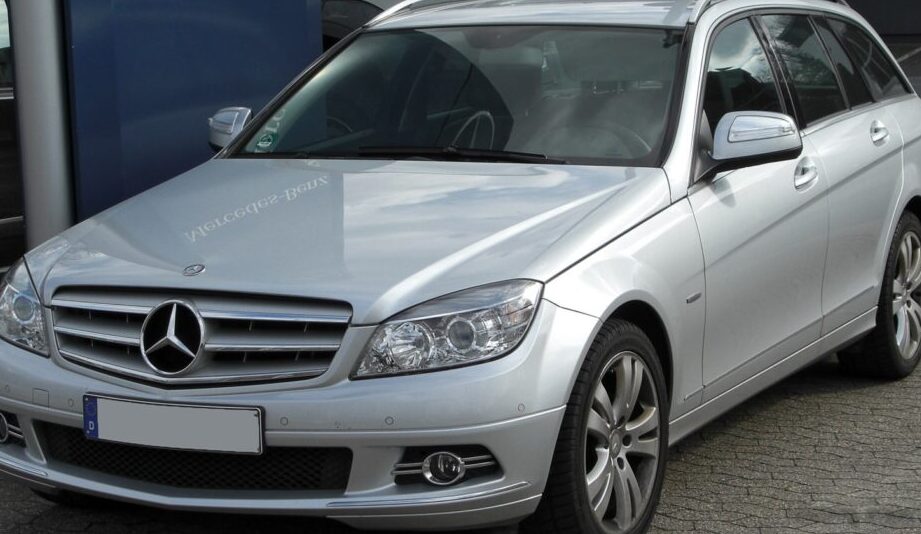
Technical Specifications
| Brand | Mercedes-Benz |
| Model | C-Class |
| Generation | C-Class T-modell (S204) |
| Type (Engine) | C 200 Kompressor (184 Hp) |
| Start of production | 2007 |
| End of production | 2010 |
| Powertrain Architecture | Internal Combustion engine |
| Body type | Station wagon (estate) |
| Seats | 5 |
| Doors | 5 |
| Fuel consumption (urban) | 10.7-10.9 l/100 km (22 – 21.6 US mpg) |
| Fuel consumption (extra urban) | 6-6.2 l/100 km (39.2 – 37.9 US mpg) |
| Fuel consumption (combined) | 7.8-8 l/100 km (30.2 – 29.4 US mpg) |
| CO2 emissions | 184-189 g/km |
| Fuel Type | Petrol (Gasoline) |
| Acceleration 0 – 100 km/h | 8.8 sec |
| Acceleration 0 – 62 mph | 8.8 sec |
| Acceleration 0 – 60 mph | 8.4 sec |
| Maximum speed | 228 km/h (141.67 mph) |
| Emission standard | Euro 4 |
| Weight-to-power ratio | 8 kg/Hp |
| Weight-to-torque ratio | 5.9 kg/Nm |
| Power | 184 Hp @ 5500 rpm |
| Torque | 250 Nm @ 2800-5000 rpm (184.39 lb.-ft. @ 2800-5000 rpm) |
| Engine layout | Front, Longitudinal |
| Engine Model/Code | M 271.950 |
| Engine displacement | 1796 cm3 (109.6 cu. in.) |
| Number of cylinders | 4 |
| Engine configuration | Inline |
| Cylinder Bore | 82 mm (3.23 in.) |
| Piston Stroke | 85 mm (3.35 in.) |
| Compression ratio | 8.5:1 |
| Number of valves per cylinder | 4 |
| Fuel injection system | Multi-port manifold injection |
| Engine aspiration | Supercharger, Intercooler |
| Valvetrain | DOHC |
| Engine oil capacity | 5.5 l (5.81 US qt | 4.84 UK qt) |
| Kerb Weight | 1465 kg (3229.77 lbs.) |
| Max. weight | 2070 kg (4563.57 lbs.) |
| Max load | 605 kg (1333.8 lbs.) |
| Trunk (boot) space – minimum | 485 l (17.13 cu. ft.) |
| Trunk (boot) space – maximum | 1500 l (52.97 cu. ft.) |
| Fuel tank capacity | 66 l (17.44 US gal | 14.52 UK gal) |
| Permitted trailer load with brakes (12%) | 1800 kg (3968.32 lbs.) |
| Permitted trailer load without brakes | 750 kg (1653.47 lbs.) |
| Length | 4596 mm (180.94 in.) |
| Width | 1770 mm (69.69 in.) |
| Width including mirrors | 2020 mm (79.53 in.) |
| Height | 1459 mm (57.44 in.) |
| Wheelbase | 2760 mm (108.66 in.) |
| Front track | 1541 mm (60.67 in.) |
| Rear track | 1544 mm (60.79 in.) |
| Front overhang | 765 mm (30.12 in.) |
| Rear overhang | 1071 mm (42.17 in.) |
| Minimum turning circle | 10.84 m (35.56 ft.) |
| Drivetrain | Rear wheel drive |
| Number of gears | 6 |
| Gearbox type | Manual transmission |
| Front suspension | Independent type McPherson, Transverse stabilizer |
| Rear suspension | Independent multi-link suspension, Transverse stabilizer |
| Front brakes | Ventilated discs |
| Rear brakes | Disc |
| Assisting systems | ABS (Anti-lock braking system) |
| Steering type | Steering rack and pinion |
| Power steering | Hydraulic Steering |
| Tires size | 205/55 R16 |
| Wheel rims size | 7J x 16 |
The Mercedes-Benz C-Class T-modell (S204) C 200 Kompressor, produced from 2007 to 2010, represents a compelling blend of practicality and performance within the compact executive estate (wagon) segment. Positioned as a mid-range offering in the S204 series, which spanned from 2007-2014, the C 200 Kompressor aimed to provide a balance between affordability, fuel efficiency, and the prestige associated with the Mercedes-Benz brand. It served as a popular choice for families and individuals seeking a versatile vehicle with a more engaging driving experience than the diesel-powered alternatives prevalent in the European market. This variant was primarily sold in Europe, where the estate body style enjoys significant popularity.
Powertrain & Engine Architecture
At the heart of the C 200 Kompressor lies the M271.950 1.8-liter inline-four cylinder engine. This engine is notable for its all-aluminum construction, contributing to weight savings and improved thermal efficiency. The M271 utilizes a Lysholm-type twin-screw supercharger, providing forced induction to boost power output. The supercharger is belt-driven by the engine and delivers boost across a broad RPM range, minimizing turbo lag. Fuel delivery is managed by a multi-port fuel injection system, and the engine features a double overhead camshaft (DOHC) valvetrain with four valves per cylinder. The engine’s electronic engine management system carefully controls fuel injection, ignition timing, and supercharger boost to optimize performance and emissions. The standard transmission for this variant was a 6-speed manual, though a 5-speed automatic transmission was also available, and often preferred by buyers seeking greater convenience.
Driving Characteristics
The C 200 Kompressor T-modell, particularly when equipped with the manual transmission, offered a reasonably engaging driving experience. The supercharger provides a noticeable surge of power in the lower and mid-range, making it feel more responsive than naturally aspirated engines of similar displacement. Acceleration from 0-60 mph took around 8.4-8.8 seconds, which was competitive for its class. The automatic transmission, while smooth, did slightly diminish performance due to its less direct power transfer and additional weight. The rear-wheel-drive configuration contributed to balanced handling, although it wasn’t as agile as some of its front-wheel-drive competitors. The steering was precise and well-weighted, providing good feedback to the driver. Overall, the C 200 Kompressor offered a comfortable and refined ride, suitable for both daily commuting and longer journeys.
Equipment & Trim Levels
The C 200 Kompressor T-modell typically came standard with features such as automatic climate control, power windows and mirrors, a multi-function steering wheel, and an audio system with CD player. Upholstery was generally cloth, although leather options were available. Optional extras included a sunroof, navigation system, premium sound system, and parking sensors. Trim levels varied depending on the market, but generally offered packages that added features like upgraded interior trim, alloy wheels, and enhanced safety equipment. The estate body style itself added to the practicality with a spacious cargo area, offering ample room for luggage and other items. The rear seats could be folded down to further increase cargo capacity.
Chassis & Braking
The S204 C-Class T-modell utilized an independent suspension system at all four wheels. The front suspension employed a McPherson strut design, while the rear featured a multi-link setup. This configuration provided a good balance between ride comfort and handling precision. Stabilizer bars were fitted to both the front and rear axles to reduce body roll during cornering. Braking duties were handled by ventilated disc brakes at the front and solid disc brakes at the rear. Anti-lock Braking System (ABS) was standard, enhancing braking performance and stability. The chassis was designed to provide a rigid and stable platform, contributing to the car’s overall handling characteristics.
Market Reception & Comparison
The C 200 Kompressor T-modell was generally well-received by automotive critics. It was praised for its refined engine, comfortable ride, and practical estate body style. However, some critics noted that the interior design was somewhat conservative compared to its rivals. Compared to the C 350, the C 200 Kompressor offered lower running costs and a more accessible price point, but it lacked the higher performance of the larger engine. Against diesel-powered C-Class models, the C 200 Kompressor provided a more engaging driving experience, but typically offered lower fuel economy. Its fuel economy figures of around 30 mpg combined were respectable for its class, but not as high as those achieved by the diesel variants.
Legacy
The M271 engine, found in the C 200 Kompressor, has proven to be a relatively reliable powertrain when properly maintained. Common issues include occasional supercharger failures and oil leaks. However, these are generally not catastrophic and can be addressed with proper servicing. Today, the S204 C-Class T-modell C 200 Kompressor represents a good value proposition in the used car market. It offers a blend of practicality, comfort, and performance at an affordable price. Its relatively simple mechanical design makes it easier and less expensive to maintain compared to more modern vehicles. The C 200 Kompressor remains a popular choice for those seeking a well-built and versatile estate car with the prestige of the Mercedes-Benz badge.