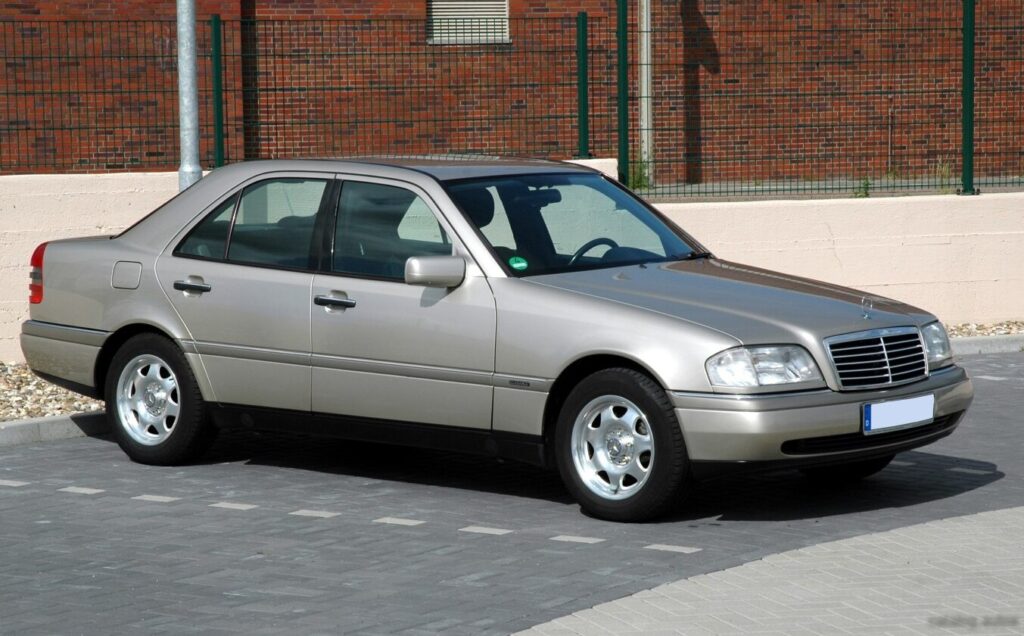
The Mercedes-Benz C 200, equipped with the 5G-TRONIC automatic transmission, was a key variant within the W202 C-Class range produced between August 1996 and June 1997. Positioned as a mid-range offering, it aimed to balance performance and affordability within the compact executive car segment. The W202 represented Mercedes-Benz’s entry into the hotly contested market previously dominated by the BMW 3 Series and Audi A4, and the C 200 Automatic played a significant role in establishing the C-Class as a viable alternative. This model offered a more accessible price point than the higher-performance C 280, while providing a more refined experience than the base C 180.
Technical Specifications
| Brand | Mercedes-Benz |
| Model | C-class |
| Generation | C-class (W202) |
| Type (Engine) | C 200 (136 Hp) 5G-TRONIC |
| Start of production | August, 1996 |
| End of production | June, 1997 |
| Powertrain Architecture | Internal Combustion engine |
| Body type | Sedan |
| Seats | 5 |
| Doors | 4 |
| Fuel consumption (urban) | 11 l/100 km (21.4 US mpg) |
| Fuel consumption (extra urban) | 8 l/100 km (29.4 US mpg) |
| Fuel Type | Petrol (Gasoline) |
| Acceleration 0 – 100 km/h | 11.5 sec |
| Acceleration 0 – 62 mph | 11.5 sec |
| Acceleration 0 – 60 mph | 10.9 sec |
| Maximum speed | 200 km/h (124.27 mph) |
| Weight-to-power ratio | 10 kg/Hp |
| Weight-to-torque ratio | 7.2 kg/Nm |
| Power | 136 Hp @ 5500 rpm |
| Torque | 190 Nm @ 4000 rpm (140.14 lb.-ft. @ 4000 rpm) |
| Engine layout | Front, Longitudinal |
| Engine Model/Code | M 111 E 20/111.940 |
| Engine displacement | 1998 cm3 (121.93 cu. in.) |
| Number of cylinders | 4 |
| Engine configuration | Inline |
| Cylinder Bore | 89.9 mm (3.54 in.) |
| Piston Stroke | 78.7 mm (3.1 in.) |
| Compression ratio | 9.6:1 |
| Number of valves per cylinder | 4 |
| Fuel injection system | Multi-port manifold injection |
| Engine aspiration | Naturally aspirated engine |
| Valvetrain | DOHC |
| Engine oil capacity | 5.5 l (5.81 US qt | 4.84 UK qt) |
| Coolant | 8.5 l (8.98 US qt | 7.48 UK qt) |
| Kerb Weight | 1365 kg (3009.31 lbs.) |
| Max. weight | 1845 kg (4067.53 lbs.) |
| Max load | 480 kg (1058.22 lbs.) |
| Trunk (boot) space – minimum | 430 l (15.19 cu. ft.) |
| Fuel tank capacity | 62 l (16.38 US gal | 13.64 UK gal) |
| Length | 4487 mm (176.65 in.) |
| Width | 1720 mm (67.72 in.) |
| Height | 1418 mm (55.83 in.) |
| Wheelbase | 2690 mm (105.91 in.) |
| Front track | 1505 mm (59.25 in.) |
| Rear (Back) track | 1476 mm (58.11 in.) |
| Drivetrain Architecture | Rear wheel drive |
| Number of gears and type of gearbox | 5 gears, automatic transmission |
| Front suspension | Double wishbone |
| Rear suspension | Independent multi-link spring suspension with stabilizer |
| Front brakes | Disc |
| Rear brakes | Disc |
| Assisting systems | ABS (Anti-lock braking system) |
| Steering type | Worm-reduction unit |
| Power steering | Hydraulic Steering |
| Tires size | 195/65 R15 |
| Wheel rims size | 6.5J x 15 |
INTRODUCTION
The Mercedes-Benz C 200 5G-TRONIC, introduced in 1996, was a significant addition to the W202 C-Class lineup. The W202, launched in 1993, was Mercedes-Benz’s first foray into the compact executive segment, aiming to attract a younger, more affluent clientele. The C 200 Automatic offered a compelling blend of comfort, refinement, and reasonable performance, making it a popular choice for buyers seeking a premium sedan with the convenience of an automatic transmission. It sat between the entry-level C 180 and the more powerful C 220 and C 280 models, offering a balance of features and price.
Powertrain & Engine Architecture
At the heart of the C 200 was the M111 E 20 engine, a 1.998-liter inline-four cylinder powerplant. This engine, part of Mercedes-Benz’s M111 family, was known for its robust construction and relatively simple design. The engine code 111.940 specifically identifies this variant. It featured multi-port fuel injection, a double overhead camshaft (DOHC) valvetrain with four valves per cylinder, and a compression ratio of 9.6:1. These features contributed to a respectable 136 horsepower at 5500 rpm and 190 Nm (140 lb-ft) of torque at 4000 rpm. The 5G-TRONIC transmission, a five-speed automatic, was a key component of this variant. This transmission was designed for smooth and refined gear changes, prioritizing comfort over outright performance. It featured electronic control for optimized shift points based on driving conditions.
Driving Characteristics
The C 200 Automatic offered a comfortable and refined driving experience, but it wasn’t designed for sporty performance. Acceleration from 0 to 60 mph took around 10.9 seconds, and the top speed was limited to 200 km/h (124 mph). The 5G-TRONIC transmission, while smooth, did result in some power loss compared to the available manual transmission. Gear ratios were tuned for fuel efficiency and relaxed cruising, rather than aggressive acceleration. Compared to the C 220 or C 280, the C 200 felt noticeably less powerful, particularly when overtaking or climbing hills. However, the automatic transmission made it a more accessible and user-friendly option for drivers prioritizing convenience.
Equipment & Trim Levels
The C 200 Automatic typically came standard with features such as power windows, central locking, power steering, and an anti-lock braking system (ABS). Interior upholstery was usually cloth, although leather was available as an option. Dashboard configuration was typical of the W202, with a functional and understated design. Optional extras included a sunroof, upgraded audio system, automatic climate control, and alloy wheels. The level of standard equipment was generally considered competitive for its price point, offering a good balance of comfort and convenience.
Chassis & Braking
The W202 C-Class featured a double wishbone front suspension and an independent multi-link rear suspension, providing a comfortable ride and good handling characteristics. The C 200 typically came equipped with disc brakes on all four wheels, providing adequate stopping power. ABS was standard, enhancing safety and stability during braking. Stabilizer bars were fitted to both the front and rear axles to reduce body roll during cornering. The suspension was tuned for comfort, prioritizing a smooth ride over aggressive handling.
Market Reception & Comparison
The C 200 Automatic was generally well-received by automotive critics as a practical and comfortable compact executive sedan. It was praised for its refinement, build quality, and fuel efficiency. However, some critics noted that its performance was somewhat underwhelming compared to its rivals, particularly the BMW 3 Series and Audi A4. Fuel economy was respectable for the time, averaging around 21.4 mpg in the city and 29.4 mpg on the highway. Compared to the C 180, the C 200 offered a noticeable performance improvement, while remaining more affordable than the C 220 and C 280. Reliability was generally good, although some owners reported issues with the automatic transmission over the long term.
Legacy
The W202 C 200 Automatic, while not the most powerful or sporty variant in the C-Class lineup, remains a popular choice among enthusiasts and collectors. The M111 engine is known for its durability and relatively simple maintenance requirements. The 5G-TRONIC transmission, while occasionally prone to issues, can provide years of reliable service with proper maintenance. Today, well-maintained examples of the C 200 Automatic are becoming increasingly sought after as classic Mercedes-Benz vehicles, offering a blend of German engineering, comfort, and affordability. Its position as a mid-range offering made it a relatively common model, meaning parts availability is generally good, contributing to its continued appeal in the used car market.