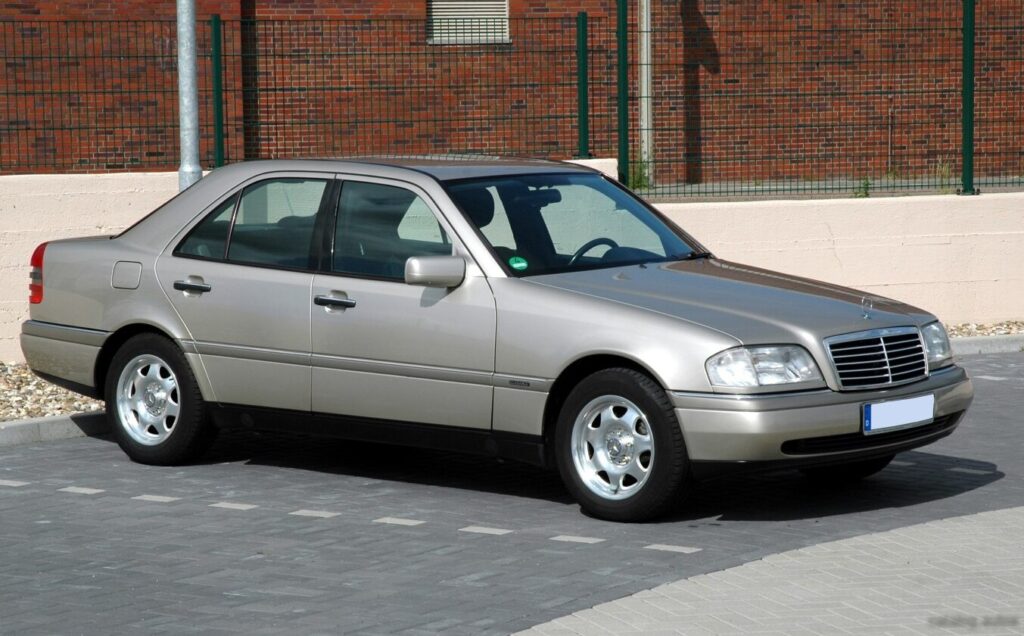
The Mercedes-Benz C 200 D (W202), produced from August 1992 to October 1995, represented the entry point into the first-generation C-Class range. Positioned as a fuel-efficient and practical sedan, it was primarily aimed at European markets where diesel engines held significant popularity. This variant combined a 2.0-liter diesel engine with a four-speed 4G-TRONIC automatic transmission, offering a comfortable, if not particularly sporty, driving experience. The W202 C-Class was a pivotal model for Mercedes-Benz, replacing the long-running W124 series and introducing a more compact and modern offering in the premium compact segment.
Technical Specifications
| Brand | Mercedes-Benz |
| Model | C-class |
| Generation | C-class (W202) |
| Type (Engine) | C 200 D (75 Hp) 4G-TRONIC |
| Start of production | August, 1992 |
| End of production | October, 1995 |
| Powertrain Architecture | Internal Combustion engine |
| Body type | Sedan |
| Seats | 5 |
| Doors | 4 |
| Fuel consumption (urban) | 7.6 l/100 km (30.9 US mpg) |
| Fuel consumption (extra urban) | 5.6 l/100 km (42 US mpg) |
| Fuel Type | Diesel |
| Acceleration 0 – 100 km/h | 21.1 sec |
| Acceleration 0 – 62 mph | 21.1 sec |
| Acceleration 0 – 60 mph | 20 sec |
| Maximum speed | 157 km/h (97.56 mph) |
| Weight-to-power ratio | 18.4 kg/Hp |
| Weight-to-torque ratio | 10.6 kg/Nm |
| Power | 75 Hp @ 4600 rpm |
| Torque | 130 Nm @ 2000 rpm (95.88 lb.-ft. @ 2000 rpm) |
| Engine layout | Front, Longitudinal |
| Engine Model/Code | OM 601 D 20 / 601.913 |
| Engine displacement | 1997 cm3 (121.86 cu. in.) |
| Number of cylinders | 4 |
| Engine configuration | Inline |
| Cylinder Bore | 87 mm (3.43 in.) |
| Piston Stroke | 84 mm (3.31 in.) |
| Compression ratio | 22:1 |
| Number of valves per cylinder | 4 |
| Fuel injection system | Precombustion chamber injection |
| Engine aspiration | Naturally aspirated engine |
| Valvetrain | SOHC |
| Engine oil capacity | 6 l (6.34 US qt | 5.28 UK qt) |
| Coolant | 8 l (8.45 US qt | 7.04 UK qt) |
| Kerb Weight | 1380 kg (3042.38 lbs.) |
| Max. weight | 1860 kg (4100.6 lbs.) |
| Max load | 480 kg (1058.22 lbs.) |
| Trunk (boot) space – minimum | 430 l (15.19 cu. ft.) |
| Fuel tank capacity | 62 l (16.38 US gal | 13.64 UK gal) |
| Length | 4487 mm (176.65 in.) |
| Width | 1720 mm (67.72 in.) |
| Height | 1414 mm (55.67 in.) |
| Wheelbase | 2690 mm (105.91 in.) |
| Front track | 1505 mm (59.25 in.) |
| Rear (Back) track | 1476 mm (58.11 in.) |
| Drivetrain Architecture | The Internal combustion engine (ICE) drives the rear wheels of the vehicle. |
| Drive wheel | Rear wheel drive |
| Number of gears and type of gearbox | 4 gears, automatic transmission G-TRONIC |
| Front suspension | Double wishbone |
| Rear suspension | Independent multi-link spring suspension with stabilizer |
| Front brakes | Disc |
| Rear brakes | Disc |
| Assisting systems | ABS (Anti-lock braking system) |
| Steering type | Worm-reduction unit |
| Power steering | Hydraulic Steering |
| Tires size | 185/70 R15 |
| Wheel rims size | 6J x 15 |
Powertrain & Engine Architecture
The C 200 D was powered by the OM 601 D 20 engine, a 1.997-liter inline-four cylinder diesel. This engine utilized precombustion chamber injection, a common technology for diesel engines of the era, which improved combustion efficiency and reduced engine noise compared to direct injection systems. The OM601 series was known for its robustness and relatively simple design. The engine produced 75 horsepower at 4600 rpm and 130 Nm (95.88 lb-ft) of torque at 2000 rpm. The 4G-TRONIC automatic transmission was a four-speed unit, offering smooth but not particularly quick shifts. It was a conventional hydraulic automatic, lacking the electronic controls found in later transmissions. The engine was mounted longitudinally in the engine bay, driving the rear wheels.
Driving Characteristics
The C 200 D Automatic offered a comfortable and relaxed driving experience. Acceleration was modest, with a 0-60 mph time of around 20 seconds and a top speed of 97.56 mph. Compared to the more powerful C 220 or C 280 models, the C 200 D felt significantly slower. The automatic transmission, while convenient, contributed to this lack of urgency. Gear ratios were optimized for fuel economy rather than performance. The relatively low horsepower and torque figures meant that overtaking required careful planning. However, the engine provided adequate power for everyday driving, particularly in urban environments. The rear-wheel drive configuration provided balanced handling, although it wasn’t particularly engaging for enthusiastic drivers.
Equipment & Trim Levels
The C 200 D typically came with a fairly basic level of equipment. Standard features included power steering, central locking, and cloth upholstery. Air conditioning was often an optional extra, as were features like power windows and a sunroof. Interior trim was generally functional and understated, reflecting the car’s positioning as an entry-level model. The dashboard layout was typical of Mercedes-Benz at the time, with a clear and logical arrangement of controls. Optional extras could significantly enhance the comfort and convenience of the C 200 D, but they added to the overall cost.
Chassis & Braking
The W202 C-Class featured a double wishbone front suspension and an independent multi-link rear suspension, providing a comfortable ride and good handling characteristics. The C 200 D typically came equipped with disc brakes on all four wheels, along with an Anti-lock Braking System (ABS) as standard. Stabilizer bars were fitted to both the front and rear axles to reduce body roll during cornering. The suspension was tuned for comfort, prioritizing ride quality over sporty handling. The relatively lightweight nature of the C 200 D, compared to higher-spec models, helped to mitigate the effects of the lower engine output.
Market Reception & Comparison
The C 200 D was generally well-received in markets where diesel cars were popular, particularly in Europe. Critics praised its fuel economy and reliability, but noted its lack of performance. Compared to the C 220 diesel, which offered more power, the C 200 D was seen as a more affordable option for budget-conscious buyers. Against gasoline-powered C-Class models, the C 200 D offered significantly better fuel economy but lacked the refinement and performance of its petrol counterparts. The C 200 D’s main competitors included the BMW 318d and the Audi 80 1.9 TDI.
Legacy
The OM 601 engine, found in the C 200 D, is known for its durability and longevity. Many examples of this engine are still in service today, having covered significant mileage. The 4G-TRONIC automatic transmission, while not as sophisticated as modern automatics, is also generally reliable. In the used car market, the C 200 D is often seen as a practical and affordable option for those seeking a classic Mercedes-Benz. However, potential buyers should be aware of the age-related issues common to all W202 models, such as rust and wear and tear on suspension components. The C 200 D represents a significant step in Mercedes-Benz’s history, marking the transition to a more compact and modern range of vehicles.