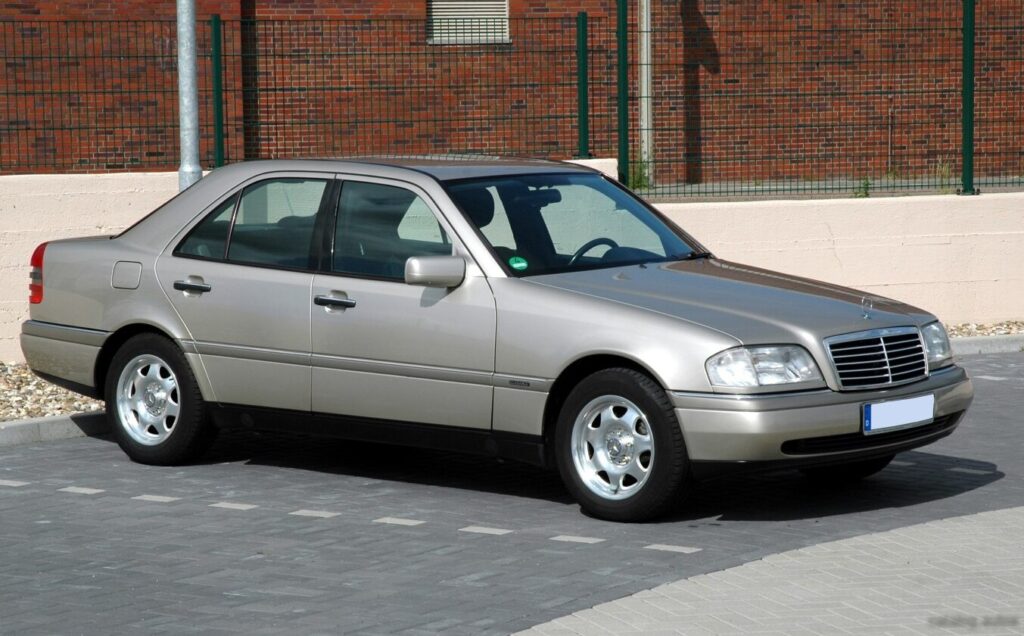
The Mercedes-Benz C 200 D, produced between April 1996 and June 1997, was a key variant within the W202 C-Class range. Positioned as an entry-level diesel offering, it aimed to provide fuel efficiency and practicality to buyers seeking the prestige of the Mercedes-Benz brand. This model occupied a specific niche, appealing to those prioritizing economy over outright performance within the broader C-Class lineup, which also included gasoline-powered variants like the C 180, C 220, and the performance-oriented C 280 and C 36 AMG. The C 200 D was primarily sold in Europe, where diesel engines held a significant market share, and represented Mercedes-Benz’s attempt to capture a larger segment of the compact executive car market.
Technical Specifications
| Brand | Mercedes-Benz |
| Model | C-class |
| Generation | C-class (W202) |
| Type (Engine) | C 200 D (88 Hp) |
| Start of production | April, 1996 |
| End of production | June, 1997 |
| Powertrain Architecture | Internal Combustion engine |
| Body type | Sedan |
| Seats | 5 |
| Doors | 4 |
| Fuel consumption (urban) | 10.2 l/100 km (23.1 US mpg, 27.7 UK mpg, 9.8 km/l) |
| Fuel consumption (extra urban) | 5.8 l/100 km (40.6 US mpg, 48.7 UK mpg, 17.2 km/l) |
| Fuel consumption (combined) | 7.4 l/100 km (31.8 US mpg, 38.2 UK mpg, 13.5 km/l) |
| Fuel Type | Diesel |
| Maximum speed | 172 km/h (106.88 mph) |
| Weight-to-power ratio | 15.8 kg/Hp, 63.3 Hp/tonne |
| Weight-to-torque ratio | 10.3 kg/Nm, 97.1 Nm/tonne |
| Power | 88 Hp @ 5000 rpm |
| Power per litre | 44.1 Hp/l |
| Torque | 135 Nm @ 2000-4650 rpm (99.57 lb.-ft. @ 2000-4650 rpm) |
| Engine layout | Front, Longitudinal |
| Engine Model/Code | OM 604 D 20 / 604.915 |
| Engine displacement | 1997 cm3 (121.86 cu. in.) |
| Number of cylinders | 4 |
| Engine configuration | Inline |
| Cylinder Bore | 87 mm (3.43 in.) |
| Piston Stroke | 84 mm (3.31 in.) |
| Compression ratio | 22:1 |
| Number of valves per cylinder | 4 |
| Fuel injection system | Precombustion chamber injection |
| Engine aspiration | Naturally aspirated engine |
| Valvetrain | DOHC |
| Engine oil capacity | 6.5 l (6.87 US qt | 5.72 UK qt) |
| Coolant | 8 l (8.45 US qt | 7.04 UK qt) |
| Kerb Weight | 1390 kg (3064.43 lbs.) |
| Max. weight | 1870 kg (4122.64 lbs.) |
| Max load | 480 kg (1058.22 lbs.) |
| Fuel tank capacity | 62 l (16.38 US gal | 13.64 UK gal) |
| Length | 4487 mm (176.65 in.) |
| Width | 1720 mm (67.72 in.) |
| Height | 1427 mm (56.18 in.) |
| Wheelbase | 2690 mm (105.91 in.) |
| Front track | 1499 mm (59.02 in.) |
| Rear track | 1464 mm (57.64 in.) |
| Drivetrain Architecture | The Internal combustion engine (ICE) drives the rear wheels of the vehicle. |
| Drive wheel | Rear wheel drive |
| Number of gears and type of gearbox | 5 gears, manual transmission |
| Front suspension | Double wishbone |
| Rear suspension | Independent multi-link spring suspension with stabilizer |
| Front brakes | Disc |
| Rear brakes | Disc |
| Steering type | Cone worm with recirculation balls |
| Power steering | Hydraulic Steering |
| Tires size | Front wheel tires: 195/65 R15Rear wheel tires: 195/65 R15 |
| Wheel rims size | Front wheel rims: 6.5J x 15Rear wheel rims: 6.5J x 15 |
Powertrain & Engine Architecture
The C 200 D was powered by the OM 604 D 20 engine, a 2.0-liter inline-four cylinder diesel. This engine, designated with the code 604.915, was a significant step forward for Mercedes-Benz in diesel technology. It featured precombustion chamber injection, a system where fuel is partially combusted in a small chamber before entering the main cylinder, promoting more complete combustion and reducing noise. The engine utilized a double overhead camshaft (DOHC) valvetrain, operating four valves per cylinder, which contributed to improved breathing and efficiency. The 88 horsepower output was achieved at 5000 rpm, while peak torque of 135 Nm (99.57 lb-ft) was available between 2000 and 4650 rpm. The engine’s relatively high compression ratio of 22:1 was typical for diesel engines of the era, maximizing efficiency. The five-speed manual transmission was standard, providing a balance between fuel economy and drivability.
Driving Characteristics
The C 200 D, with its 88 horsepower and 135 Nm of torque, offered modest performance. Acceleration was not its strong suit, with a 0-60 mph time estimated around 12-13 seconds. However, the engine’s torque delivery provided adequate pulling power for everyday driving situations. The manual transmission allowed for precise control, but the gear ratios were geared towards fuel efficiency rather than spirited acceleration. Compared to the more powerful C 220 or C 280 gasoline models, the C 200 D felt noticeably slower. However, it offered significantly better fuel economy, making it a practical choice for drivers covering long distances. The rear-wheel drive configuration provided a balanced driving experience, typical of Mercedes-Benz sedans of the time.
Equipment & Trim Levels
The C 200 D typically came with a fairly basic level of equipment, reflecting its position as the entry-level model. Standard features included power steering, central locking, and cloth upholstery. Air conditioning was often an optional extra, as were features like power windows and a sunroof. The interior design was functional and understated, typical of Mercedes-Benz interiors of the 1990s. Trim levels were relatively limited, with most C 200 D models featuring a similar specification. Optional extras allowed buyers to personalize their vehicles, but the focus remained on providing a practical and reliable vehicle at an accessible price point.
Chassis & Braking
The W202 C-Class featured a robust chassis with a double wishbone front suspension and an independent multi-link rear suspension. This setup provided a comfortable ride and good handling characteristics. The C 200 D, being a lighter variant, benefited from this well-engineered suspension. Braking was handled by disc brakes on all four wheels, providing adequate stopping power. The hydraulic power steering offered a good balance between assistance and feedback. Stabilizer bars were fitted to both the front and rear axles, reducing body roll during cornering.
Market Reception & Comparison
The C 200 D was generally well-received in European markets, where diesel engines were popular. Critics praised its fuel efficiency and reliability, but noted its modest performance. Compared to the gasoline-powered C-Class models, the C 200 D offered a lower purchase price and significantly better fuel economy. However, it lacked the refinement and performance of its gasoline counterparts. Against competitors like the BMW 318d and Audi A4 TDI, the C 200 D offered a comparable level of fuel efficiency and practicality, with the Mercedes-Benz badge providing a perceived advantage in terms of prestige and build quality.
Legacy
The OM 604 engine family, including the 604.915 found in the C 200 D, is known for its durability and longevity. These engines, when properly maintained, can accumulate very high mileage. Today, the C 200 D is a relatively rare sight, but well-maintained examples are sought after by enthusiasts who appreciate their simplicity and reliability. The C 200 D represents a transitional period for Mercedes-Benz, bridging the gap between older, more mechanically complex designs and the more technologically advanced models that followed. Its enduring reputation for reliability ensures its continued presence on the roads, and it remains a testament to Mercedes-Benz’s engineering prowess.