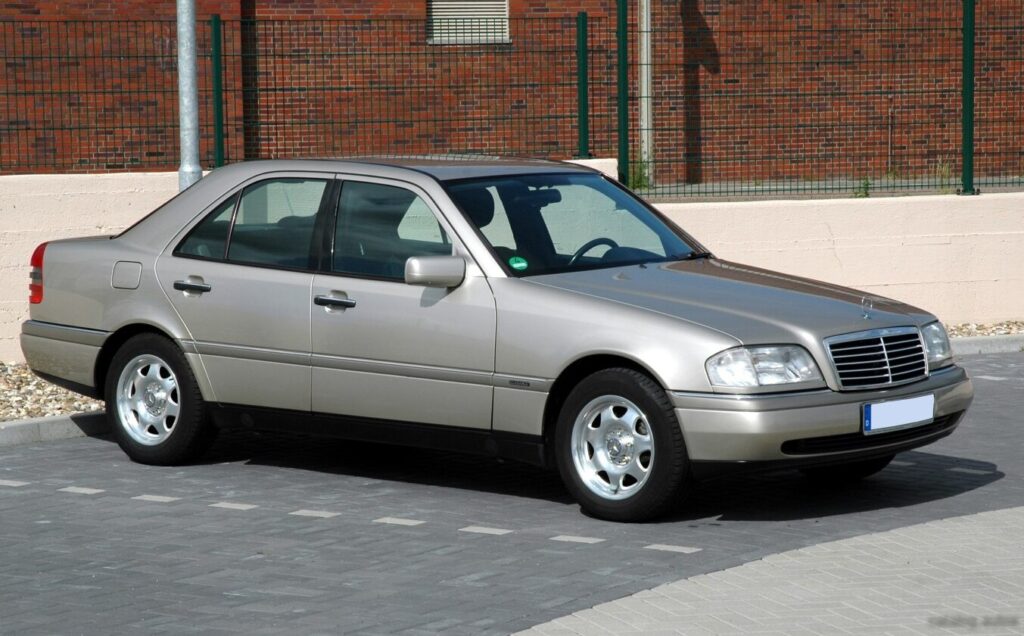
The Mercedes-Benz C 200 Kompressor, produced between September 1995 and August 1996, was a pivotal variant within the W202 C-Class range. Representing a substantial upgrade over the base C 180, the C 200 Kompressor introduced forced induction to the compact executive segment for Mercedes-Benz. This model occupied a mid-range position in the W202 lineup, striking a balance between performance and affordability, positioned below the more powerful C 220 and C 280 models. It primarily targeted buyers desiring a more engaging driving experience than the entry-level C 180, without incurring the higher cost of the larger-engined options.
Technical Specifications
| Brand | Mercedes-Benz |
| Model | C-class |
| Generation | C-class (W202) |
| Type (Engine) | C 200 Kompressor (180 Hp) |
| Start of production | September, 1995 |
| End of production | August, 1996 |
| Powertrain Architecture | Internal Combustion engine |
| Body type | Sedan |
| Seats | 5 |
| Doors | 4 |
| Fuel consumption (urban) | 10.6 l/100 km (22.2 US mpg) |
| Fuel consumption (extra urban) | 6 l/100 km (39.2 US mpg) |
| Fuel Type | Petrol (Gasoline) |
| Acceleration 0 – 100 km/h | 8.8 sec |
| Acceleration 0 – 62 mph | 8.8 sec |
| Acceleration 0 – 60 mph | 8.4 sec |
| Maximum speed | 225 km/h (139.81 mph) |
| Weight-to-power ratio | 7.8 kg/Hp |
| Weight-to-torque ratio | 5.6 kg/Nm |
| Power | 180 Hp @ 5400 rpm |
| Power per litre | 90.1 Hp/l |
| Torque | 250 Nm @ 2550 rpm (184.39 lb.-ft. @ 2550 rpm) |
| Engine layout | Front, Longitudinal |
| Engine Model/Code | M 111 E 20 ML / 111.944 |
| Engine displacement | 1998 cm3 (121.93 cu. in.) |
| Number of cylinders | 4 |
| Engine configuration | Inline |
| Cylinder Bore | 89.9 mm (3.54 in.) |
| Piston Stroke | 78.7 mm (3.1 in.) |
| Compression ratio | 8.5:1 |
| Number of valves per cylinder | 4 |
| Fuel injection system | Multi-port manifold injection |
| Engine aspiration | Supercharger, Intercooler |
| Valvetrain | DOHC |
| Engine oil capacity | 5.5 l (5.81 US qt | 4.84 UK qt) |
| Coolant | 8.5 l (8.98 US qt | 7.48 UK qt) |
| Kerb Weight | 1410 kg (3108.52 lbs.) |
| Max. weight | 1890 kg (4166.74 lbs.) |
| Max load | 480 kg (1058.22 lbs.) |
| Fuel tank capacity | 62 l (16.38 US gal | 13.64 UK gal) |
| Length | 4487 mm (176.65 in.) |
| Width | 1720 mm (67.72 in.) |
| Height | 1427 mm (56.18 in.) |
| Wheelbase | 2690 mm (105.91 in.) |
| Front track | 1499 mm (59.02 in.) |
| Rear track | 1464 mm (57.64 in.) |
| Drivetrain Architecture | Rear wheel drive |
| Number of gears | 5 gears, manual transmission |
| Front suspension | Double wishbone |
| Rear suspension | Independent multi-link spring suspension with stabilizer |
| Front brakes | Ventilated discs |
| Rear brakes | Disc |
| Assisting systems | ABS (Anti-lock braking system) |
| Steering type | Cone worm with recirculation balls |
| Power steering | Hydraulic Steering |
| Tires size | 195/65 R16 |
| Wheel rims size | 6.5J x 15 |
Powertrain & Engine Architecture
The core of the C 200 Kompressor was the M111 E 20 ML engine, a 1.998-liter inline-four cylinder powerplant. The defining feature of this engine was the addition of a mechanically driven supercharger (branded as “Kompressor” by Mercedes-Benz) and an intercooler. This setup increased air intake, resulting in a power output of 180 horsepower at 5400 rpm and 250 Nm (184 lb-ft) of torque at 2550 rpm. The engine incorporated multi-port fuel injection and a double overhead camshaft (DOHC) valvetrain with four valves per cylinder. The supercharger provided almost instantaneous boost, eliminating turbo lag and delivering a more responsive driving experience. A five-speed manual transmission was standard, offering precise gear changes and allowing drivers to fully utilize the engine’s powerband.
Driving Characteristics
The C 200 Kompressor provided a noticeable performance improvement compared to the naturally aspirated C 180. The supercharger delivered strong low-end and mid-range torque, making it feel significantly quicker in everyday driving scenarios. While not a dedicated sports car, the C 200 Kompressor could accelerate from 0 to 60 mph in approximately 8.4 seconds and achieve a top speed of 139.81 mph. In comparison to the C 220, which offered more overall power, the C 200 Kompressor felt more agile and responsive due to its lighter weight and quicker-spooling supercharger. The manual transmission, while engaging, had a slightly longer throw than some competitors, but was generally well-suited to the engine’s characteristics.
Equipment & Trim Levels
The C 200 Kompressor typically included features such as power windows, central locking, and an upgraded audio system compared to the base C 180. Interior upholstery was generally cloth, with leather options available. The standard dashboard configuration featured analog gauges and a simple, functional layout. Optional extras included a sunroof, automatic climate control, and upgraded alloy wheels. The C 200 Kompressor was often selected by buyers seeking a step up in comfort and features without opting for the more expensive luxury trims.
Chassis & Braking
The W202 C-Class utilized a double wishbone front suspension and an independent multi-link rear suspension, providing a comfortable yet controlled ride. The C 200 Kompressor, with its increased power, benefited from slightly stiffer suspension components compared to the C 180. Braking was handled by ventilated discs at the front and solid discs at the rear, equipped with ABS (Anti-lock Braking System) as standard. The braking system was adequate for the car’s performance, providing confident stopping power in most conditions.
Market Reception & Comparison
The C 200 Kompressor was generally well-received by automotive critics. It was praised for its responsive engine, comfortable ride, and relatively affordable price point. Compared to competitors like the BMW 3 Series and Audi A4, the C 200 Kompressor offered a unique combination of performance and luxury. Fuel economy was respectable for the era, averaging around 22.2 mpg in the city and 39.2 mpg on the highway. Reliability was generally good, although the supercharger system required periodic maintenance.
Legacy
The M111 engine family, including the 1.998-liter variant in the C 200 Kompressor, proved to be a durable and reliable powerplant. Today, well-maintained examples of the W202 C 200 Kompressor are sought after by enthusiasts and collectors. The supercharged engine provides a distinctive driving experience that differentiates it from other W202 models. While parts availability can be a concern for older vehicles, the M111 engine is generally considered relatively easy to maintain and repair. The C 200 Kompressor represents a significant milestone in Mercedes-Benz’s history, marking the introduction of forced induction to the C-Class lineup and paving the way for future performance models.