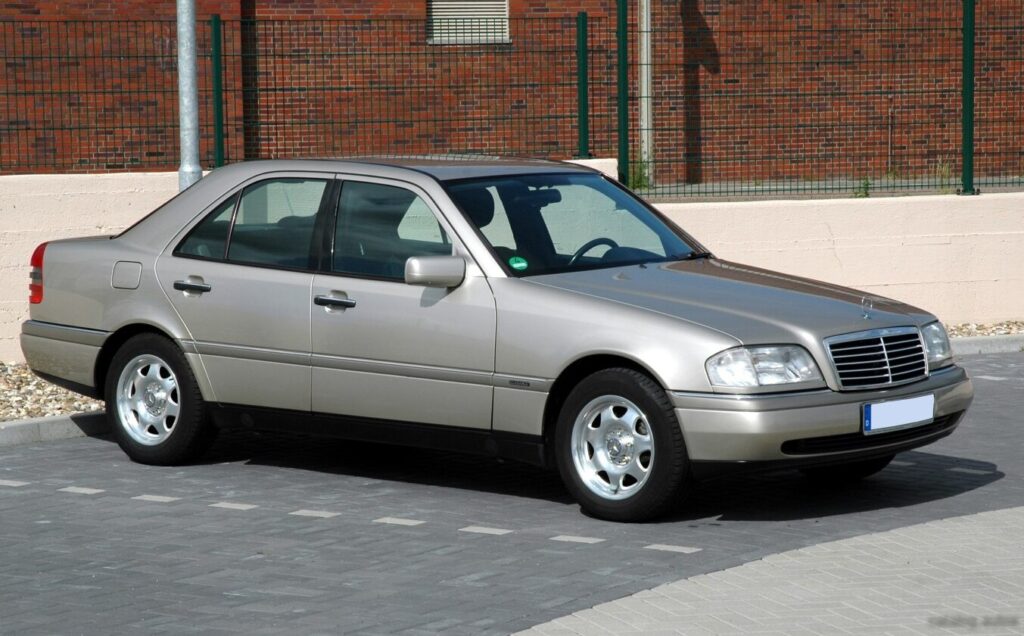
The Mercedes-Benz C-Class (W202) C 220, produced from September 1992 to August 1996, represented a significant step for Mercedes-Benz into the entry-level luxury sedan segment. Positioned as a more accessible alternative to the larger and more expensive W124, the W202 aimed to attract a younger demographic while maintaining the brand’s reputation for quality and engineering. The C 220 variant, powered by a 2.2-liter inline-four engine producing 150 horsepower, occupied a middle ground within the initial W202 lineup, offering a balance between performance and fuel efficiency. It served as a key model in establishing the C-Class as a competitor to BMW’s 3 Series and Audi’s A4.
Technical Specifications
| Brand | Mercedes-Benz |
| Model | C-class |
| Generation | C-class (W202) |
| Type (Engine) | C 220 (150 Hp) |
| Start of production | September, 1992 |
| End of production | August, 1996 |
| Powertrain Architecture | Internal Combustion engine |
| Body type | Sedan |
| Seats | 5 |
| Doors | 4 |
| Fuel consumption (urban) | 11.5 l/100 km (20.5 US mpg) |
| Fuel consumption (extra urban) | 6.5 l/100 km (36.2 US mpg) |
| Fuel Type | Petrol (Gasoline) |
| Acceleration 0 – 100 km/h | 10.5 sec |
| Acceleration 0 – 62 mph | 10.5 sec |
| Acceleration 0 – 60 mph | 10 sec |
| Maximum speed | 210 km/h (130.49 mph) |
| Emission standard | Euro 2 |
| Weight-to-power ratio | 9.4 kg/Hp |
| Weight-to-torque ratio | 6.7 kg/Nm |
| Power | 150 Hp @ 5500 rpm |
| Torque | 210 Nm @ 4000 rpm (154.89 lb.-ft. @ 4000 rpm) |
| Engine layout | Front, Longitudinal |
| Engine Model/Code | M 111 E 22 / 111.961 |
| Engine displacement | 2199 cm3 (134.19 cu. in.) |
| Number of cylinders | 4 |
| Engine configuration | Inline |
| Cylinder Bore | 89.9 mm (3.54 in.) |
| Piston Stroke | 86.6 mm (3.41 in.) |
| Compression ratio | 10:1 |
| Number of valves per cylinder | 4 |
| Fuel injection system | Multi-port manifold injection |
| Engine aspiration | Naturally aspirated engine |
| Valvetrain | DOHC |
| Engine oil capacity | 5.5 l (5.81 US qt | 4.84 UK qt) |
| Coolant | 8.5 l (8.98 US qt | 7.48 UK qt) |
| Kerb Weight | 1410 kg (3108.52 lbs.) |
| Max. weight | 1890 kg (4166.74 lbs.) |
| Max load | 480 kg (1058.22 lbs.) |
| Trunk (boot) space – minimum | 430 l (15.19 cu. ft.) |
| Fuel tank capacity | 62 l (16.38 US gal | 13.64 UK gal) |
| Max. roof load | 100 kg (220.46 lbs.) |
| Length | 4487 mm (176.65 in.) |
| Width | 1720 mm (67.72 in.) |
| Height | 1424 mm (56.06 in.) |
| Wheelbase | 2690 mm (105.91 in.) |
| Front track | 1493 mm (58.78 in.) |
| Rear (Back) track | 1464 mm (57.64 in.) |
| Drag coefficient (Cd) | 0.30 |
| Minimum turning circle | 10.74 m (35.24 ft.) |
| Drivetrain Architecture | Rear wheel drive |
| Number of gears | 5 gears, manual transmission |
| Front suspension | Double wishbone, Transverse stabilizer |
| Rear suspension | Independent multi-link spring suspension with stabilizer |
| Front brakes | Ventilated discs |
| Rear brakes | Disc |
| Assisting systems | ABS (Anti-lock braking system) |
| Steering type | Cone worm with recirculation balls |
| Power steering | Hydraulic Steering |
| Tires size | 195/65 R15; 205/60 R15 |
| Wheel rims size | 6.5J x 15; 7J x 15 |
Powertrain & Engine Architecture
The C 220’s engine, designated the M 111 E 22 (internal code 111.961), was a 2.2-liter inline-four cylinder engine. This engine was a significant departure from the older, less efficient designs used in previous Mercedes-Benz models. It featured a double overhead camshaft (DOHC) valvetrain with four valves per cylinder, contributing to improved breathing and higher output. Fuel delivery was handled by a multi-port fuel injection system, optimizing the air-fuel mixture for both performance and emissions. The engine boasted a compression ratio of 10:1. The five-speed manual transmission was the standard offering, providing drivers with direct control over the engine’s power. The engine was mounted longitudinally in the front of the vehicle, driving the rear wheels – a traditional configuration for Mercedes-Benz sedans of the era.
Driving Characteristics
The C 220, with its 150 horsepower and 155 lb-ft of torque, offered a respectable, though not exhilarating, driving experience. Acceleration from 0 to 60 mph took around 10 seconds, and top speed was limited to 130 mph. Compared to the more powerful C 280 models, the C 220 felt noticeably less responsive, particularly during overtaking maneuvers. However, the C 220’s strength lay in its smooth power delivery and relatively fuel-efficient operation. The five-speed manual transmission allowed for precise gear selection, maximizing the engine’s potential. The gear ratios were tuned for a balance between acceleration and highway cruising, making it a comfortable long-distance companion. The rear-wheel-drive configuration provided a balanced feel, although it lacked the all-weather capability of all-wheel-drive systems offered on some competitors.
Equipment & Trim Levels
The C 220 typically came standard with features considered essential for a luxury car of its time, including power windows, central locking, and an AM/FM radio. Interior upholstery was typically cloth, although leather was available as an option. Dashboard design was functional and understated, reflecting the conservative aesthetic favored by Mercedes-Benz. Optional extras included a sunroof, automatic climate control, and upgraded audio systems. The C 220 was often seen as a stepping stone into the Mercedes-Benz brand, offering a taste of luxury without the higher price tag of the more fully-equipped models.
Chassis & Braking
The W202 C-Class featured a double wishbone front suspension and an independent multi-link rear suspension, providing a comfortable ride and good handling characteristics. Stabilizer bars were fitted to both axles to reduce body roll during cornering. Braking duties were handled by ventilated discs at the front and solid discs at the rear. Anti-lock braking system (ABS) was standard, enhancing safety and control during emergency braking situations. The chassis was designed to provide a balance between rigidity and weight, contributing to the car’s overall stability.
Market Reception & Comparison
The C 220 was generally well-received by automotive critics, who praised its build quality, comfortable ride, and relatively fuel-efficient engine. However, some reviewers noted that its performance was not as exciting as that of its rivals, particularly the BMW 3 Series. Compared to the C 280, the C 220 offered better fuel economy but lacked the same level of performance. The C 220’s price point made it an attractive option for buyers seeking a luxury sedan without breaking the bank. Its reliability was generally considered good, although maintenance costs could be higher than those of some Japanese competitors.
Legacy
The W202 C-Class, and the C 220 variant in particular, played a crucial role in establishing Mercedes-Benz as a major player in the compact executive car segment. The M 111 engine proved to be a durable and reliable powerplant, and many examples are still on the road today. While not as sought-after as some of the higher-performance C-Class models, the C 220 remains a popular choice for enthusiasts seeking a classic Mercedes-Benz sedan that offers a comfortable ride, good fuel economy, and a reputation for quality. The W202 laid the foundation for the subsequent generations of C-Class, which have become some of Mercedes-Benz’s best-selling models.