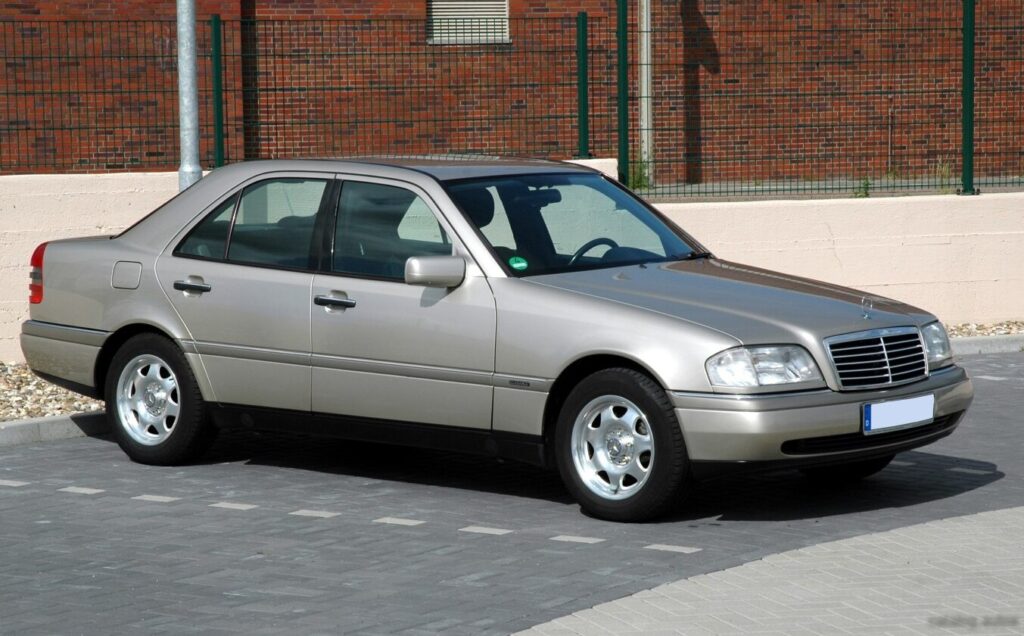
The Mercedes-Benz C-Class (W202) C 220 D, equipped with a 95 horsepower diesel engine and a 4G-TRONIC automatic transmission, was a significant offering in the compact executive car segment during its production run from October 1992 to July 1996. Positioned as an entry-level to mid-range variant within the W202 series, it aimed to provide the prestige and comfort of the Mercedes-Benz brand with improved fuel economy and a more accessible price point. The W202 represented a departure for Mercedes-Benz, being the first C-Class model and a direct replacement for the W201 190E, offering a more rounded and modern design.
Technical Specifications
| Brand | Mercedes-Benz |
| Model | C-class |
| Generation | C-class (W202) |
| Type (Engine) | C 220 D (95 Hp) 4G-TRONIC |
| Start of production | October, 1992 |
| End of production | July, 1996 |
| Powertrain Architecture | Internal Combustion engine |
| Body type | Sedan |
| Seats | 5 |
| Doors | 4 |
| Fuel consumption (urban) | 8.2 l/100 km (28.7 US mpg) |
| Fuel consumption (extra urban) | 5.8 l/100 km (40.6 US mpg) |
| Fuel Type | Diesel |
| Acceleration 0 – 100 km/h | 17.4 sec |
| Acceleration 0 – 62 mph | 17.4 sec |
| Acceleration 0 – 60 mph | 16.5 sec |
| Maximum speed | 172 km/h (106.88 mph) |
| Emission standard | Euro 2 |
| Weight-to-power ratio | 14.7 kg/Hp |
| Weight-to-torque ratio | 9.3 kg/Nm |
| Power | 95 Hp @ 5000 rpm |
| Torque | 150 Nm @ 3100-4500 rpm (110.63 lb.-ft.) |
| Engine layout | Front, Longitudinal |
| Engine Model/Code | OM 604 D 22 / 604.910 |
| Engine displacement | 2155 cm3 (131.51 cu. in.) |
| Number of cylinders | 4 |
| Engine configuration | Inline |
| Cylinder Bore | 89 mm (3.5 in.) |
| Piston Stroke | 86.6 mm (3.41 in.) |
| Compression ratio | 22:1 |
| Number of valves per cylinder | 4 |
| Fuel injection system | Precombustion chamber injection |
| Engine aspiration | Naturally aspirated engine |
| Valvetrain | DOHC |
| Engine oil capacity | 6.5 l (6.87 US qt | 5.72 UK qt) |
| Coolant | 7 l (7.4 US qt | 6.16 UK qt) |
| Kerb Weight | 1400 kg (3086.47 lbs.) |
| Max. weight | 1880 kg (4144.69 lbs.) |
| Max load | 480 kg (1058.22 lbs.) |
| Trunk (boot) space – minimum | 430 l (15.19 cu. ft.) |
| Fuel tank capacity | 62 l (16.38 US gal | 13.64 UK gal) |
| Max. roof load | 100 kg (220.46 lbs.) |
| Length | 4487 mm (176.65 in.) |
| Width | 1720 mm (67.72 in.) |
| Height | 1418 mm (55.83 in.) |
| Wheelbase | 2690 mm (105.91 in.) |
| Front track | 1505 mm (59.25 in.) |
| Rear (Back) track | 1476 mm (58.11 in.) |
| Drag coefficient (Cd) | 0.31 |
| Minimum turning circle | 10.74 m (35.24 ft.) |
| Drivetrain Architecture | Rear wheel drive |
| Number of gears | 4 |
| Gearbox type | automatic transmission G-TRONIC |
| Front suspension | Double wishbone, Transverse stabilizer |
| Rear suspension | Independent multi-link spring suspension with stabilizer |
| Front brakes | Disc |
| Rear brakes | Disc |
| Assisting systems | ABS (Anti-lock braking system) |
| Steering type | Cone worm with recirculation balls |
| Power steering | Hydraulic Steering |
| Tires size | 185/65 R15 |
| Wheel rims size | 6J x 15 |
Powertrain & Engine Architecture
The C 220 D was powered by the OM604 D 22 engine, a 2.2-liter inline-four cylinder diesel. This engine utilized precombustion chamber injection, a system common in Mercedes-Benz diesels of the era. This system involved injecting fuel into a small precombustion chamber connected to the main cylinder, promoting more complete combustion and reducing engine noise. The engine produced 95 horsepower at 5000 rpm and 150 Nm (110.63 lb-ft) of torque between 3100 and 4500 rpm. The 4G-TRONIC automatic transmission was a four-speed unit, designed to provide smooth and comfortable shifting. It was a hydraulically controlled transmission, offering a less direct feel compared to manual transmissions but prioritizing ease of use.
Driving Characteristics
The C 220 D Automatic offered a comfortable, albeit not particularly sporty, driving experience. The 95 horsepower output and the characteristics of the automatic transmission resulted in relatively slow acceleration – 0 to 60 mph took approximately 16.5 seconds. The focus was on fuel efficiency and relaxed cruising. The automatic transmission’s gear ratios were optimized for economy, meaning the engine often operated at lower rpm, contributing to the car’s good fuel economy figures. Compared to the more powerful C 280 or even the manual versions of the C 220 D, this variant felt noticeably slower and less engaging. However, it provided a smooth and refined ride, typical of Mercedes-Benz vehicles.
Equipment & Trim Levels
The C 220 D Automatic typically came standard with features such as power windows, central locking, and a basic audio system. Interior upholstery was usually cloth, although leather was available as an option. Dashboard configuration was relatively simple and functional, reflecting the car’s positioning as an entry-level luxury vehicle. Optional extras included air conditioning, a sunroof, upgraded audio systems, and alloy wheels. The level of standard equipment was generally considered competitive for its price point in the early 1990s.
Chassis & Braking
The W202 C-Class featured a double wishbone front suspension and an independent multi-link rear suspension, providing a comfortable and controlled ride. The C 220 D typically came equipped with disc brakes on all four wheels, along with an Anti-lock Braking System (ABS) as standard. Stabilizer bars were fitted to both the front and rear axles to reduce body roll during cornering. The suspension setup was tuned for comfort rather than outright handling performance, prioritizing a smooth ride over sharp responsiveness.
Market Reception & Comparison
The C 220 D Automatic was generally well-received by critics as a practical and economical option within the C-Class range. It was praised for its fuel efficiency and comfortable ride, but criticized for its relatively slow acceleration. Compared to the higher-output C 280 models, the C 220 D offered significantly lower running costs but lacked the same level of performance. Against competitors like the BMW 325i or Audi 80, the C 220 D offered a different proposition – prioritizing comfort and economy over outright driving excitement. Its diesel engine also appealed to buyers seeking lower fuel bills and longer intervals between maintenance.
Legacy
The OM604 engine family, including the one found in the C 220 D, is known for its durability and reliability. These engines, when properly maintained, can accumulate very high mileage. Today, the W202 C 220 D Automatic is a relatively affordable classic car. While not highly sought after by collectors, it represents a solid and dependable entry point into Mercedes-Benz ownership. Parts availability is generally good, and the relatively simple mechanical design makes it a viable option for DIY mechanics. However, potential buyers should be aware of the age-related issues common to vehicles of this era, such as corrosion and wear on rubber components.