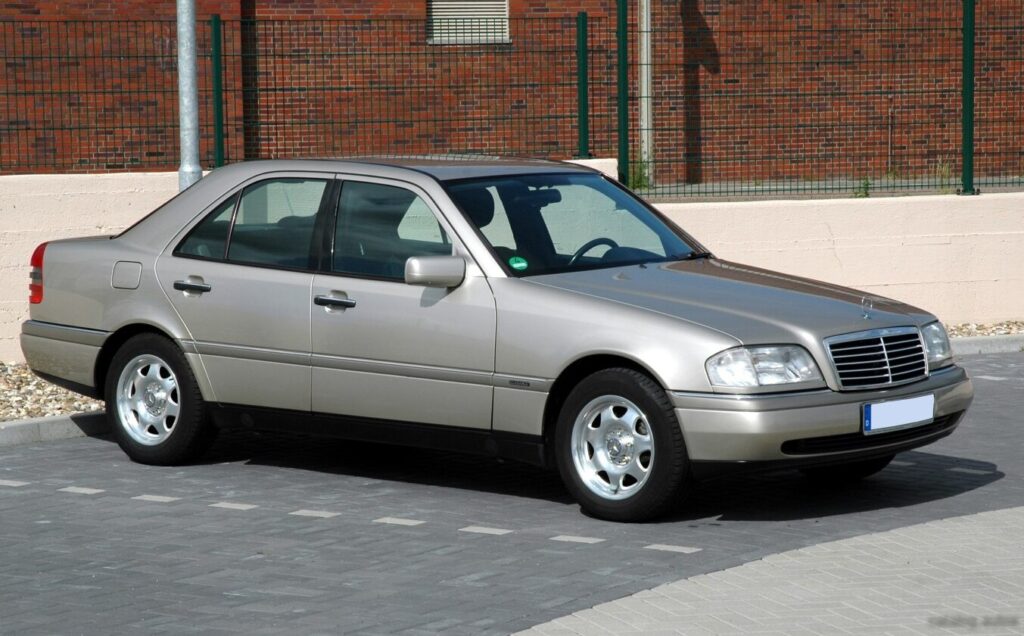
The Mercedes-Benz C-Class (W202) C 250 D, produced from June 1993 to July 1996, represented a significant entry point into the premium compact executive car segment for Mercedes-Benz. Positioned as a diesel-powered variant within the first generation C-Class (replacing the 190E), the C 250 D offered a blend of fuel efficiency and Mercedes-Benz build quality. It was primarily aimed at European markets where diesel engines held a strong preference due to taxation and fuel costs. This model utilized the OM 605 engine family and a four-speed 4G-TRONIC automatic transmission, offering a comfortable, if not particularly sporty, driving experience. The W202 platform itself was a major step forward for Mercedes-Benz, incorporating multi-link rear suspension and improved safety features compared to its predecessor.
Technical Specifications
| Brand | Mercedes-Benz |
| Model | C-class |
| Generation | C-class (W202) |
| Type (Engine) | C 250 D (113 Hp) 4G-TRONIC |
| Start of production | June, 1993 |
| End of production | July, 1996 |
| Powertrain Architecture | Internal Combustion engine |
| Body type | Sedan |
| Seats | 5 |
| Doors | 4 |
| Fuel consumption (urban) | 8.4 l/100 km (28 US mpg, 33.6 UK mpg, 11.9 km/l) |
| Fuel consumption (extra urban) | 5.8 l/100 km (40.6 US mpg, 48.7 UK mpg, 17.2 km/l) |
| Fuel Type | Diesel |
| Acceleration 0 – 100 km/h | 15.3 sec |
| Acceleration 0 – 62 mph | 15.3 sec |
| Acceleration 0 – 60 mph | 14.5 sec |
| Maximum speed | 187 km/h (116.2 mph) |
| Emission standard | Euro 2 |
| Weight-to-power ratio | 12.8 kg/Hp, 77.9 Hp/tonne |
| Weight-to-torque ratio | 8.5 kg/Nm, 117.2 Nm/tonne |
| Power | 113 Hp @ 5000 rpm |
| Power per litre | 45.3 Hp/l |
| Torque | 170 Nm @ 2800-4600 rpm (125.39 lb.-ft. @ 2800-4600 rpm) |
| Engine layout | Front, Longitudinal |
| Engine Model/Code | OM 605 D 25 / 605.910 |
| Engine displacement | 2497 cm3 (152.38 cu. in.) |
| Number of cylinders | 5 |
| Engine configuration | Inline |
| Cylinder Bore | 87 mm (3.43 in.) |
| Piston Stroke | 84 mm (3.31 in.) |
| Compression ratio | 22:1 |
| Number of valves per cylinder | 4 |
| Fuel injection system | Precombustion chamber injection |
| Engine aspiration | Naturally aspirated engine |
| Valvetrain | DOHC |
| Engine oil capacity | 7 l (7.4 US qt | 6.16 UK qt) |
| Coolant | 7.5 l (7.93 US qt | 6.6 UK qt) |
| Kerb Weight | 1450 kg (3196.7 lbs.) |
| Max. weight | 1930 kg (4254.92 lbs.) |
| Max load | 480 kg (1058.22 lbs.) |
| Trunk (boot) space – minimum | 430 l (15.19 cu. ft.) |
| Fuel tank capacity | 62 l (16.38 US gal | 13.64 UK gal) |
| Max. roof load | 100 kg (220.46 lbs.) |
| Length | 4487 mm (176.65 in.) |
| Width | 1720 mm (67.72 in.) |
| Height | 1418 mm (55.83 in.) |
| Wheelbase | 2690 mm (105.91 in.) |
| Front track | 1505 mm (59.25 in.) |
| Rear (Back) track | 1476 mm (58.11 in.) |
| Drag coefficient (Cd) | 0.31 |
| Minimum turning circle | 10.74 m (35.24 ft.) |
| Drivetrain Architecture | Rear wheel drive |
| Drive wheel | Rear wheel drive |
| Number of gears and type of gearbox | 4 gears, automatic transmission G-TRONIC |
| Front suspension | Double wishbone, Transverse stabilizer |
| Rear suspension | Independent multi-link spring suspension with stabilizer |
| Front brakes | Disc |
| Rear brakes | Disc |
| Assisting systems | ABS (Anti-lock braking system) |
| Steering type | Cone worm with recirculation balls |
| Power steering | Hydraulic Steering |
| Tires size | 185/65 R15; 205/60 R15 |
| Wheel rims size | 6J x 15; 7J x 15 |
Powertrain & Engine Architecture
The C 250 D was powered by the Mercedes-Benz OM 605 D 25, a 2.5-liter inline five-cylinder diesel engine. This engine was a key component of Mercedes-Benz’s diesel offerings during the early to mid-1990s. The ‘D 25’ designation indicated the engine’s displacement. The OM 605 series was known for its robust construction and relatively quiet operation for a diesel of the era. It utilized precombustion chamber injection, a system where fuel is partially combusted in a small chamber before entering the main cylinder, aiding in smoother combustion and reduced noise. The engine featured a double overhead camshaft (DOHC) valvetrain, contributing to improved breathing and efficiency. Paired with the engine was the 4G-TRONIC four-speed automatic transmission. This transmission, while providing smooth shifts, wasn’t known for its sportiness or fuel efficiency compared to later automatic designs. It was a conventional hydraulic control unit, lacking the electronic sophistication of modern transmissions.
Driving Characteristics
The C 250 D with the 4G-TRONIC automatic offered a comfortable, but unhurried, driving experience. With 113 horsepower and 170 Nm (125 lb-ft) of torque, acceleration was modest, taking around 15.3 seconds to reach 60 mph. The automatic transmission’s gear ratios were geared towards fuel economy and smooth cruising rather than rapid acceleration. Compared to the more powerful C 280 or the sportier manual transmission options, the C 250 D felt noticeably slower. However, the diesel engine provided ample low-end torque, making it suitable for everyday driving and highway cruising. The rear-wheel drive configuration offered balanced handling, but the relatively soft suspension setup prioritized ride comfort over sharp cornering.
Equipment & Trim Levels
The C 250 D typically came with a reasonable level of standard equipment for a premium car of its time. This included power windows, central locking, and an anti-lock braking system (ABS). Interior upholstery was typically cloth, although leather was available as an option. Dashboard design was functional and understated, typical of Mercedes-Benz interiors of the period. Optional extras included a sunroof, upgraded audio systems, and automatic climate control. The C 250 D generally occupied a mid-range position in the C-Class lineup, offering a more affordable entry point than the petrol-powered models while still providing the core Mercedes-Benz experience.
Chassis & Braking
The W202 C-Class featured a sophisticated chassis design for its time, particularly the multi-link rear suspension. This independent suspension setup significantly improved ride comfort and handling compared to the previous generation. The C 250 D utilized disc brakes on all four wheels, providing adequate stopping power. The ABS system further enhanced safety by preventing wheel lockup during hard braking. Stabilizer bars were fitted to both the front and rear suspension to reduce body roll during cornering. The steering was a recirculating ball system with hydraulic power assistance, offering a reasonably direct feel.
Market Reception & Comparison
The C 250 D was well-received in European markets, particularly by buyers who prioritized fuel economy and reliability. Critics praised the engine’s quietness and smoothness for a diesel, as well as the car’s overall build quality. However, the relatively slow acceleration and the somewhat dated 4G-TRONIC transmission were points of criticism. Compared to the C 220 D, the C 250 D offered a noticeable power increase. Against the petrol-powered C 280, the C 250 D traded performance for significantly better fuel economy. The C 250 D’s fuel economy figures of around 8.4 l/100km (urban) and 5.8 l/100km (extra urban) were competitive for its class.
Legacy
The OM 605 engine family, including the version used in the C 250 D, is known for its durability and longevity. Many examples have exceeded 200,000 miles with proper maintenance. The C 250 D, while not a particularly sought-after model today, represents a solid and reliable classic Mercedes-Benz. In the used car market, these vehicles are often appreciated for their simplicity and relatively low running costs. Parts availability is generally good, although some specific trim pieces may be difficult to find. The W202 C-Class, and the C 250 D in particular, laid the foundation for the continued success of the C-Class line, establishing it as a key player in the premium compact executive car segment.