Technical Specifications
| Brand | Mercedes-Benz |
| Model | C-class |
| Generation | C-class (W202, facelift 1997) |
| Type (Engine) | AMG C 43 V8 (306 Hp) 5G-TRONIC |
| Start of production | October, 1997 |
| End of production | May, 2000 |
| Powertrain Architecture | Internal Combustion engine |
| Body type | Sedan |
| Seats | 5 |
| Doors | 4 |
| Fuel consumption (urban) | 16.5 l/100 km (14.3 US mpg, 17.1 UK mpg, 6.1 km/l) |
| Fuel consumption (extra urban) | 8.9 l/100 km (26.4 US mpg, 31.7 UK mpg, 11.2 km/l) |
| Fuel consumption (combined) | 11.7 l/100 km (20.1 US mpg, 24.1 UK mpg, 8.5 km/l) |
| CO2 emissions | 280 g/km |
| Fuel Type | Petrol (Gasoline) |
| Acceleration 0 – 100 km/h | 6.5 sec |
| Acceleration 0 – 62 mph | 6.5 sec |
| Acceleration 0 – 60 mph | 6.2 sec |
| Maximum speed | 250 km/h (155.34 mph), Electronically limited |
| Emission standard | Euro 3 |
| Weight-to-power ratio | 5.1 kg/Hp, 194.9 Hp/tonne |
| Weight-to-torque ratio | 3.8 kg/Nm, 261.1 Nm/tonne |
| Power | 306 Hp @ 5850 rpm |
| Power per litre | 71.7 Hp/l |
| Torque | 410 Nm @ 3250-5000 rpm (302.4 lb.-ft. @ 3250-5000 rpm) |
| Engine layout | Front, Longitudinal |
| Engine Model/Code | M 113 E 43 / 113.944 |
| Engine displacement | 4266 cm3 (260.33 cu. in.) |
| Number of cylinders | 8 |
| Engine configuration | V-engine |
| Cylinder Bore | 89.9 mm (3.54 in.) |
| Piston Stroke | 84 mm (3.31 in.) |
| Compression ratio | 10:1 |
| Number of valves per cylinder | 3 |
| Fuel injection system | Multi-port manifold injection |
| Engine aspiration | Naturally aspirated engine |
| Valvetrain | SOHC |
| Engine oil capacity | 7.5 l (7.93 US qt | 6.6 UK qt) |
| Coolant | 11 l (11.62 US qt | 9.68 UK qt) |
| Kerb Weight | 1570 kg (3461.26 lbs.) |
| Max. weight | 1970 kg (4343.11 lbs.) |
| Max load | 400 kg (881.85 lbs.) |
| Trunk (boot) space – minimum | 430 l (15.19 cu. ft.) |
| Fuel tank capacity | 62 l (16.38 US gal | 13.64 UK gal) |
| Max. roof load | 100 kg (220.46 lbs.) |
| Length | 4516 mm (177.8 in.) |
| Width | 1723 mm (67.83 in.) |
| Height | 1387 mm (54.61 in.) |
| Wheelbase | 2690 mm (105.91 in.) |
| Front track | 1509 mm (59.41 in.) |
| Rear (Back) track | 1483 mm (58.39 in.) |
| Drag coefficient (Cd) | 0.33 |
| Minimum turning circle | 10.74 m (35.24 ft.) |
| Drivetrain Architecture | Rear wheel drive |
| Drive wheel | Rear wheel drive |
| Number of gears | 5 |
| Gearbox type | automatic transmission G-TRONIC |
| Front suspension | Double wishbone, Transverse stabilizer |
| Rear suspension | Independent multi-link spring suspension with stabilizer |
| Front brakes | Ventilated discs |
| Rear brakes | Ventilated discs |
| Assisting systems | ABS (Anti-lock braking system) |
| Steering type | Cone worm with recirculation balls |
| Power steering | Hydraulic Steering |
| Front tires | 225/45 R17 |
| Rear tires | 245/40 R17 |
| Front wheel rims | 7.5J x 17 |
| Rear wheel rims | 8.5J x 17 |
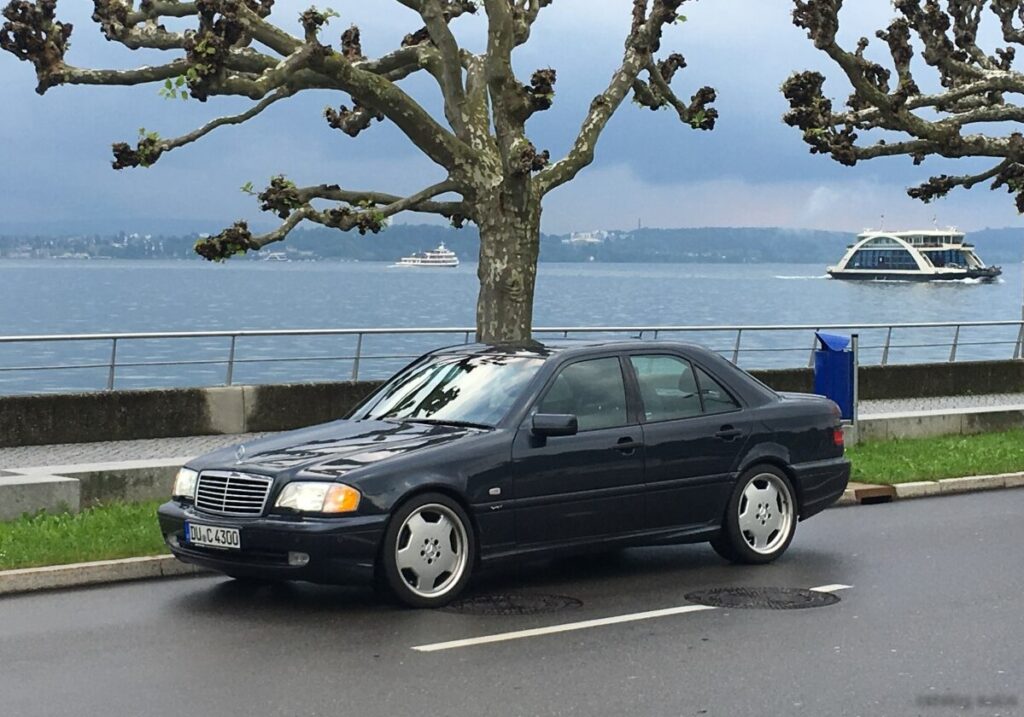
The Mercedes-Benz C 43 AMG, launched in late 1997, was a pivotal model for the brand. Built on the W202 C-Class platform (following the 1997 facelift), it represented AMG’s first serious foray into offering a truly high-performance version of Mercedes’ entry-level sedan. Prior to this, AMG had primarily focused on bespoke modifications and limited-production models. The C 43 aimed to bridge the gap between luxury and performance, appealing to buyers who desired a more engaging driving experience without sacrificing the comfort and refinement expected from a Mercedes-Benz. Production continued until May 2000, with approximately 4,300 units built.
Powertrain & Engine Architecture
The heart of the C 43 AMG is the M113 E 43 4.3-liter V8 engine. This naturally aspirated powerplant, also used in the R129 SL 430 and W140 S 430, was extensively modified by AMG to deliver 306 horsepower at 5850 rpm and 410 Nm (302 lb-ft) of torque between 3250 and 5000 rpm. Key modifications included a higher compression ratio, revised cylinder heads, and a more aggressive camshaft profile. The engine utilized multi-port fuel injection and a single overhead camshaft (SOHC) valvetrain per cylinder bank. The engine is longitudinally mounted in the front of the vehicle.
Power is transmitted to the rear wheels via a five-speed 5G-TRONIC automatic transmission. This transmission was specifically tuned by AMG for quicker shifts and improved responsiveness. While a manual transmission was not offered, the 5G-TRONIC provided a relatively engaging driving experience, especially when utilizing the manual shift mode. The transmission’s gear ratios were optimized to balance acceleration and fuel efficiency, though the C 43 was never intended to be a fuel-sipping vehicle.
Driving Characteristics
The C 43 AMG offered a noticeable performance upgrade over the standard W202 C-Class models. The 0-60 mph sprint took approximately 6.2 seconds, and the car was electronically limited to a top speed of 250 km/h (155 mph). The V8 engine delivered a smooth and linear power delivery, with ample torque available throughout the rev range. The automatic transmission, while not as engaging as a manual, provided quick and seamless shifts. The car felt planted and stable at high speeds, thanks to its well-tuned suspension and relatively wide track.
Compared to the standard C-Class, the C 43 had a firmer ride due to its sport-tuned suspension. However, it wasn’t overly harsh, maintaining a reasonable level of comfort for everyday driving. Compared to the later C55 AMG, the C 43 felt slightly less raw and aggressive, offering a more refined and balanced driving experience. The C 43 also differed significantly from the diesel-powered C 250 TD or C 300 TD models, offering a vastly different power delivery and overall driving character.
Equipment & Trim Levels
The C 43 AMG came standard with a generous array of features, reflecting its position as the flagship C-Class model. Standard equipment included leather upholstery, power-adjustable front seats with memory function, automatic climate control, a premium sound system, and alloy wheels. Exterior features included AMG-specific body styling, including a front spoiler, side skirts, and a rear spoiler. Optional extras included a sunroof, navigation system, and upgraded interior trim options.
Chassis & Braking
The C 43 AMG featured a modified chassis and suspension compared to the standard W202 C-Class. The suspension was lowered and stiffened, and thicker stabilizer bars were fitted to reduce body roll. The car was equipped with ventilated disc brakes on all four wheels, providing ample stopping power. ABS (Anti-lock Braking System) was standard. The steering was a hydraulic power-assisted system, offering a good balance of feel and assistance.
Market Reception & Comparison
The C 43 AMG was generally well-received by automotive critics. It was praised for its powerful engine, comfortable ride, and refined interior. However, some critics noted that the automatic transmission wasn’t as engaging as a manual, and that the car’s fuel economy was relatively poor. Compared to the BMW M3, the C 43 offered a more luxurious and comfortable driving experience, but lacked the M3’s razor-sharp handling. Compared to the Audi S4, the C 43 provided a more powerful engine, but the S4 offered all-wheel drive for improved traction.
Legacy
The Mercedes-Benz C 43 AMG played a crucial role in establishing AMG as a credible performance brand. It demonstrated that AMG could successfully transform a mainstream Mercedes-Benz model into a genuinely exciting and capable performance car. Today, the C 43 AMG is a sought-after classic, particularly among Mercedes-Benz enthusiasts. Well-maintained examples command a premium in the used car market. The M113 V8 engine is known for its reliability, although regular maintenance is essential. The C 43 remains a compelling option for those seeking a blend of performance, luxury, and classic Mercedes-Benz styling.