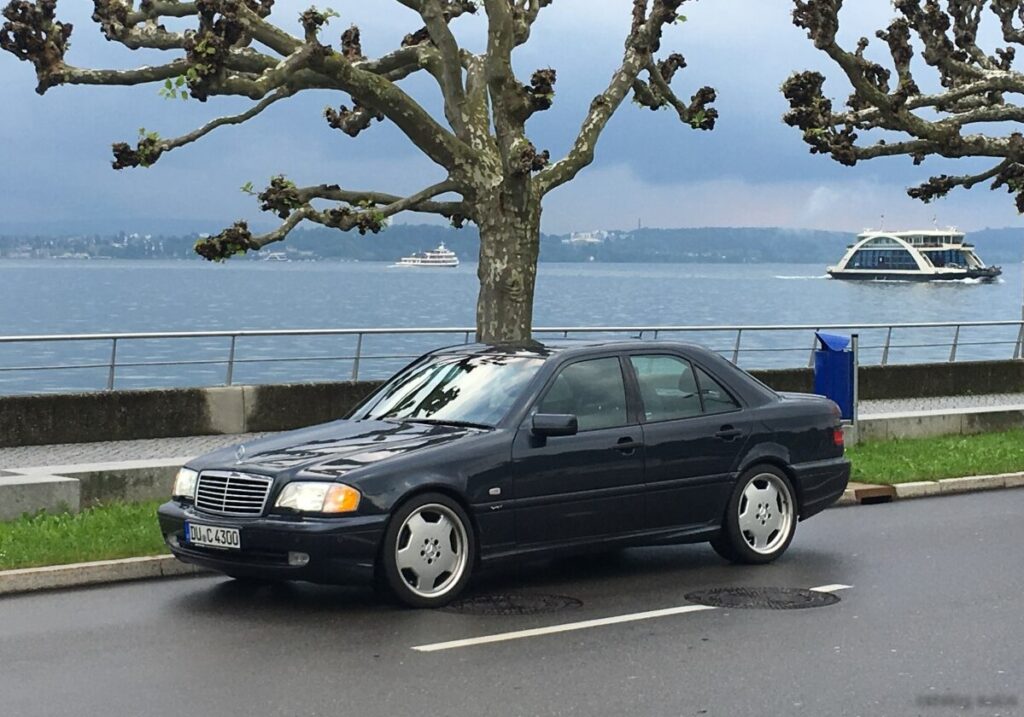
The Mercedes-Benz C 200 Kompressor, introduced as part of the W202 facelift in June 1997 and continuing through May 2000, represented a significant step forward in the compact executive car segment. Positioned as a mid-range offering within the W202 lineup, it bridged the gap between the base C 180 and the more potent C 230 Kompressor and C 280 models. This variant was primarily aimed at buyers seeking a blend of performance, refinement, and fuel efficiency, offering a compelling alternative to naturally aspirated competitors. The introduction of the Kompressor – Mercedes’ designation for supercharged engines – was a key differentiator, providing a noticeable boost in power and torque compared to earlier W202 models.
Technical Specifications
| Brand | Mercedes-Benz |
| Model | C-class |
| Generation | C-class (W202, facelift 1997) |
| Type (Engine) | C 200 Kompressor (192 Hp) |
| Start of production | June, 1997 |
| End of production | May, 2000 |
| Powertrain Architecture | Internal Combustion engine |
| Body type | Sedan |
| Seats | 5 |
| Doors | 4 |
| Fuel consumption (urban) | 13.6 l/100 km (17.3 US mpg, 20.8 UK mpg) |
| Fuel consumption (extra urban) | 7.5 l/100 km (31.4 US mpg, 37.7 UK mpg) |
| Fuel consumption (combined) | 9.8 l/100 km (24 US mpg, 28.8 UK mpg) |
| Fuel Type | Petrol (Gasoline) |
| Acceleration 0 – 100 km/h | 8.4 sec |
| Acceleration 0 – 62 mph | 8.4 sec |
| Acceleration 0 – 60 mph | 8 sec |
| Maximum speed | 230 km/h (142.92 mph) |
| Weight-to-power ratio | 7.3 kg/Hp |
| Weight-to-torque ratio | 5.2 kg/Nm |
| Power | 192 Hp @ 5300 rpm |
| Power per litre | 96.1 Hp/l |
| Torque | 270 Nm @ 2500-4800 rpm (199.14 lb.-ft. @ 2500-4800 rpm) |
| Engine layout | Front, Longitudinal |
| Engine Model/Code | M 111 E 20 ML / 111.944 |
| Engine displacement | 1998 cm3 (121.93 cu. in.) |
| Number of cylinders | 4 |
| Engine configuration | Inline |
| Cylinder Bore | 89.9 mm (3.54 in.) |
| Piston Stroke | 78.7 mm (3.1 in.) |
| Compression ratio | 8.5:1 |
| Number of valves per cylinder | 4 |
| Fuel injection system | Multi-port manifold injection |
| Engine aspiration | Supercharger, Intercooler |
| Valvetrain | DOHC |
| Engine oil capacity | 5.5 l (5.81 US qt | 4.84 UK qt) |
| Coolant | 8.5 l (8.98 US qt | 7.48 UK qt) |
| Kerb Weight | 1410 kg (3108.52 lbs.) |
| Max. weight | 1890 kg (4166.74 lbs.) |
| Max load | 480 kg (1058.22 lbs.) |
| Fuel tank capacity | 62 l (16.38 US gal | 13.64 UK gal) |
| Length | 4516 mm (177.8 in.) |
| Width | 1723 mm (67.83 in.) |
| Height | 1427 mm (56.18 in.) |
| Wheelbase | 2690 mm (105.91 in.) |
| Front track | 1499 mm (59.02 in.) |
| Rear track | 1464 mm (57.64 in.) |
| Drag coefficient (Cd) | 0.32 |
| Drivetrain Architecture | Rear wheel drive |
| Drive wheel | Rear wheel drive |
| Number of gears | 5 |
| Type of gearbox | Manual transmission |
| Front suspension | Double wishbone |
| Rear suspension | Independent multi-link spring suspension with stabilizer |
| Front brakes | Ventilated discs |
| Rear brakes | Disc |
| Assisting systems | ABS (Anti-lock braking system) |
| Steering type | Cone worm with recirculation balls |
| Power steering | Hydraulic Steering |
| Tires size | 195/65 R15 |
| Wheel rims size | 6.5J x 15 |
Powertrain & Engine Architecture
The heart of the C 200 Kompressor was the M111 E 20 ML engine, a 1.998-liter inline-four cylinder powerplant. This engine utilized a Lysholm-type mechanical supercharger, providing forced induction to enhance power output. The supercharger, driven by the engine’s crankshaft via a belt, delivered boost at lower engine speeds, effectively eliminating turbo lag and providing a more linear power delivery. The engine featured multi-port fuel injection and a double overhead camshaft (DOHC) valvetrain with four valves per cylinder. The compression ratio was set at 8.5:1. The five-speed manual transmission was standard, offering precise gear changes and contributing to the car’s engaging driving experience. An optional four-speed automatic transmission was also available, though it slightly diminished performance and fuel economy.
Driving Characteristics
The C 200 Kompressor offered a noticeable improvement in performance over the naturally aspirated C 180. The supercharger provided a strong surge of torque from low RPMs, making it feel more responsive in everyday driving situations. While not a sports car, the C 200 Kompressor could accelerate from 0 to 60 mph in around 8 seconds and reach a top speed of 143 mph. The manual transmission version offered a more direct and engaging driving experience, while the automatic, though smoother, felt somewhat less eager. The gear ratios were well-chosen to balance acceleration and fuel efficiency. Compared to the C 230 Kompressor, the C 200 offered a slightly more relaxed driving experience, prioritizing comfort and fuel economy over outright performance.
Equipment & Trim Levels
The C 200 Kompressor typically came equipped with features such as power windows, central locking, and an AM/FM radio with cassette player. Air conditioning was a common option. Interior upholstery was typically cloth, though leather was available as an upgrade. Dashboard trim could be specified in wood or aluminum. Optional extras included a sunroof, heated seats, and a more advanced audio system. The trim level was generally considered a step above the base C 180, offering a more refined interior and a slightly more comprehensive list of standard features.
Chassis & Braking
The W202 C-Class featured a double wishbone front suspension and an independent multi-link rear suspension, providing a comfortable ride and good handling characteristics. The C 200 Kompressor utilized ventilated disc brakes at the front and solid discs at the rear. Anti-lock braking system (ABS) was standard, enhancing safety and control during hard braking. Stabilizer bars were fitted to both the front and rear axles to reduce body roll during cornering. The suspension was tuned to provide a balance between comfort and handling, making it suitable for both city driving and longer journeys.
Market Reception & Comparison
The C 200 Kompressor was generally well-received by automotive critics. It was praised for its responsive engine, comfortable ride, and refined interior. However, some reviewers noted that the automatic transmission could feel sluggish at times. Compared to the C 180, the C 200 Kompressor offered a significant performance upgrade without the higher price tag of the C 230 Kompressor. Fuel economy was respectable, averaging around 24 mpg in combined driving. Reliability was generally good, although the supercharger did require periodic maintenance.
Legacy
The M111 engine family, including the 1.998-liter unit found in the C 200 Kompressor, proved to be a durable and reliable powerplant. Today, well-maintained examples of the W202 C 200 Kompressor are sought after by enthusiasts as affordable and enjoyable classic Mercedes-Benz vehicles. The supercharged engine provides a unique driving experience, and the car’s relatively simple mechanicals make it easier to maintain than more modern vehicles. While parts availability can be a concern, a dedicated community of owners and suppliers helps to keep these cars on the road. The C 200 Kompressor represents a pivotal moment in Mercedes-Benz history, showcasing the brand’s commitment to innovation and performance in the compact executive segment.