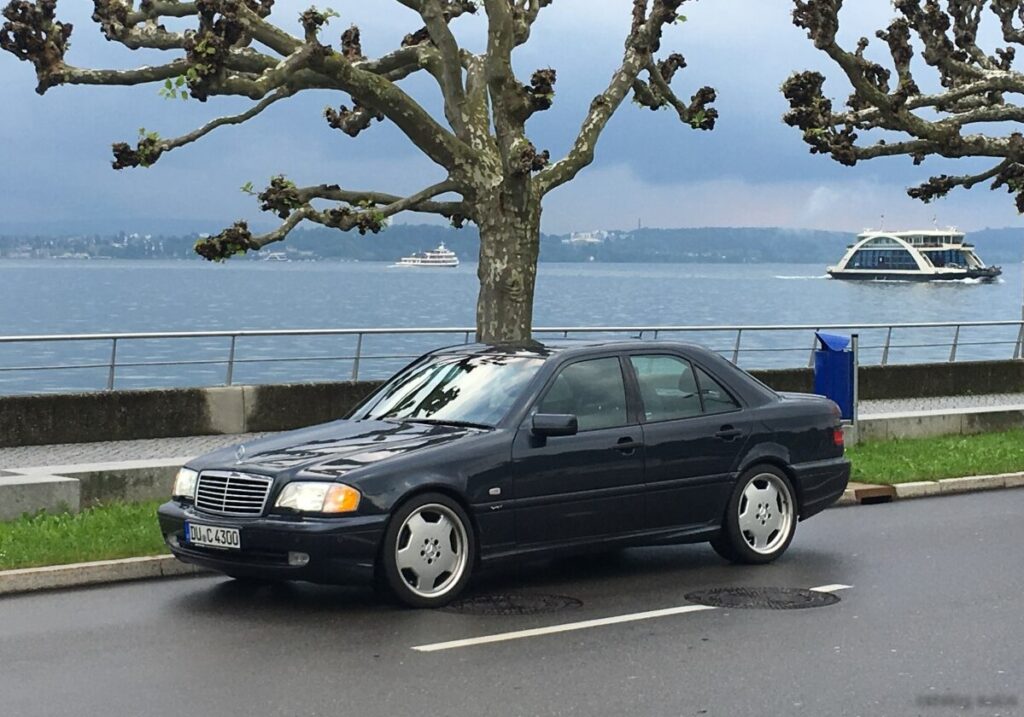
The Mercedes-Benz C 230 Kompressor, produced from June 1997 to May 2000, was a significant variant within the W202 C-Class facelift range. Representing a blend of performance and luxury, this model aimed to bridge the gap between the more economical C 180/C 200 models and the higher-performance C 280. The introduction of the Kompressor – a supercharger – marked a notable advancement for the W202, providing a substantial power increase over naturally aspirated engines. This variant primarily targeted buyers seeking a more engaging driving experience without sacrificing the comfort and refinement expected from a Mercedes-Benz. It was positioned as a mid-range offering, appealing to those who desired a sporty feel but didn’t require the ultimate performance of the C 280.
Technical Specifications
| Brand | Mercedes-Benz |
| Model | C-class |
| Generation | C-class (W202, facelift 1997) |
| Type (Engine) | C 230 Kompressor (193 Hp) 5G-TRONIC |
| Start of production | June, 1997 |
| End of production | May, 2000 |
| Powertrain Architecture | Internal Combustion engine |
| Body type | Sedan |
| Seats | 5 |
| Doors | 4 |
| Fuel consumption (urban) | 10.7 l/100 km (22 US mpg) |
| Fuel consumption (extra urban) | 6.2 l/100 km (37.9 US mpg) |
| Fuel Type | Petrol (Gasoline) |
| Maximum speed | 227 km/h (141.05 mph) |
| Weight-to-power ratio | 7.3 kg/Hp |
| Weight-to-torque ratio | 5.2 kg/Nm |
| Power | 193 Hp @ 5300 rpm |
| Power per litre | 84.1 Hp/l |
| Torque | 270 Nm @ 2500-4800 rpm (199.14 lb.-ft. @ 2500-4800 rpm) |
| Engine layout | Front, Longitudinal |
| Engine Model/Code | M 111 E 23 ML / 111.975 |
| Engine displacement | 2295 cm3 (140.05 cu. in.) |
| Number of cylinders | 4 |
| Engine configuration | Inline |
| Cylinder Bore | 90.9 mm (3.58 in.) |
| Piston Stroke | 88.4 mm (3.48 in.) |
| Compression ratio | 8.8:1 |
| Number of valves per cylinder | 4 |
| Fuel injection system | Multi-port manifold injection |
| Engine aspiration | Supercharger, Intercooler |
| Valvetrain | DOHC |
| Engine oil capacity | 5.5 l (5.81 US qt | 4.84 UK qt) |
| Coolant | 8.5 l (8.98 US qt | 7.48 UK qt) |
| Kerb Weight | 1410 kg (3108.52 lbs.) |
| Max. weight | 1890 kg (4166.74 lbs.) |
| Max load | 480 kg (1058.22 lbs.) |
| Fuel tank capacity | 62 l (16.38 US gal | 13.64 UK gal) |
| Length | 4516 mm (177.8 in.) |
| Width | 1723 mm (67.83 in.) |
| Height | 1427 mm (56.18 in.) |
| Wheelbase | 2690 mm (105.91 in.) |
| Front track | 1499 mm (59.02 in.) |
| Rear track | 1464 mm (57.64 in.) |
| Drivetrain Architecture | Rear wheel drive |
| Drive wheel | Rear wheel drive |
| Number of gears | 5 |
| Gearbox type | automatic transmission 5G-TRONIC |
| Front suspension | Double wishbone |
| Rear suspension | Independent multi-link spring suspension with stabilizer |
| Front brakes | Ventilated discs |
| Rear brakes | Disc |
| Assisting systems | ABS (Anti-lock braking system) |
| Steering type | Cone worm with recirculation balls |
| Power steering | Hydraulic Steering |
| Tires size | 195/65 R15 |
| Wheel rims size | 6.5J x 15 |
Powertrain & Engine Architecture
The heart of the C 230 Kompressor is the M111 E 23 ML engine, a 2.3-liter inline-four cylinder powerplant. This engine is distinguished by its Lysholm-type supercharger, which provides forced induction to significantly boost power output. Unlike turbochargers, superchargers are mechanically driven by the engine’s crankshaft, offering immediate boost response without the lag often associated with turbocharging. The M111 featured multi-port fuel injection and a double overhead camshaft (DOHC) valvetrain, contributing to efficient combustion and power delivery. The engine code 111.975 specifically denotes this supercharged variant. Paired with the engine is the 5G-TRONIC automatic transmission, a five-speed unit known for its smooth shifting and adaptability. This transmission was a key component in delivering a refined driving experience, complementing the engine’s power characteristics.
Driving Characteristics
The C 230 Kompressor offered a noticeable step up in performance compared to the naturally aspirated C 180 or C 200 models. The supercharger provided strong low-end torque, making the car feel responsive in everyday driving situations. While not as overtly sporty as the C 280, the C 230 Kompressor delivered a respectable 0-60 mph time of around 8.5 seconds and a top speed of 141 mph. The 5G-TRONIC transmission contributed to a comfortable and effortless driving experience, with well-chosen gear ratios that kept the engine within its optimal power band. The automatic transmission, while convenient, did slightly diminish the sense of driver engagement compared to the available manual transmission options.
Equipment & Trim Levels
The C 230 Kompressor typically came equipped with a generous array of standard features, including automatic climate control, power windows and locks, and a premium sound system. Interior upholstery was generally cloth, but leather options were available. Dashboard trim could be specified in wood or aluminum finishes. Optional extras included a sunroof, heated seats, and upgraded audio systems. The C 230 Kompressor often served as a platform for various option packages, allowing buyers to customize their vehicle to their preferences. Safety features such as ABS and airbags were standard.
Chassis & Braking
The W202 C-Class featured a double wishbone front suspension and an independent multi-link rear suspension, providing a comfortable ride and good handling characteristics. The C 230 Kompressor, due to its increased power, often benefited from slightly stiffer suspension components compared to the base models. Braking duties were handled by ventilated discs at the front and solid discs at the rear, with ABS providing enhanced stopping power and stability. Stabilizer bars were fitted front and rear to reduce body roll during cornering.
Market Reception & Comparison
The C 230 Kompressor was generally well-received by automotive critics, who praised its blend of performance, comfort, and refinement. It was seen as a compelling alternative to rivals such as the BMW 323i and Audi A4. Fuel economy was respectable for a performance-oriented sedan, averaging around 22 mpg in the city and 38 mpg on the highway. Compared to the C 280, the C 230 Kompressor offered a similar level of performance at a lower price point, making it a more accessible option for many buyers. However, some critics noted that the supercharger’s whine could be noticeable under hard acceleration.
Legacy
The M111 engine, particularly the supercharged variants like the C 230 Kompressor, proved to be a reliable and durable powerplant. With proper maintenance, these engines can continue to provide years of service. Today, the W202 C 230 Kompressor is gaining recognition as a classic Mercedes-Benz, appreciated for its unique combination of performance and luxury. The availability of parts remains relatively good, making it a viable option for enthusiasts seeking a well-engineered and rewarding driving experience. While not as sought-after as some of the more iconic Mercedes-Benz models, the C 230 Kompressor represents a significant chapter in the evolution of the C-Class, showcasing the brand’s commitment to innovation and driving pleasure.