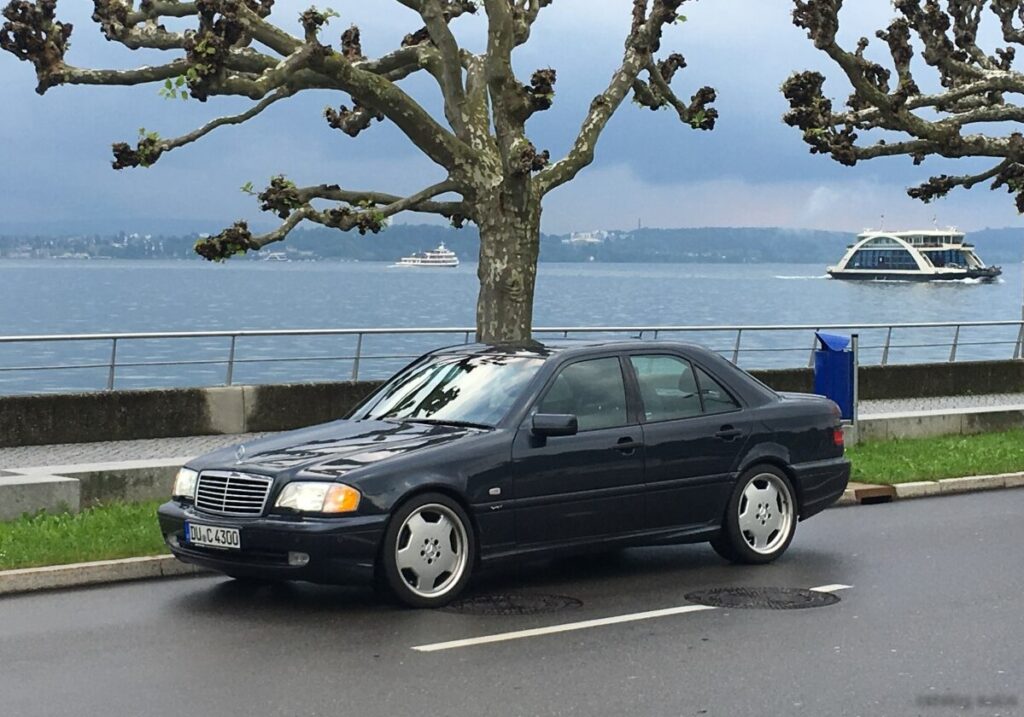
The Mercedes-Benz C 240 V6, part of the W202 C-Class facelift introduced in January 1997 and continuing through May 2000, represented a significant step up in performance and refinement for the compact executive car. Positioned as a mid-range offering within the W202 lineup, it bridged the gap between the more economical four-cylinder models and the high-performance C 36 AMG. This variant was primarily aimed at buyers seeking a blend of luxury, performance, and the prestige associated with the Mercedes-Benz brand. The W202 C-Class, as a whole, was crucial in establishing Mercedes-Benz as a competitor in the burgeoning compact luxury segment, challenging established players like BMW and Audi.
Technical Specifications
| Brand | Mercedes-Benz |
| Model | C-class |
| Generation | C-class (W202, facelift 1997) |
| Type (Engine) | C 240 V6 (170 Hp) |
| Start of production | January, 1997 |
| End of production | May, 2000 |
| Powertrain Architecture | Internal Combustion engine |
| Body type | Sedan |
| Seats | 5 |
| Doors | 4 |
| Fuel consumption (urban) | 14.3 l/100 km (16.4 US mpg, 19.8 UK mpg, 7 km/l) |
| Fuel consumption (extra urban) | 7.5 l/100 km (31.4 US mpg, 37.7 UK mpg, 13.3 km/l) |
| Fuel consumption (combined) | 10 l/100 km (23.5 US mpg, 28.2 UK mpg, 10 km/l) |
| CO2 emissions | 239 g/km |
| Fuel Type | Petrol (Gasoline) |
| Acceleration 0 – 100 km/h | 9.3 sec |
| Acceleration 0 – 62 mph | 9.3 sec |
| Acceleration 0 – 60 mph | 8.8 sec |
| Maximum speed | 218 km/h (135.46 mph) |
| Emission standard | Euro 3 |
| Weight-to-power ratio | 8.4 kg/Hp, 119.7 Hp/tonne |
| Weight-to-torque ratio | 6.3 kg/Nm, 158.5 Nm/tonne |
| Power | 170 Hp @ 5900 rpm |
| Power per litre | 70.9 Hp/l |
| Torque | 225 Nm @ 3000-5000 rpm (165.95 lb.-ft. @ 3000-5000 rpm) |
| Engine layout | Front, Longitudinal |
| Engine Model/Code | M 112 E 24 / 112.910 |
| Engine displacement | 2398 cm3 (146.33 cu. in.) |
| Number of cylinders | 6 |
| Engine configuration | V-engine |
| Cylinder Bore | 83.2 mm (3.28 in.) |
| Piston Stroke | 73.5 mm (2.89 in.) |
| Compression ratio | 10:1 |
| Number of valves per cylinder | 3 |
| Fuel injection system | Multi-port manifold injection |
| Engine aspiration | Naturally aspirated engine |
| Valvetrain | SOHC |
| Engine oil capacity | 8 l (8.45 US qt | 7.04 UK qt) |
| Coolant | 9.5 l (10.04 US qt | 8.36 UK qt) |
| Kerb Weight | 1420 kg (3130.56 lbs.) |
| Max. weight | 1900 kg (4188.78 lbs.) |
| Max load | 480 kg (1058.22 lbs.) |
| Trunk (boot) space – minimum | 430 l (15.19 cu. ft.) |
| Fuel tank capacity | 62 l (16.38 US gal | 13.64 UK gal) |
| Max. roof load | 100 kg (220.46 lbs.) |
| Permitted trailer load with brakes (12%) | 1500 kg (3306.93 lbs.) |
| Permitted trailer load without brakes | 710 kg (1565.28 lbs.) |
| Length | 4516 mm (177.8 in.) |
| Width | 1723 mm (67.83 in.) |
| Height | 1427 mm (56.18 in.) |
| Wheelbase | 2690 mm (105.91 in.) |
| Front track | 1499 mm (59.02 in.) |
| Rear (Back) track | 1464 mm (57.64 in.) |
| Drag coefficient (Cd) | 0.31 |
| Minimum turning circle (turning diameter) | 10.74 m (35.24 ft.) |
| Drivetrain Architecture | The Internal combustion engine (ICE) drives the rear wheels of the vehicle. |
| Drive wheel | Rear wheel drive |
| Number of gears and type of gearbox | 5 gears, manual transmission |
| Front suspension | Double wishbone, Transverse stabilizer |
| Rear suspension | Independent multi-link spring suspension with stabilizer |
| Front brakes | Ventilated discs |
| Rear brakes | Disc |
| Assisting systems | ABS (Anti-lock braking system) |
| Steering type | Cone worm with recirculation balls |
| Power steering | Hydraulic Steering |
| Tires size | 195/65 R15; 205/60 R15 |
| Wheel rims size | 6.5J x 15; 7J x 15 |
Powertrain & Engine Architecture
The heart of the C 240 V6 was the M112 E 24 engine, a 2.4-liter naturally aspirated V6. This engine represented a departure from the traditional inline-six configurations previously favored by Mercedes-Benz. The M112 featured a 60-degree V-angle, contributing to a more compact engine bay footprint. It utilized a single overhead camshaft (SOHC) design per cylinder bank, operating three valves per cylinder (two intake, one exhaust). Fuel delivery was managed by a multi-port fuel injection system, ensuring precise fuel atomization. The engine produced 170 horsepower at 5900 rpm and 225 Nm (165.95 lb-ft) of torque between 3000 and 5000 rpm. The engine’s relatively high compression ratio of 10:1 contributed to its efficiency and responsiveness. The C 240 V6 was exclusively offered with a 5-speed manual transmission, providing drivers with direct control over the engine’s power.
Driving Characteristics
The C 240 V6 offered a noticeably more refined and powerful driving experience compared to the base C 180 or C 220 models. While not a sports car, the V6 engine provided ample power for comfortable highway cruising and confident overtaking maneuvers. The 0-60 mph acceleration time of around 8.8 seconds was respectable for its time. The 5-speed manual transmission allowed for precise gear selection, maximizing the engine’s torque output. Compared to the later C 36 AMG, the C 240 V6 prioritized smoothness and refinement over outright performance. The gear ratios were tuned for a balance between acceleration and fuel economy, making it a practical choice for daily driving.
Equipment & Trim Levels
The C 240 V6 typically came equipped with a generous array of standard features, reflecting its mid-range positioning. These included power windows, power locks, air conditioning, and an upgraded audio system. Interior upholstery was typically cloth, although leather options were available. The dashboard featured wood trim accents, enhancing the car’s luxurious ambiance. Optional extras included a sunroof, automatic climate control, heated seats, and upgraded alloy wheels. Safety features such as ABS (Anti-lock Braking System) and airbags were standard.
Chassis & Braking
The C 240 V6 utilized a double wishbone suspension at the front and an independent multi-link spring suspension at the rear, providing a comfortable and controlled ride. A transverse stabilizer bar was fitted to both axles, reducing body roll during cornering. The braking system consisted of ventilated discs at the front and solid discs at the rear, providing adequate stopping power. The hydraulic power steering offered precise and responsive steering feel.
Market Reception & Comparison
The C 240 V6 was generally well-received by automotive critics, who praised its smooth engine, comfortable ride, and refined interior. It was seen as a compelling alternative to its rivals, offering a blend of luxury and performance at a competitive price point. Compared to the four-cylinder C-Class models, the C 240 V6 offered a significant performance upgrade, while remaining more affordable than the C 36 AMG. Fuel economy was reasonable for a V6 engine, averaging around 23.5 US mpg in combined driving. Reliability was generally good, although preventative maintenance was crucial to ensure long-term durability.
Legacy
The M112 engine family proved to be remarkably durable, and well-maintained C 240 V6 models continue to be found on the road today. While not as sought-after as the C 36 AMG, the C 240 V6 represents a sweet spot in the W202 lineup, offering a good balance of performance, luxury, and reliability. In the used car market, these models are often appreciated for their relative affordability and the prestige of the Mercedes-Benz badge. The C 240 V6 played a key role in establishing the C-Class as a successful and enduring model in the compact executive car segment.