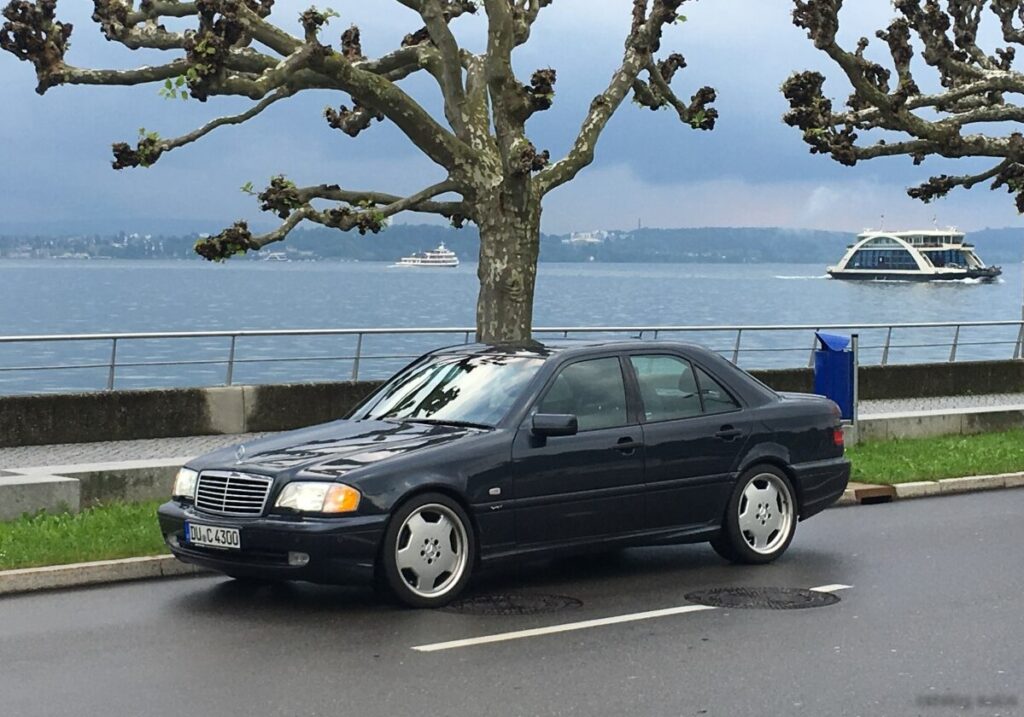
The Mercedes-Benz C 240 V6, produced from June 1997 to May 2000, was a significant variant within the W202 C-Class range, particularly after the 1997 facelift. Representing a step up in performance and refinement from the four-cylinder models, the C 240 V6 aimed to offer a more luxurious and capable experience while remaining accessible to a broader customer base. It occupied a mid-range position in the lineup, bridging the gap between the entry-level C 180/C 200 and the higher-performance C 280/C 36 AMG models. This model was primarily marketed in Europe and other international markets, offering a blend of German engineering and a comfortable driving experience.
Technical Specifications
| Brand | Mercedes-Benz |
| Model | C-class |
| Generation | C-class (W202, facelift 1997) |
| Type (Engine) | C 240 V6 (170 Hp) 5G-TRONIC |
| Start of production | June, 1997 |
| End of production | May, 2000 |
| Powertrain Architecture | Internal Combustion engine |
| Body type | Sedan |
| Seats | 5 |
| Doors | 4 |
| Fuel consumption (economy) – urban (NEDC) | 14.3 l/100 km (16.4 US mpg, 19.8 UK mpg, 7 km/l) |
| Fuel consumption (economy) – extra urban (NEDC) | 7.3 l/100 km (32.2 US mpg, 38.7 UK mpg, 13.7 km/l) |
| Fuel consumption (economy) – combined (NEDC) | 9.9 l/100 km (23.8 US mpg, 28.5 UK mpg, 10.1 km/l) |
| CO2 emissions (NEDC) | 235 g/km |
| Fuel Type | Petrol (Gasoline) |
| Acceleration 0 – 100 km/h | 9.9 sec |
| Acceleration 0 – 62 mph | 9.9 sec |
| Acceleration 0 – 60 mph | 9.4 sec |
| Maximum speed | 214 km/h (132.97 mph) |
| Emission standard | Euro 3 |
| Weight-to-power ratio | 8.4 kg/Hp, 119.7 Hp/tonne |
| Weight-to-torque ratio | 6.3 kg/Nm, 158.5 Nm/tonne |
| Power | 170 Hp @ 5900 rpm |
| Power per litre | 70.9 Hp/l |
| Torque | 225 Nm @ 3000-4500 rpm (165.95 lb.-ft. @ 3000-4500 rpm) |
| Engine layout | Front, Longitudinal |
| Engine Model/Code | M 112 E 24 / 112.910 |
| Engine displacement | 2398 cm3 (146.33 cu. in.) |
| Number of cylinders | 6 |
| Engine configuration | V-engine |
| Cylinder Bore | 83.2 mm (3.28 in.) |
| Piston Stroke | 73.5 mm (2.89 in.) |
| Compression ratio | 10:1 |
| Number of valves per cylinder | 3 |
| Fuel injection system | Multi-port manifold injection |
| Engine aspiration | Naturally aspirated engine |
| Valvetrain | SOHC |
| Engine oil capacity | 8 l (8.45 US qt | 7.04 UK qt) |
| Coolant | 9.5 l (10.04 US qt | 8.36 UK qt) |
| Kerb Weight | 1420 kg (3130.56 lbs.) |
| Max. weight | 1900 kg (4188.78 lbs.) |
| Max load | 480 kg (1058.22 lbs.) |
| Trunk (boot) space – minimum | 430 l (15.19 cu. ft.) |
| Fuel tank capacity | 62 l (16.38 US gal | 13.64 UK gal) |
| Max. roof load | 100 kg (220.46 lbs.) |
| Permitted trailer load with brakes (12%) | 1500 kg (3306.93 lbs.) |
| Permitted trailer load without brakes | 710 kg (1565.28 lbs.) |
| Length | 4516 mm (177.8 in.) |
| Width | 1723 mm (67.83 in.) |
| Height | 1427 mm (56.18 in.) |
| Wheelbase | 2690 mm (105.91 in.) |
| Front track | 1499 mm (59.02 in.) |
| Rear (Back) track | 1464 mm (57.64 in.) |
| Drag coefficient (Cd) | 0.31 |
| Minimum turning circle (turning diameter) | 10.74 m (35.24 ft.) |
| Drivetrain Architecture | The Internal combustion engine (ICE) drives the rear wheels of the vehicle. |
| Drive wheel | Rear wheel drive |
| Number of gears and type of gearbox | 5 gears, automatic transmission G-TRONIC |
| Front suspension | Double wishbone, Transverse stabilizer |
| Rear suspension | Independent multi-link spring suspension with stabilizer |
| Front brakes | Ventilated discs |
| Rear brakes | Disc |
| Assisting systems | ABS (Anti-lock braking system) |
| Steering type | Cone worm with recirculation balls |
| Power steering | Hydraulic Steering |
| Tires size | 195/65 R15; 205/60 R15 |
| Wheel rims size | 6.5J x 15; 7J x 15 |
Powertrain & Engine Architecture
The C 240 V6 was powered by the M112 E 24 engine, a 2.4-liter naturally aspirated V6. This engine was a significant departure from the earlier inline-four engines used in the C-Class, offering smoother operation and increased power. The M112 featured a 60-degree V-angle, three valves per cylinder (two intake, one exhaust), and a single overhead camshaft (SOHC) design. Fuel delivery was handled by a multi-port fuel injection system, ensuring precise fuel metering for optimal combustion. The engine produced 170 horsepower at 5900 rpm and 225 Nm (165.95 lb-ft) of torque between 3000 and 4500 rpm. Paired with the engine was the 5G-TRONIC automatic transmission, a five-speed unit known for its smooth shifting and adaptability. This transmission was designed to provide a balance between fuel efficiency and performance, and its gear ratios were tuned to complement the V6 engine’s power delivery.
Driving Characteristics
The C 240 V6 with the 5G-TRONIC transmission offered a comfortable and refined driving experience. While not overtly sporty, the V6 engine provided ample power for everyday driving and confident overtaking. The automatic transmission, while smooth, wasn’t particularly quick to downshift, meaning the engine sometimes felt slightly strained during aggressive acceleration. Compared to the manual transmission versions of the C 240, the automatic offered less driver engagement but greater convenience. The 5G-TRONIC’s gear ratios were optimized for cruising, making it a pleasant companion on long journeys. The rear-wheel drive configuration provided balanced handling, although it lacked the all-weather capability of some competitors.
Equipment & Trim Levels
The C 240 V6 typically came equipped with a respectable level of standard features. These included power windows, central locking, air conditioning, and an audio system. Interior upholstery was usually cloth, although leather was available as an option. Optional extras included a sunroof, heated seats, automatic climate control, and upgraded audio systems. The dashboard layout was typical of Mercedes-Benz at the time, featuring a functional and understated design. Trim levels varied slightly depending on the market, but generally, the C 240 V6 offered a more luxurious interior than the base C 180/C 200 models.
Chassis & Braking
The C 240 V6 utilized a double wishbone front suspension and an independent multi-link rear suspension, providing a comfortable ride and good handling characteristics. Stabilizer bars were fitted to both axles to reduce body roll during cornering. Braking duties were handled by ventilated discs at the front and solid discs at the rear. Anti-lock Braking System (ABS) was standard, enhancing safety and control during emergency braking. The suspension was tuned to prioritize comfort over outright sportiness, making it well-suited for everyday driving conditions.
Market Reception & Comparison
The C 240 V6 was generally well-received by automotive critics. It was praised for its smooth engine, comfortable ride, and refined interior. However, some critics noted that the automatic transmission could feel sluggish at times, and the car wasn’t as engaging to drive as some of its rivals. Compared to the C 280, the C 240 V6 offered a more affordable entry point into the six-cylinder C-Class range, while still providing a significant step up in performance and refinement over the four-cylinder models. Fuel economy was reasonable for a V6 engine of that era, but it wasn’t as efficient as the smaller-engined versions.
Legacy
The M112 engine family, including the 2.4-liter version found in the C 240 V6, proved to be relatively reliable. With proper maintenance, these engines can last for many years. The 5G-TRONIC transmission is also generally durable, although it may require servicing as it ages. Today, the C 240 V6 represents an affordable entry point into Mercedes-Benz ownership. Well-maintained examples are still relatively common on the used car market, and they offer a comfortable and reliable driving experience. While not a collector’s item, the C 240 V6 is appreciated by enthusiasts for its blend of German engineering and classic Mercedes-Benz styling.