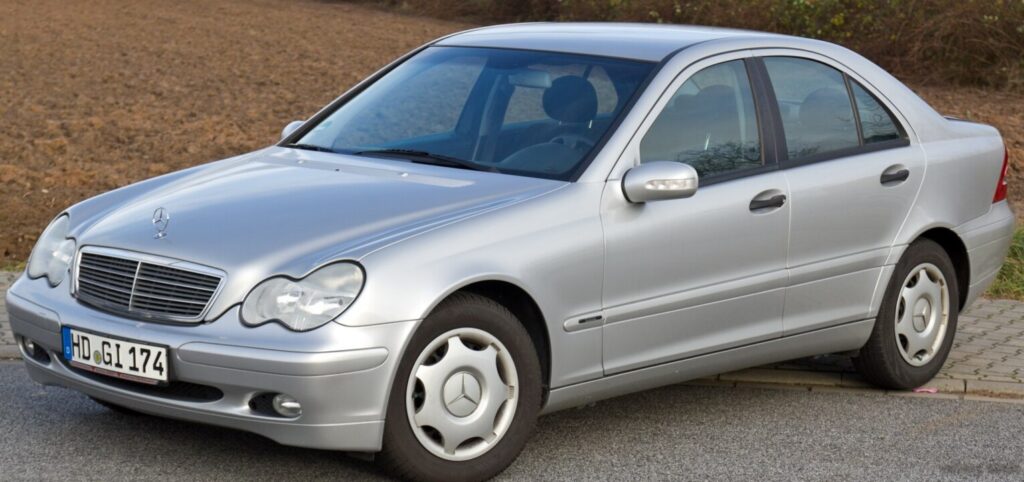
The Mercedes-Benz C 180, produced between August 2000 and August 2002, was an entry-level variant of the W203 C-Class sedan. Positioned as the most accessible model in the range, it offered Mercedes-Benz luxury and build quality to a broader customer base. The W203 generation, launched in 2000, represented a significant step forward for Mercedes-Benz in terms of modern design and technology, moving away from the more conservative styling of its predecessors. The C 180 specifically targeted buyers prioritizing fuel efficiency and affordability within the premium compact executive segment, while still delivering the core Mercedes-Benz experience. It served as a stepping stone into the C-Class lineup, offering a more economical alternative to the more powerful C 200 Kompressor, C 230 Kompressor, and C 320 models.
Technical Specifications
| Brand | Mercedes-Benz |
| Model | C-class |
| Generation | C-class (W203) |
| Type (Engine) | C 180 (129 Hp) |
| Start of production | August, 2000 |
| End of production | August, 2002 |
| Powertrain Architecture | Internal Combustion engine |
| Body type | Sedan |
| Seats | 5 |
| Doors | 4 |
| Fuel consumption (economy) – urban (NEDC) | 13.9 l/100 km (16.9 US mpg, 20.3 UK mpg, 7.2 km/l) |
| Fuel consumption (economy) – extra urban (NEDC) | 6.8 l/100 km (34.6 US mpg, 41.5 UK mpg, 14.7 km/l) |
| Fuel consumption (economy) – combined (NEDC) | 9.4 l/100 km (25 US mpg, 30.1 UK mpg, 10.6 km/l) |
| CO2 emissions (NEDC) | 225 g/km |
| Fuel Type | Petrol (Gasoline) |
| Acceleration 0 – 100 km/h | 10.1 sec |
| Acceleration 0 – 62 mph | 10.1 sec |
| Acceleration 0 – 60 mph | 9.6 sec |
| Maximum speed | 210 km/h (130.49 mph) |
| Weight-to-power ratio | 10.7 kg/Hp, 93.5 Hp/tonne |
| Weight-to-torque ratio | 7.3 kg/Nm, 137.7 Nm/tonne |
| Power | 129 Hp @ 5300 rpm |
| Power per litre | 64.6 Hp/l |
| Torque | 190 Nm @ 4000 rpm (140.14 lb.-ft. @ 4000 rpm) |
| Maximum engine speed | 6200 rpm |
| Engine layout | Front, Longitudinal |
| Engine Model/Code | M 111.951 |
| Engine displacement | 1998 cm3 (121.93 cu. in.) |
| Number of cylinders | 4 |
| Engine configuration | Inline |
| Cylinder Bore | 89.9 mm (3.54 in.) |
| Piston Stroke | 78.7 mm (3.1 in.) |
| Compression ratio | 10.6:1 |
| Number of valves per cylinder | 4 |
| Fuel injection system | Multi-port manifold injection |
| Engine aspiration | Naturally aspirated engine |
| Valvetrain | DOHC |
| Engine oil capacity | 7 l (7.4 US qt | 6.16 UK qt) |
| Coolant | 8 l (8.45 US qt | 7.04 UK qt) |
| Kerb Weight | 1380 kg (3042.38 lbs.) |
| Max. weight | 1935 kg (4265.94 lbs.) |
| Max load | 555 kg (1223.57 lbs.) |
| Trunk (boot) space – minimum | 455 l (16.07 cu. ft.) |
| Fuel tank capacity | 62 l (16.38 US gal | 13.64 UK gal) |
| Max. roof load | 100 kg (220.46 lbs.) |
| Permitted trailer load with brakes (12%) | 1500 kg (3306.93 lbs.) |
| Permitted trailer load without brakes | 725 kg (1598.35 lbs.) |
| Length | 4526 mm (178.19 in.) |
| Width | 1728 mm (68.03 in.) |
| Width including mirrors | 1980 mm (77.95 in.) |
| Height | 1426 mm (56.14 in.) |
| Wheelbase | 2715 mm (106.89 in.) |
| Front track | 1505 mm (59.25 in.) |
| Rear (Back) track | 1476 mm (58.11 in.) |
| Front overhang | 755 mm (29.72 in.) |
| Rear overhang | 1056 mm (41.57 in.) |
| Drag coefficient (Cd) | 0.26 |
| Minimum turning circle (turning diameter) | 10.76 m (35.3 ft.) |
| Drivetrain Architecture | The Internal combustion engine (ICE) drives the rear wheels of the vehicle. |
| Drive wheel | Rear wheel drive |
| Number of gears and type of gearbox | 6 gears, manual transmission |
| Front suspension | Independent type McPherson, Transverse stabilizer |
| Rear suspension | Independent multi-link suspension, Transverse stabilizer |
| Front brakes | Ventilated discs, 288 mm |
| Rear brakes | Disc, 278 mm |
| Assisting systems | ABS (Anti-lock braking system) |
| Steering type | Steering rack and pinion |
| Power steering | Hydraulic Steering |
| Tires size | 195/65 R 15 91 H |
| Wheel rims size | 6 J x 15 H 2 |
Powertrain & Engine Architecture
The C 180 was powered by the M111.951, a 1.998-liter (2.0L) inline-four cylinder engine. This engine was a naturally aspirated design, utilizing multi-port fuel injection. The engine featured a double overhead camshaft (DOHC) valvetrain with four valves per cylinder, contributing to its relatively efficient operation. The M111 engine family was known for its durability and relatively simple design, making it easier to maintain compared to some of its more technologically advanced counterparts. The engine produced 129 horsepower at 5300 rpm and 190 Nm (140 lb-ft) of torque at 4000 rpm. The engine was longitudinally mounted in the engine bay, driving the rear wheels. The standard transmission for the C 180 was a 6-speed manual gearbox, although a 5-speed automatic transmission was also available as an option. The automatic transmission, while offering convenience, did slightly impact acceleration and fuel economy compared to the manual version.
Driving Characteristics
The C 180, particularly with the manual transmission, offered a reasonably engaging driving experience for its class. However, with 129 hp propelling a curb weight of around 1380 kg (3042 lbs), acceleration was not its strong suit. The 0-60 mph sprint took approximately 9.6 seconds, and the top speed was limited to 210 km/h (130 mph). The automatic transmission version was slightly slower. The engine delivered adequate power for everyday driving, but overtaking maneuvers required careful planning. The rear-wheel-drive configuration provided a balanced feel, and the suspension offered a comfortable ride, typical of Mercedes-Benz. The gear ratios in the manual transmission were well-spaced, allowing the engine to remain in its optimal power band. The automatic transmission, while smooth, sometimes felt hesitant during quick acceleration.
Equipment & Trim Levels
The C 180 typically came standard with features such as power windows, central locking, air conditioning, and an audio system. Interior upholstery was generally cloth, although leather options were available. The dashboard layout was functional and well-built, reflecting Mercedes-Benz’s commitment to quality. Optional extras included sunroof, upgraded audio systems, alloy wheels, and automatic climate control. The C 180 was often seen as a base model, so it lacked some of the more luxurious features found in higher-trim C-Class variants. However, it provided a solid foundation for those seeking a comfortable and well-equipped entry-level luxury sedan.
Chassis & Braking
The W203 C-Class featured an independent suspension system all around. The front suspension utilized McPherson struts with a transverse stabilizer bar, while the rear suspension employed a multi-link setup, also with a stabilizer bar. This configuration provided a good balance between ride comfort and handling. The C 180 was equipped with ventilated disc brakes at the front and solid disc brakes at the rear. Anti-lock Braking System (ABS) was standard. The steering was a rack-and-pinion system with hydraulic power assistance, providing precise and responsive steering feel. The tire size was typically 195/65 R15.
Market Reception & Comparison
The C 180 was generally well-received as an affordable entry point into the C-Class range. Critics praised its build quality, comfortable ride, and fuel efficiency. However, some reviewers noted its relatively modest performance compared to the more powerful C-Class models. Compared to the C 200 Kompressor, the C 180 offered lower running costs but lacked the extra punch provided by the supercharged engine. The C 180’s fuel economy was competitive for its class, averaging around 9.4 l/100 km (25 US mpg) in combined driving. Reliability was generally good, although routine maintenance was essential to ensure long-term durability.
Legacy
The M111 engine, found in the C 180, is known for its robustness and longevity. Well-maintained examples can still be found on the road today. The C 180, while not the most sought-after C-Class variant, represents a good value proposition in the used car market. Its relatively simple mechanicals and readily available parts make it a relatively affordable classic Mercedes-Benz to own and maintain. The W203 C-Class, as a whole, helped solidify Mercedes-Benz’s position in the compact executive segment, and the C 180 played a crucial role in attracting a wider range of customers to the brand.