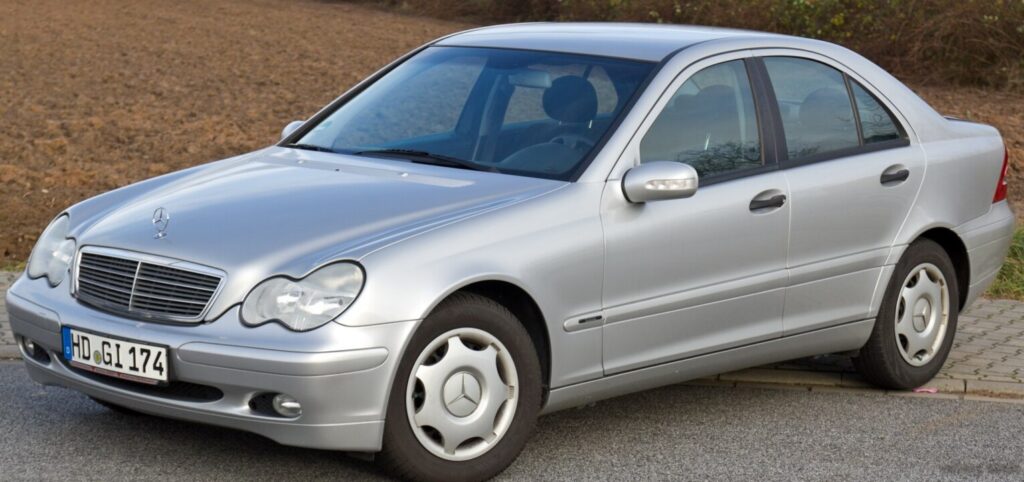
The Mercedes-Benz C-Class (W203) C 200 Kompressor Automatic, produced from February 2000 to August 2002, represented a key entry point into the premium compact executive car segment for Mercedes-Benz. Positioned as a mid-range offering within the W203 series, it aimed to balance performance, comfort, and affordability. This variant utilized a supercharged 2.0-liter inline-four engine paired with a five-speed automatic transmission, catering to buyers prioritizing ease of use over outright sportiness. The W203 generation itself was a significant model for Mercedes-Benz, representing a move towards a more modern and contemporary design language, and establishing a stronger foothold in the competitive C-segment.
Technical Specifications
| Brand | Mercedes-Benz |
| Model | C-class |
| Generation | C-class (W203) |
| Type (Engine) | C 200 Kompressor (163 Hp) Automatic |
| Start of production | February, 2000 |
| End of production | August, 2002 |
| Powertrain Architecture | Internal Combustion engine |
| Body type | Sedan |
| Seats | 5 |
| Doors | 4 |
| Fuel consumption (economy) – urban (NEDC) | 13.8 l/100 km (17 US mpg, 20.5 UK mpg, 7.2 km/l) |
| Fuel consumption (economy) – extra urban (NEDC) | 7 l/100 km (33.6 US mpg, 40.4 UK mpg, 14.3 km/l) |
| Fuel consumption (economy) – combined (NEDC) | 9.5 l/100 km (24.8 US mpg, 29.7 UK mpg, 10.5 km/l) |
| CO2 emissions (NEDC) | 227 g/km |
| Fuel Type | Petrol (Gasoline) |
| Acceleration 0 – 100 km/h | 9.7 sec |
| Acceleration 0 – 62 mph | 9.7 sec |
| Acceleration 0 – 60 mph | 9.2 sec |
| Maximum speed | 227 km/h (141.05 mph) |
| Power | 163 Hp @ 5300 rpm |
| Torque | 230 Nm @ 2500-4800 rpm (169.64 lb.-ft. @ 2500-4800 rpm) |
| Maximum engine speed | 6500 rpm |
| Engine layout | Front, Longitudinal |
| Engine Model/Code | M 111.955 |
| Engine displacement | 1998 cm3 (121.93 cu. in.) |
| Number of cylinders | 4 |
| Engine configuration | Inline |
| Cylinder Bore | 89.9 mm (3.54 in.) |
| Piston Stroke | 78.7 mm (3.1 in.) |
| Compression ratio | 9.5:1 |
| Number of valves per cylinder | 4 |
| Fuel injection system | Multi-port manifold injection |
| Engine aspiration | Supercharger, Intercooler |
| Valvetrain | DOHC |
| Engine oil capacity | 7 l (7.4 US qt | 6.16 UK qt) |
| Coolant | 8 l (8.45 US qt | 7.04 UK qt) |
| Kerb Weight | 1415 kg (3119.54 lbs.) |
| Max. weight | 1970 kg (4343.11 lbs.) |
| Max load | 555 kg (1223.57 lbs.) |
| Trunk (boot) space – minimum | 455 l (16.07 cu. ft.) |
| Fuel tank capacity | 62 l (16.38 US gal | 13.64 UK gal) |
| Max. roof load | 100 kg (220.46 lbs.) |
| Permitted trailer load with brakes (12%) | 1500 kg (3306.93 lbs.) |
| Permitted trailer load without brakes | 745 kg (1642.44 lbs.) |
| Length | 4526 mm (178.19 in.) |
| Width | 1728 mm (68.03 in.) |
| Width including mirrors | 1980 mm (77.95 in.) |
| Height | 1426 mm (56.14 in.) |
| Wheelbase | 2715 mm (106.89 in.) |
| Front track | 1505 mm (59.25 in.) |
| Rear (Back) track | 1476 mm (58.11 in.) |
| Front overhang | 755 mm (29.72 in.) |
| Rear overhang | 1056 mm (41.57 in.) |
| Drag coefficient (Cd) | 0.27 |
| Minimum turning circle (turning diameter) | 10.76 m (35.3 ft.) |
| Drivetrain Architecture | The Internal combustion engine (ICE) drives the rear wheels of the vehicle. |
| Drive wheel | Rear wheel drive |
| Number of gears and type of gearbox | 5 gears, automatic transmission |
| Front suspension | Independent type McPherson, Transverse stabilizer |
| Rear suspension | Independent multi-link suspension, Transverse stabilizer |
| Front brakes | Ventilated discs, 288 mm |
| Rear brakes | Disc, 278 mm |
| Assisting systems | ABS (Anti-lock braking system) |
| Steering type | Steering rack and pinion |
| Power steering | Hydraulic Steering |
| Tires size | 195/65 R 15 91 V |
| Wheel rims size | 6 J x 15 H 2 |
Powertrain & Engine Architecture
The heart of the C 200 Kompressor was the M111.955 2.0-liter inline-four engine. This engine was notable for its use of a mechanically driven supercharger (Kompressor in Mercedes terminology) rather than a turbocharger. The supercharger, a Lysholm-type unit, provided near-instant boost across the rev range, resulting in a more linear power delivery compared to a turbocharged engine. Fuel was delivered via multi-port fuel injection, and the engine featured a double overhead camshaft (DOHC) valvetrain with four valves per cylinder. The five-speed automatic transmission (typically the 722.6) was chosen for its smoothness and convenience, although it wasn’t known for its particularly quick shift times. This transmission featured electronic control for optimized shift points based on throttle position and vehicle speed.
Driving Characteristics
The C 200 Kompressor Automatic offered a comfortable and refined driving experience. With 163 horsepower and 230 Nm (169.64 lb-ft) of torque, acceleration to 60 mph took around 9.2 seconds, and it reached a top speed of 141 mph. While not a sports car, the supercharger provided ample low-end torque, making it feel responsive in everyday driving situations. The automatic transmission, while smooth, could feel somewhat sluggish during quick overtaking maneuvers. Compared to the manual transmission version, the automatic sacrificed some responsiveness, and the higher-output C 230 Kompressor offered significantly more performance. The gear ratios were tuned for fuel efficiency and comfort rather than outright acceleration.
Equipment & Trim Levels
The C 200 Kompressor Automatic typically came standard with features such as air conditioning, power windows, central locking, and an audio system. Interior upholstery was usually cloth, although leather was available as an option. Dashboard trim could be specified in wood or aluminum. Common optional extras included a sunroof, upgraded audio systems, and parking sensors. The trim level generally fell in the mid-range of the W203 lineup, offering a good balance of features and price. It was positioned above the base C 180 Kompressor but below the more powerful C 230 Kompressor and C 320 models.
Chassis & Braking
The W203 C-Class featured an independent suspension system all around, with McPherson struts at the front and a multi-link setup at the rear. This provided a comfortable ride and good handling characteristics. The C 200 Kompressor typically came equipped with ventilated disc brakes at the front and solid discs at the rear. Anti-lock braking system (ABS) was standard. Stabilizer bars were fitted to both the front and rear axles to reduce body roll during cornering. The suspension was tuned for comfort, prioritizing ride quality over aggressive handling.
Market Reception & Comparison
The C 200 Kompressor Automatic was generally well-received by critics as a practical and comfortable entry-level luxury sedan. It was praised for its smooth engine, comfortable ride, and well-appointed interior. However, some reviewers noted that the automatic transmission could feel slow to respond, and the performance wasn’t as exhilarating as some of its rivals. Compared to the manual transmission version, fuel economy was slightly lower, but the convenience of the automatic was a significant draw for many buyers. In terms of reliability, the M111 engine proved to be relatively robust, although regular maintenance was essential.
Legacy
The M111 engine, in its various iterations, proved to be a durable and reliable powerplant. The C 200 Kompressor Automatic, while not the most sought-after W203 variant today, remains a relatively affordable and practical option in the used car market. Its combination of comfort, fuel efficiency, and reasonable performance makes it a good choice for those seeking a classic Mercedes-Benz experience without breaking the bank. Parts availability is generally good, and the car’s relatively simple mechanical design makes it easier to maintain than some of the more complex modern vehicles.