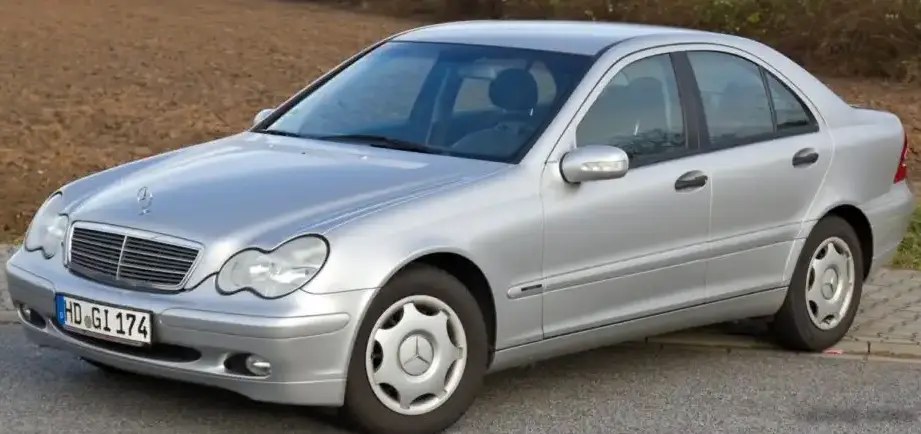
The Mercedes-Benz C 230 Kompressor, produced from November 2002 to March 2004, was a key variant within the W203 C-Class range. Positioned as a mid-range offering, it bridged the gap between the entry-level C 180 Kompressor and the more potent C 320 models. This model aimed to deliver a balance of performance and efficiency, appealing to buyers seeking a premium compact executive sedan with a touch of sporting character. The W203 generation, launched in 2000, represented a significant step forward for Mercedes-Benz in terms of build quality and modern technology, and the C 230 Kompressor exemplified these advancements.
Technical Specifications
| Brand | Mercedes-Benz |
| Model | C-class |
| Generation | C-class (W203) |
| Type (Engine) | C 230 Kompressor (192 Hp) 5G-TRONIC |
| Start of production | November, 2002 |
| End of production | March, 2004 |
| Powertrain Architecture | Internal Combustion engine |
| Body type | Sedan |
| Seats | 5 |
| Doors | 4 |
| Fuel consumption (economy) – urban (NEDC) | 13.8 l/100 km (17 US mpg, 20.5 UK mpg, 7.2 km/l) |
| Fuel consumption (economy) – extra urban (NEDC) | 7 l/100 km (33.6 US mpg, 40.4 UK mpg, 14.3 km/l) |
| Fuel consumption (economy) – combined (NEDC) | 9.5 l/100 km (24.8 US mpg, 29.7 UK mpg, 10.5 km/l) |
| Fuel Type | Petrol (Gasoline) |
| Weight-to-power ratio | 7.6 kg/Hp, 131.1 Hp/tonne |
| Weight-to-torque ratio | 5.6 kg/Nm, 177.5 Nm/tonne |
| Power | 192 Hp @ 5800 rpm |
| Power per litre | 106.9 Hp/l |
| Torque | 260 Nm @ 3500-4000 rpm (191.77 lb.-ft. @ 3500-4000 rpm) |
| Maximum engine speed | 6000 rpm |
| Engine layout | Front, Longitudinal |
| Engine Model/Code | M 271.948 |
| Engine displacement | 1796 cm3 (109.6 cu. in.) |
| Number of cylinders | 4 |
| Engine configuration | Inline |
| Cylinder Bore | 82 mm (3.23 in.) |
| Piston Stroke | 85 mm (3.35 in.) |
| Compression ratio | 8.5:1 |
| Number of valves per cylinder | 4 |
| Fuel injection system | Multi-port manifold injection |
| Engine aspiration | Supercharger, Intercooler |
| Valvetrain | DOHC |
| Engine oil capacity | 5.5 l (5.81 US qt, 4.84 UK qt) |
| Coolant | 8 l (8.45 US qt, 7.04 UK qt) |
| Kerb Weight | 1465 kg (3229.77 lbs.) |
| Max. weight | 1970 kg (4343.11 lbs.) |
| Max load | 505 kg (1113.33 lbs.) |
| Trunk (boot) space – minimum | 455 l (16.07 cu. ft.) |
| Fuel tank capacity | 62 l (16.38 US gal, 13.64 UK gal) |
| Max. roof load | 100 kg (220.46 lbs.) |
| Length | 4526 mm (178.19 in.) |
| Width | 1728 mm (68.03 in.) |
| Height | 1412-1433 mm (55.59 – 56.42 in.) |
| Wheelbase | 2715 mm (106.89 in.) |
| Front track | 1493-1505 mm (58.78 – 59.25 in.) |
| Rear (Back) track | 1464-1476 mm (57.64 – 58.11 in.) |
| Front overhang | 755 mm (29.72 in.) |
| Rear overhang | 1056 mm (41.57 in.) |
| Drag coefficient (Cd) | 0.27 |
| Minimum turning circle (turning diameter) | 10.76 m (35.3 ft.) |
| Drivetrain Architecture | The Internal combustion engine (ICE) drives the rear wheels of the vehicle. |
| Drive wheel | Rear wheel drive |
| Number of gears and type of gearbox | 5 gears, automatic transmission G-TRONIC |
| Front suspension | Independent, type McPherson with coil spring and anti-roll bar |
| Rear suspension | Independent multi-link spring suspension with stabilizer |
| Front brakes | Ventilated discs |
| Rear brakes | Disc |
| Assisting systems | ABS (Anti-lock braking system) |
| Steering type | Steering rack and pinion |
| Power steering | Hydraulic Steering |
| Tires size | 195/65 R15; 205/55 R16; 225/50 R16; 225/45 R17 |
| Wheel rims size | 6J x 15; 7J x 16; 7.5J x 17 |
Powertrain & Engine Architecture
The heart of the C 230 Kompressor was the M271.948 1.8-liter inline-four engine. This engine was a significant departure from previous Mercedes-Benz four-cylinder designs, featuring all-aluminum construction and a Roots-type supercharger. The supercharger, coupled with an intercooler, provided instant boost and a flatter torque curve compared to naturally aspirated engines. Fuel delivery was handled by a multi-port fuel injection system. The engine produced 192 horsepower at 5800 rpm and 260 Nm (191.77 lb-ft) of torque between 3500 and 4000 rpm. This power was channeled through a five-speed 5G-TRONIC automatic transmission, known for its smooth shifts and adaptive learning capabilities. The 5G-TRONIC transmission was designed to optimize fuel efficiency and provide a comfortable driving experience.
Driving Characteristics
The C 230 Kompressor with the 5G-TRONIC transmission offered a refined and comfortable driving experience. While not as overtly sporty as the manual transmission or higher-powered variants, the supercharged engine provided ample power for everyday driving and overtaking maneuvers. The automatic transmission’s gear ratios were tuned for efficiency and smoothness, prioritizing comfort over aggressive acceleration. Compared to the C 180 Kompressor, the C 230 offered a noticeable performance boost, while remaining more economical than the C 320. The supercharger eliminated much of the turbo lag often associated with forced induction, providing a responsive feel across the rev range. However, the automatic transmission did slightly diminish the sense of driver engagement compared to the available six-speed manual.
Equipment & Trim Levels
The C 230 Kompressor typically came standard with features such as automatic climate control, power windows and locks, a multi-function steering wheel, and an audio system. Upholstery was generally cloth, with leather options available as an upgrade. Optional extras included a sunroof, premium audio systems, navigation, and various driver assistance features. Trim levels varied depending on the market, but generally offered packages that bundled popular options together. The interior design was typical of Mercedes-Benz at the time, emphasizing quality materials and a sophisticated aesthetic.
Chassis & Braking
The W203 C-Class featured an independent suspension system at all four corners. The front suspension utilized a McPherson strut design, while the rear employed a multi-link setup. This configuration provided a good balance of ride comfort and handling. The C 230 Kompressor typically came equipped with ventilated disc brakes at the front and solid discs at the rear. Anti-lock braking system (ABS) was standard. The suspension was tuned to provide a comfortable ride, but the chassis was capable of handling spirited driving. Stabilizer bars were fitted front and rear to reduce body roll.
Market Reception & Comparison
The C 230 Kompressor was generally well-received by automotive critics. It was praised for its refined engine, comfortable ride, and high-quality interior. However, some reviewers noted that the automatic transmission could feel slightly sluggish at times. Compared to the C 180 Kompressor, the C 230 offered a significant performance upgrade, making it a more appealing option for drivers who prioritized power. Fuel economy was respectable, averaging around 24.8 US mpg in combined driving. Reliability was generally good, although some owners reported issues with the supercharger and electronic components.
Legacy
The M271 engine family, including the 1.8-liter supercharged variant found in the C 230 Kompressor, proved to be relatively durable. While preventative maintenance is crucial, these engines can often reach high mileage with proper care. Today, the W203 C 230 Kompressor represents an affordable entry point into Mercedes-Benz ownership. The cars are readily available on the used market, and parts are generally accessible. While not a collector’s item, the C 230 Kompressor remains a popular choice for those seeking a comfortable, reliable, and relatively fuel-efficient compact executive sedan.