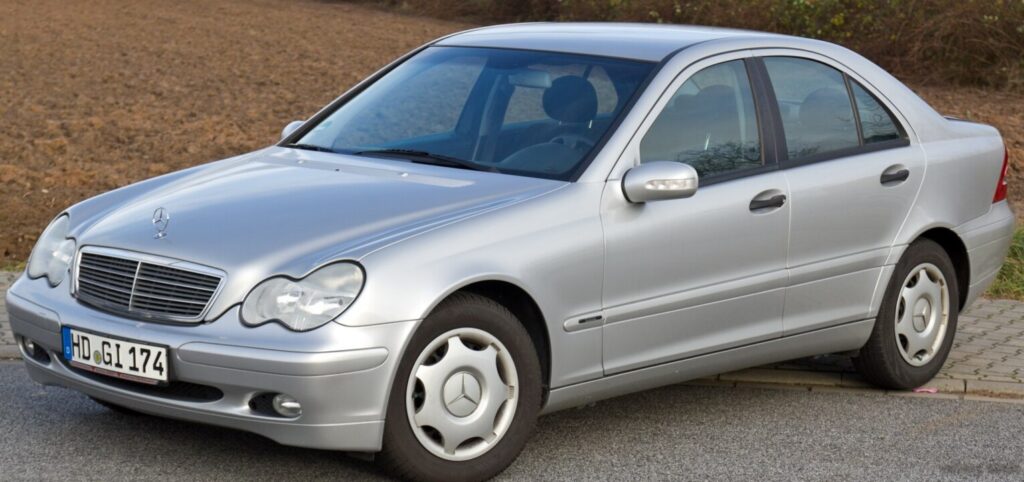
The Mercedes-Benz C-Class (W203) C 270 CDI, produced from November 2000 to March 2004, represented a significant step forward in diesel technology for the compact executive car segment. Positioned as a mid-range offering within the W203 lineup, it bridged the gap between the more economical C 200 CDI and the higher-performance C 320 CDI. This variant aimed to deliver a blend of fuel efficiency, respectable performance, and the luxury expected from the Mercedes-Benz brand. The C 270 CDI was primarily marketed in Europe, where diesel engines held a much larger market share than in North America, and quickly became a popular choice for drivers seeking a refined and economical touring car.
Technical Specifications
| Brand | Mercedes-Benz |
| Model | C-class |
| Generation | C-class (W203) |
| Type (Engine) | C 270 CDI (170 Hp) |
| Start of production | November, 2000 year |
| End of production | March, 2004 year |
| Powertrain Architecture | Internal Combustion engine |
| Body type | Sedan |
| Seats | 5 |
| Doors | 4 |
| Fuel consumption (economy) – urban (NEDC) | 9.7 l/100 km (24.2 US mpg, 29.1 UK mpg, 10.3 km/l) |
| Fuel consumption (economy) – extra urban (NEDC) | 5.1 l/100 km (46.1 US mpg, 55.4 UK mpg, 19.6 km/l) |
| Fuel consumption (economy) – combined (NEDC) | 6.8 l/100 km (34.6 US mpg, 41.5 UK mpg, 14.7 km/l) |
| CO2 emissions (NEDC) | 181 g/km |
| Fuel Type | Diesel |
| Acceleration 0 – 100 km/h | 8.9 sec |
| Acceleration 0 – 62 mph | 8.9 sec |
| Acceleration 0 – 60 mph | 8.5 sec |
| Maximum speed | 230 km/h (142.92 mph) |
| Power | 170 Hp @ 4200 rpm |
| Torque | 370 Nm @ 1600-2800 rpm (272.9 lb.-ft. @ 1600-2800 rpm) |
| Maximum engine speed | 4500 rpm |
| Engine layout | Front, Longitudinal |
| Engine Model/Code | OM 612.962 |
| Engine displacement | 2685 cm3 (163.85 cu. in.) |
| Number of cylinders | 5 |
| Engine configuration | Inline |
| Cylinder Bore | 88 mm (3.46 in.) |
| Piston Stroke | 88.3 mm (3.48 in.) |
| Compression ratio | 18:1 |
| Number of valves per cylinder | 4 |
| Fuel injection system | Diesel Commonrail |
| Engine aspiration | Turbocharger, Intercooler |
| Valvetrain | DOHC |
| Engine oil capacity | 6.5 l (6.87 US qt | 5.72 UK qt) |
| Coolant | 10.5 l (11.1 US qt | 9.24 UK qt) |
| Kerb Weight | 1525 kg (3362.05 lbs.) |
| Max. weight | 2080 kg (4585.62 lbs.) |
| Max load | 555 kg (1223.57 lbs.) |
| Trunk (boot) space – minimum | 455 l (16.07 cu. ft.) |
| Fuel tank capacity | 62 l (16.38 US gal | 13.64 UK gal) |
| Length | 4526 mm (178.19 in.) |
| Width | 1728 mm (68.03 in.) |
| Width including mirrors | 1980 mm (77.95 in.) |
| Height | 1427 mm (56.18 in.) |
| Wheelbase | 2715 mm (106.89 in.) |
| Front track | 1493 mm (58.78 in.) |
| Rear (Back) track | 1464 mm (57.64 in.) |
| Front overhang | 755 mm (29.72 in.) |
| Rear overhang | 1056 mm (41.57 in.) |
| Drag coefficient (Cd) | 0.27 |
| Minimum turning circle | 10.76 m (35.3 ft.) |
| Drivetrain Architecture | Rear wheel drive |
| Number of gears and type of gearbox | 6 gears, manual transmission |
| Front suspension | Independent type McPherson, Transverse stabilizer |
| Rear suspension | Independent multi-link suspension, Transverse stabilizer |
| Front brakes | Ventilated discs, 300 mm |
| Rear brakes | Disc, 290 mm |
| Assisting systems | ABS (Anti-lock braking system) |
| Steering type | Steering rack and pinion |
| Power steering | Hydraulic Steering |
| Tires size | 205/55 R 16 91 V |
| Wheel rims size | 7 J x 16 H 2 |
Powertrain & Engine Architecture
The heart of the C 270 CDI is the OM 612.962, a 2.7-liter inline-five cylinder diesel engine. This engine was a significant advancement for Mercedes-Benz, utilizing common rail direct injection technology. This system, supplied by Bosch, allowed for multiple injections per combustion cycle, resulting in quieter operation, reduced emissions, and improved fuel efficiency. The engine featured a single turbocharger with an intercooler, boosting power output to 170 horsepower at 4200 rpm and a substantial 370 Nm (272.9 lb-ft) of torque available from a low 1600 rpm all the way to 2800 rpm. The engine’s robust bottom end and carefully tuned valvetrain (Double Overhead Camshaft – DOHC, 4 valves per cylinder) contributed to its durability and smooth power delivery. The C 270 CDI was typically paired with a 6-speed manual transmission, although a 5-speed automatic transmission was also available, albeit less common.
Driving Characteristics
The C 270 CDI offered a distinctly different driving experience compared to its gasoline-powered siblings. While not a sports car, the engine’s ample torque provided strong acceleration, particularly in the mid-range. The 0-60 mph sprint took around 8.5 seconds, and top speed was electronically limited to 230 km/h (143 mph). The manual transmission allowed for precise control, while the automatic, though offering convenience, felt somewhat less responsive. The focus was on effortless cruising and relaxed long-distance driving. The relatively high weight of the W203 chassis meant that the C 270 CDI wasn’t particularly nimble, but the well-tuned suspension provided a comfortable ride. Compared to the C 200 CDI, the C 270 CDI offered a noticeable performance boost, while remaining more fuel-efficient than the C 320 CDI.
Equipment & Trim Levels
The C 270 CDI typically came equipped with a respectable level of standard features, including automatic climate control, power windows and mirrors, a multi-function steering wheel, and an audio system. Upholstery was generally cloth, but leather options were available. Optional extras included sunroof, navigation system, heated seats, and upgraded audio systems. Trim levels varied slightly depending on the market, but generally followed a progression from base ‘Classic’ to more luxurious ‘Elegance’ and sporty ‘Avantgarde’ specifications. The Avantgarde trim often included sport suspension, alloy wheels, and more aggressive styling cues.
Chassis & Braking
The W203 C-Class utilized a MacPherson strut front suspension and a multi-link independent rear suspension. The C 270 CDI, due to its weight, often featured slightly stiffer springs and dampers compared to the lighter models. Braking was typically accomplished with ventilated discs at the front and solid discs at the rear, with ABS (Anti-lock Braking System) standard. The steering was a hydraulic power-assisted rack and pinion system, providing a reasonably direct feel. Stabilizer bars were fitted front and rear to reduce body roll during cornering.
Market Reception & Comparison
The C 270 CDI was generally well-received by automotive critics. It was praised for its refined engine, good fuel economy (around 34.6 US mpg combined), and comfortable ride. However, some critics noted the slightly bland styling and the somewhat heavy steering. Compared to the C 200 CDI, the C 270 CDI offered a significant performance upgrade without a substantial penalty in fuel economy. Against the C 320 CDI, it provided a more balanced proposition, offering a good compromise between performance and running costs. The C 270 CDI proved to be a popular choice for fleet operators and private buyers alike.
Legacy
The OM 612 engine family, including the 2.7-liter variant found in the C 270 CDI, proved to be remarkably durable. With regular maintenance, these engines can reliably exceed 200,000 miles. However, common issues include injector failure, turbocharger wear, and potential problems with the glow plug system. On the used car market today, the C 270 CDI represents a relatively affordable entry point into Mercedes-Benz ownership. Its combination of fuel efficiency, comfort, and reliability makes it a practical and appealing choice for those seeking a well-built and refined compact executive car. While not a collector’s item, well-maintained examples are increasingly sought after by enthusiasts who appreciate the engineering and build quality of the W203 generation.