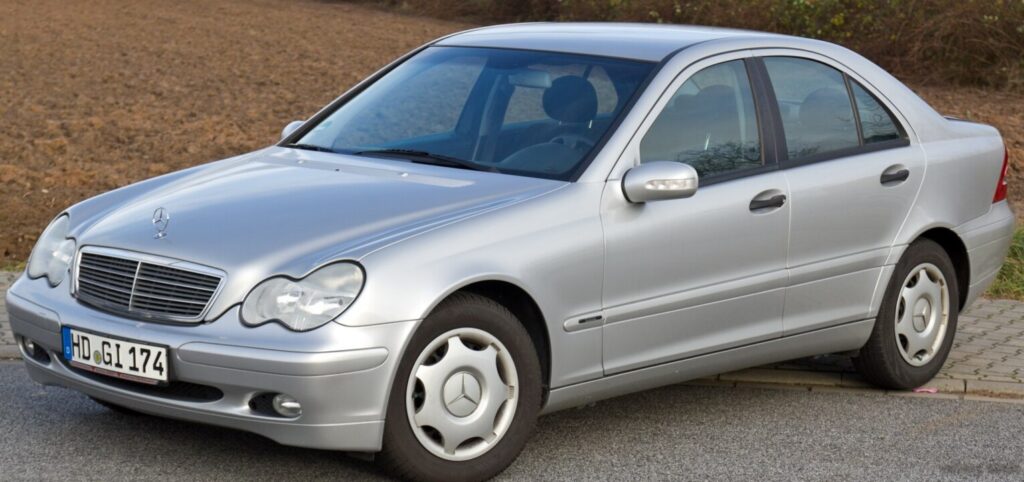
The Mercedes-Benz C-Class (W203) C 270 CDI Automatic, produced from November 2000 to March 2004, represented a significant step forward in diesel technology for the compact executive car segment. Positioned as a mid-range offering within the W203 lineup, it bridged the gap between the more affordable C 200 CDI and the performance-oriented C 320 CDI. This variant aimed to deliver a blend of fuel efficiency, respectable performance, and the luxury expected of the Mercedes-Benz brand, primarily targeting European buyers seeking a refined and economical touring car. The C 270 CDI was a key component of Mercedes’ strategy to offer compelling diesel alternatives in a market increasingly focused on fuel economy and reduced emissions.
Technical Specifications
| Brand | Mercedes-Benz |
| Model | C-class |
| Generation | C-class (W203) |
| Type (Engine) | C 270 CDI (170 Hp) Automatic |
| Start of production | November, 2000 year |
| End of production | March, 2004 year |
| Powertrain Architecture | Internal Combustion engine |
| Body type | Sedan |
| Seats | 5 |
| Doors | 4 |
| Fuel consumption (economy) – urban (NEDC) | 9.8 l/100 km (24 US mpg, 28.8 UK mpg, 10.2 km/l) |
| Fuel consumption (economy) – extra urban (NEDC) | 5.6 l/100 km (42 US mpg, 50.4 UK mpg, 17.9 km/l) |
| Fuel consumption (economy) – combined (NEDC) | 7.1 l/100 km (33.1 US mpg, 39.8 UK mpg, 14.1 km/l) |
| CO2 emissions (NEDC) | 189 g/km |
| Fuel Type | Diesel |
| Acceleration 0 – 100 km/h | 9.1 sec |
| Acceleration 0 – 62 mph | 9.1 sec |
| Acceleration 0 – 60 mph | 8.6 sec |
| Maximum speed | 225 km/h (139.81 mph) |
| Power | 170 Hp @ 4200 rpm |
| Torque | 370 Nm @ 1600-2800 rpm (272.9 lb.-ft. @ 1600-2800 rpm) |
| Maximum engine speed | 4800 rpm |
| Engine layout | Front, Longitudinal |
| Engine Model/Code | OM 612.962 |
| Engine displacement | 2685 cm3 (163.85 cu. in.) |
| Number of cylinders | 5 |
| Engine configuration | Inline |
| Cylinder Bore | 88 mm (3.46 in.) |
| Piston Stroke | 88.3 mm (3.48 in.) |
| Compression ratio | 18:1 |
| Number of valves per cylinder | 4 |
| Fuel injection system | Diesel Commonrail |
| Engine aspiration | Turbocharger, Intercooler |
| Valvetrain | DOHC |
| Engine oil capacity | 6.5 l (6.87 US qt | 5.72 UK qt) |
| Coolant | 10.5 l (11.1 US qt | 9.24 UK qt) |
| Kerb Weight | 1525 kg (3362.05 lbs.) |
| Max. weight | 2080 kg (4585.62 lbs.) |
| Max load | 555 kg (1223.57 lbs.) |
| Trunk (boot) space – minimum | 455 l (16.07 cu. ft.) |
| Fuel tank capacity | 62 l (16.38 US gal | 13.64 UK gal) |
| Max. roof load | 100 kg (220.46 lbs.) |
| Permitted trailer load with brakes (12%) | 1500 kg (3306.93 lbs.) |
| Permitted trailer load without brakes | 750 kg (1653.47 lbs.) |
| Length | 4526 mm (178.19 in.) |
| Width | 1728 mm (68.03 in.) |
| Width including mirrors | 1980 mm (77.95 in.) |
| Height | 1427 mm (56.18 in.) |
| Wheelbase | 2715 mm (106.89 in.) |
| Front track | 1493 mm (58.78 in.) |
| Rear (Back) track | 1464 mm (57.64 in.) |
| Front overhang | 755 mm (29.72 in.) |
| Rear overhang | 1056 mm (41.57 in.) |
| Drag coefficient (Cd) | 0.27 |
| Minimum turning circle (turning diameter) | 10.76 m (35.3 ft.) |
| Drivetrain Architecture | The Internal combustion engine (ICE) drives the rear wheels of the vehicle. |
| Drive wheel | Rear wheel drive |
| Number of gears and type of gearbox | 5 gears, automatic transmission |
| Front suspension | Independent type McPherson, Transverse stabilizer |
| Rear suspension | Independent multi-link suspension, Transverse stabilizer |
| Front brakes | Ventilated discs, 300 mm |
| Rear brakes | Disc, 290 mm |
| Assisting systems | ABS (Anti-lock braking system) |
| Steering type | Steering rack and pinion |
| Power steering | Hydraulic Steering |
| Tires size | 205/55 R 16 91 V |
| Wheel rims size | 7 J x 16 H 2 |
Powertrain & Engine Architecture
The heart of the C 270 CDI is the OM 612.962, a 2.7-liter inline-five cylinder diesel engine. This engine was a significant advancement for Mercedes-Benz, utilizing common rail direct injection technology. Bosch supplied the fuel injection system, capable of delivering multiple injections per combustion cycle for improved efficiency and reduced noise. The engine featured a turbocharger with an intercooler, boosting power output to 170 horsepower at 4200 rpm and a substantial 370 Nm (272.9 lb-ft) of torque between 1600 and 2800 rpm. The engine’s robust construction and relatively low redline of 4800 rpm prioritized durability and low-end grunt over high-revving performance. The five-speed automatic transmission, a conventional torque converter type, was specifically tuned to complement the engine’s torque characteristics, providing smooth shifts and adequate responsiveness.
Driving Characteristics
The C 270 CDI Automatic offered a comfortable and relaxed driving experience. While not overtly sporty, the engine’s ample torque provided brisk acceleration, with a 0-60 mph time of around 8.6 seconds. The automatic transmission, while smooth, wasn’t particularly quick to downshift, meaning overtaking maneuvers required some planning. Compared to the manual transmission versions of the C 270 CDI, the automatic sacrificed some responsiveness, but gained in ease of use, particularly in urban environments. Against the higher-output C 320 CDI, the C 270 CDI felt noticeably less powerful, but offered a more economical and refined driving experience. The rear-wheel drive configuration provided balanced handling, although it wasn’t as engaging as some of its competitors with front-wheel drive or all-wheel drive systems.
Equipment & Trim Levels
The C 270 CDI Automatic typically came equipped with a respectable level of standard features, including automatic climate control, power windows and mirrors, a multi-function steering wheel, and a basic audio system. Interior upholstery was generally cloth, although leather options were available. Optional extras included a sunroof, upgraded audio systems, navigation, and heated seats. Trim levels varied slightly depending on the market, but generally followed a progressive structure, with higher trims offering more luxurious appointments and additional features. The C 270 CDI aimed for a balance between comfort and practicality, offering a well-equipped interior without the excessive cost of the top-of-the-line models.
Chassis & Braking
The W203 C-Class featured an independent suspension setup at all four wheels. The front utilized a McPherson strut design, while the rear employed a multi-link suspension, both incorporating a transverse stabilizer bar to reduce body roll. Braking duties were handled by ventilated discs at the front and solid discs at the rear, equipped with ABS (Anti-lock Braking System) as standard. The suspension tuning prioritized ride comfort over outright handling prowess, providing a smooth and compliant ride on most road surfaces. The braking system was adequate for everyday use, but lacked the stopping power of some of its more performance-focused rivals.
Market Reception & Comparison
The C 270 CDI Automatic was generally well-received by automotive critics. It was praised for its fuel efficiency, comfortable ride, and refined engine. However, some reviewers noted the automatic transmission’s lack of responsiveness and the car’s somewhat bland styling. Compared to competitors like the BMW 320d and Audi A4 TDI, the C 270 CDI offered a more luxurious interior and a more comfortable ride, but lacked the same level of driving engagement. Fuel economy was competitive, typically achieving around 33-40 mpg in mixed driving conditions. Reliability was generally good, although some owners reported issues with the fuel injection system and the automatic transmission.
Legacy
The OM 612 engine family, including the 2.7-liter variant found in the C 270 CDI, proved to be remarkably durable. Well-maintained examples continue to be found on the road today, often with high mileage. The C 270 CDI Automatic has become a popular choice among enthusiasts seeking a comfortable, economical, and reliable classic Mercedes-Benz. On the used car market, prices for well-preserved examples remain relatively affordable, making it an attractive option for those looking for a taste of German engineering without breaking the bank. The C 270 CDI represents a pivotal moment in Mercedes-Benz’s diesel development, showcasing the potential of common rail technology and paving the way for future generations of efficient and refined diesel engines.