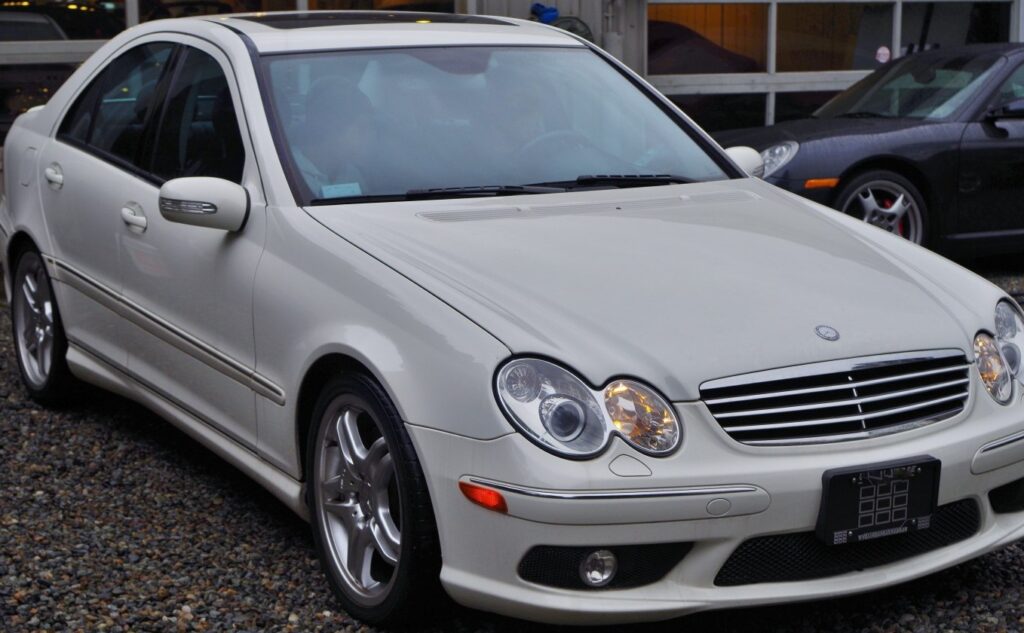
The Mercedes-Benz C-Class (W203) facelift AMG C 55, produced from May 2004 to February 2007, represented the performance pinnacle of the second-generation C-Class. Positioned as the flagship variant, it offered a substantial upgrade over the more common four and six-cylinder models, and even the supercharged C32 AMG it replaced. This model year saw a refresh of the W203 platform, incorporating styling and technological updates alongside the potent naturally aspirated V8 engine. The C55 aimed to deliver a blend of luxury, performance, and a more traditional AMG experience compared to the forced induction route taken with the C32.
Technical Specifications
| Brand | Mercedes-Benz |
| Model | C-class |
| Generation | C-class (W203, facelift 2004) |
| Type | AMG C 55 V8 (367 Hp) Automatic |
| Start of production | May, 2004 |
| End of production | February, 2007 |
| Powertrain Architecture | Internal Combustion engine |
| Body type | Sedan |
| Seats | 5 |
| Doors | 4 |
| Fuel consumption (urban) | 17.3 l/100 km (13.6 US mpg, 16.3 UK mpg, 5.8 km/l) |
| Fuel consumption (extra urban) | 8.8 l/100 km (26.7 US mpg, 32.1 UK mpg, 11.4 km/l) |
| Fuel consumption (combined) | 11.9 l/100 km (19.8 US mpg, 23.7 UK mpg, 8.4 km/l) |
| CO2 emissions | 286 g/km |
| Fuel Type | Petrol (Gasoline) |
| Acceleration 0 – 100 km/h | 5.2 sec |
| Acceleration 0 – 62 mph | 5.2 sec |
| Acceleration 0 – 60 mph | 4.9 sec |
| Maximum speed | 250 km/h (155.34 mph) – Electronically limited |
| Emission standard | Euro 4 |
| Weight-to-power ratio | 4.3 kg/Hp, 235.3 Hp/tonne |
| Weight-to-torque ratio | 3.1 kg/Nm, 326.9 Nm/tonne |
| Power | 367 Hp @ 5750 rpm |
| Power per litre | 67.5 Hp/l |
| Torque | 510 Nm @ 4000 rpm (376.16 lb.-ft. @ 4000 rpm) |
| Engine layout | Front, Longitudinal |
| Engine Model/Code | M 113.988 |
| Engine displacement | 5439 cm3 (331.91 cu. in.) |
| Number of cylinders | 8 |
| Engine configuration | V-engine |
| Cylinder Bore | 97 mm (3.82 in.) |
| Piston Stroke | 92 mm (3.62 in.) |
| Compression ratio | 11:1 |
| Number of valves per cylinder | 3 |
| Fuel injection system | Multi-port manifold injection |
| Engine aspiration | Naturally aspirated engine |
| Valvetrain | SOHC |
| Engine oil capacity | 8.5 l (8.98 US qt | 7.48 UK qt) |
| Coolant capacity | 11.5 l (12.15 US qt | 10.12 UK qt) |
| Kerb Weight | 1560 kg (3439.21 lbs.) |
| Max. weight | 2115 kg (4662.78 lbs.) |
| Max load | 555 kg (1223.57 lbs.) |
| Trunk (boot) space (minimum) | 455 l (16.07 cu. ft.) |
| Fuel tank capacity | 62 l (16.38 US gal | 13.64 UK gal) |
| Max. roof load | 100 kg (220.46 lbs.) |
| Length | 4611 mm (181.54 in.) |
| Width | 1744 mm (68.66 in.) |
| Width including mirrors | 1980 mm (77.95 in.) |
| Height | 1412 mm (55.59 in.) |
| Wheelbase | 2715 mm (106.89 in.) |
| Front track | 1507 mm (59.33 in.) |
| Rear track | 1478 mm (58.19 in.) |
| Drag coefficient (Cd) | 0.29 |
| Minimum turning circle | 10.76 m (35.3 ft.) |
| Drivetrain Architecture | Rear wheel drive |
| Number of gears | 5 |
| Gearbox type | Automatic transmission |
| Front suspension | Independent type McPherson, Transverse stabilizer |
| Rear suspension | Independent multi-link suspension, Transverse stabilizer |
| Front brakes | Ventilated discs |
| Rear brakes | Ventilated discs |
| Assisting systems | ABS (Anti-lock braking system) |
| Steering type | Steering rack and pinion |
| Power steering | Hydraulic Steering |
| Front tires | 225/40 R 18 |
| Rear tires | 245/35 R 18 |
| Front wheel rims | 7.5 J x 18 H 2 |
| Rear wheel rims | 8.5 J x 18 H 2 |
INTRODUCTION
The W203 C-Class, launched in 2000, aimed to elevate Mercedes-Benz’s compact executive offering. The facelift in 2004 brought revised styling, improved interior materials, and updated technology. The AMG C55, introduced as part of this facelift, was a significant departure from its predecessor, the C32 AMG. While the C32 utilized a supercharged V6, the C55 returned to a naturally aspirated V8 configuration, a nod to AMG’s heritage. It was positioned above the standard C-Class models, offering a more potent and luxurious experience. Production spanned from May 2004 to February 2007, making it a relatively short-lived but highly regarded variant.
Powertrain & Engine Architecture
The heart of the C55 is the M113.988 5.4-liter naturally aspirated V8 engine. This engine, derived from the larger M113 family used in the S-Class and E-Class, produces 367 horsepower at 5750 rpm and 510 Nm (376 lb-ft) of torque at 4000 rpm. It features a three-valve-per-cylinder design (two intake, one exhaust) and utilizes multi-port fuel injection. The engine’s architecture is a 90-degree V8, providing inherent balance and smoothness. The engine is longitudinally mounted, driving the rear wheels. Paired with the engine is a five-speed automatic transmission (722.6), specifically tuned by AMG for quicker shifts and more responsive performance. This transmission lacks a manual shift mode, a point of criticism for some enthusiasts.
Driving Characteristics
The AMG C55 delivers a distinctly different driving experience compared to the C32 or the lower-powered C-Class variants. The naturally aspirated V8 provides a linear power delivery, with strong torque available throughout the rev range. While not as explosively quick as the supercharged C32 in initial acceleration, the C55 feels more robust and predictable. The five-speed automatic transmission, while smooth, can feel slightly dated compared to more modern transmissions with more gears. Gear ratios are optimized for a balance of acceleration and cruising comfort. The car’s weight (approximately 3439 lbs) is noticeable, but the powerful V8 mitigates this somewhat. The steering is precise, and the suspension provides a firm but compliant ride.
Equipment & Trim Levels
The AMG C55 came generously equipped as standard. Interior features included sport seats upholstered in Nappa leather, AMG-specific trim pieces, and a multi-function steering wheel. Exterior features included AMG body styling (front and rear bumpers, side skirts), quad exhaust outlets, and 18-inch AMG alloy wheels. Optional extras included a sunroof, premium sound system, and parking assist. The interior generally featured a dark color scheme, with options for wood or carbon fiber trim. The overall ambiance was one of understated luxury, befitting a high-performance Mercedes-Benz.
Chassis & Braking
The C55 featured a revised suspension setup compared to the standard C-Class, with stiffer springs and dampers, and larger stabilizer bars. The front suspension utilized a McPherson strut design, while the rear employed a multi-link setup. This configuration aimed to reduce body roll and improve handling. Braking duties were handled by ventilated discs on all four wheels, providing ample stopping power. The Anti-lock Braking System (ABS) was standard. The suspension tuning prioritized a balance between sporty handling and everyday comfort.
Market Reception & Comparison
The AMG C55 was generally well-received by automotive critics. It was praised for its powerful engine, comfortable ride, and understated styling. However, the lack of a manual transmission and the relatively dated five-speed automatic were common criticisms. Compared to the C32 AMG, the C55 offered a more traditional AMG experience, with a focus on naturally aspirated power and a more refined driving experience. Fuel economy, unsurprisingly, was not a strong point, with combined figures around 19.8 US mpg. Reliability was generally good, although maintenance costs were higher than for the standard C-Class models due to the more complex engine and AMG-specific components.
Legacy
The AMG C55 has developed a loyal following among enthusiasts. Its naturally aspirated V8 engine is highly regarded for its sound and character. While not as technologically advanced as later AMG models, the C55 represents a sweet spot in terms of performance, reliability, and affordability. On the used car market, well-maintained examples command a premium. The M113 engine is known for its durability, but regular maintenance is crucial to prevent issues. The C55 remains a compelling option for those seeking a classic AMG experience with a blend of luxury and performance.