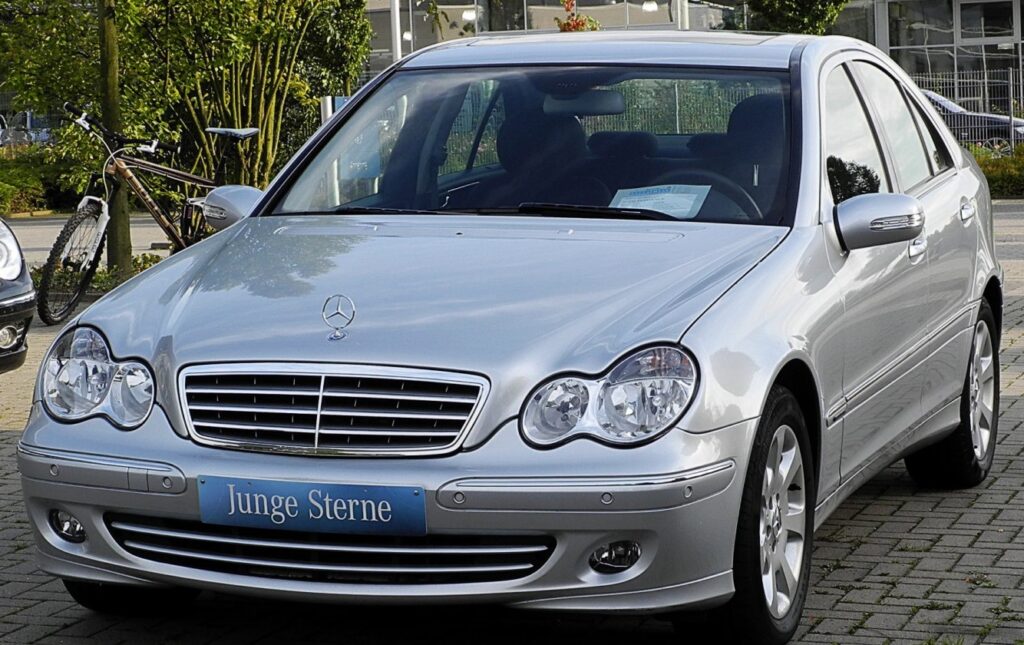
The Mercedes-Benz C-Class W203, specifically the C 200 CDI variant with 122 horsepower and a Diesel Particulate Filter (DPF), was produced from April 2005 to March 2007. This model represented a mid-cycle refresh of the W203 generation, which ran from 2000 to 2007, and aimed to offer a more fuel-efficient and environmentally conscious option within the C-Class lineup. Positioned as an entry-level diesel offering, it catered to European drivers prioritizing economy and lower emissions. The C200 CDI with the DPF was a key component of Mercedes-Benz’s strategy to meet increasingly stringent Euro 4 emission standards.
Technical Specifications
| Brand | Mercedes-Benz |
| Model | C-Class |
| Generation | C-Class (W203, facelift 2004) |
| Type (Engine) | C 200 CDI (122 Hp) DPF |
| Start of production | April, 2005 |
| End of production | March, 2007 |
| Powertrain Architecture | Internal Combustion engine |
| Body type | Sedan |
| Seats | 5 |
| Doors | 4 |
| Fuel consumption (urban) | 8.5 l/100 km (27.7 US mpg, 33.2 UK mpg, 11.8 km/l) |
| Fuel consumption (extra urban) | 5.1 l/100 km (46.1 US mpg, 55.4 UK mpg, 19.6 km/l) |
| Fuel consumption (combined) | 6.3 l/100 km (37.3 US mpg, 44.8 UK mpg, 15.9 km/l) |
| CO2 emissions | 167 g/km |
| Fuel Type | Diesel |
| Acceleration 0 – 100 km/h | 11.7 sec |
| Acceleration 0 – 62 mph | 11.7 sec |
| Acceleration 0 – 60 mph | 11.1 sec |
| Maximum speed | 208 km/h (129.25 mph) |
| Emission standard | Euro 4 |
| Weight-to-power ratio | 11.8 kg/Hp, 84.7 Hp/tonne |
| Weight-to-torque ratio | 5.3 kg/Nm, 187.5 Nm/tonne |
| Power | 122 Hp @ 4200 rpm |
| Power per litre | 56.8 Hp/l |
| Torque | 270 Nm @ 1600-2800 rpm (199.14 lb.-ft. @ 1600-2800 rpm) |
| Engine layout | Front, Longitudinal |
| Engine Model/Code | OM 646.962 |
| Engine displacement | 2148 cm3 (131.08 cu. in.) |
| Number of cylinders | 4 |
| Engine configuration | Inline |
| Cylinder Bore | 88 mm (3.46 in.) |
| Piston Stroke | 88.3 mm (3.48 in.) |
| Compression ratio | 18:1 |
| Number of valves per cylinder | 4 |
| Fuel injection system | Diesel Commonrail |
| Engine aspiration | Turbocharger, Intercooler |
| Valvetrain | DOHC |
| Engine oil capacity | 6.5 l (6.87 US qt | 5.72 UK qt) |
| Coolant capacity | 8.5 l (8.98 US qt | 7.48 UK qt) |
| Kerb Weight | 1440 kg (3174.66 lbs.) |
| Max. weight | 1995 kg (4398.22 lbs.) |
| Max load | 555 kg (1223.57 lbs.) |
| Trunk (boot) space (minimum) | 455 l (16.07 cu. ft.) |
| Fuel tank capacity | 62 l (16.38 US gal | 13.64 UK gal) |
| Max. roof load | 100 kg (220.46 lbs.) |
| Permitted trailer load (with brakes) | 1500 kg (3306.93 lbs.) |
| Permitted trailer load (without brakes) | 750 kg (1653.47 lbs.) |
| Length | 4526 mm (178.19 in.) |
| Width | 1728 mm (68.03 in.) |
| Width including mirrors | 1980 mm (77.95 in.) |
| Height | 1426 mm (56.14 in.) |
| Wheelbase | 2715 mm (106.89 in.) |
| Front track | 1493 mm (58.78 in.) |
| Rear track | 1464 mm (57.64 in.) |
| Front overhang | 755 mm (29.72 in.) |
| Rear overhang | 1056 mm (41.57 in.) |
| Drag coefficient (Cd) | 0.27 |
| Minimum turning circle | 10.76 m (35.3 ft.) |
| Drivetrain Architecture | Rear wheel drive |
| Drive wheel | Rear wheel drive |
| Number of gears | 6 |
| Gearbox type | Manual transmission |
| Front suspension | Independent type McPherson, Transverse stabilizer |
| Rear suspension | Independent multi-link suspension, Transverse stabilizer |
| Front brakes | Ventilated discs |
| Rear brakes | Disc |
| Assisting systems | ABS (Anti-lock braking system) |
| Steering type | Steering rack and pinion |
| Power steering | Hydraulic Steering |
| Tires size | 205/55 R 16 V |
| Wheel rims size | 7 J x 16 H 2 |
Powertrain & Engine Architecture
The C 200 CDI was powered by the OM 646.962, a 2.1-liter inline-four cylinder diesel engine. This engine was a mainstay of Mercedes-Benz’s diesel offerings during the early 2000s. It featured common-rail direct injection, a turbocharger with an intercooler, and a double overhead camshaft (DOHC) valvetrain with four valves per cylinder. The high compression ratio of 18:1 contributed to its efficiency. The inclusion of a Diesel Particulate Filter (DPF) was crucial for meeting Euro 4 emissions standards, trapping soot particles and periodically undergoing regeneration cycles to burn them off. The 6-speed manual transmission was standard, offering a balance between fuel economy and driver control.
Driving Characteristics
The 122 hp output and 270 Nm (199 lb-ft) of torque provided adequate, though not exhilarating, performance. Acceleration from 0 to 60 mph took around 11.1 seconds, and the top speed was 208 km/h (129 mph). Compared to the more powerful C 220 CDI or the petrol-powered C 230 Kompressor, the C 200 CDI felt less responsive, particularly during overtaking maneuvers. However, the engine’s torque delivery was strong from low RPMs, making it suitable for everyday driving and long-distance cruising. The manual transmission allowed for precise gear selection, but the gear ratios were optimized for fuel efficiency rather than outright performance.
Equipment & Trim Levels
The C 200 CDI typically came with a reasonable level of standard equipment, including air conditioning, power windows, central locking, and an audio system. Interior upholstery was usually cloth, with options for leather upgrades. The dashboard layout was typical of the W203, with a functional and straightforward design. Optional extras included a sunroof, upgraded audio systems, parking sensors, and alloy wheels. The C 200 CDI was often seen as a more practical and affordable entry point into the C-Class range, foregoing some of the luxury features found in higher-spec models.
Chassis & Braking
The W203 C-Class featured an independent suspension setup, with McPherson struts at the front and a multi-link suspension at the rear. This provided a comfortable ride quality, although it wasn’t particularly sporty. The C 200 CDI was equipped with ventilated disc brakes at the front and solid discs at the rear. Anti-lock Braking System (ABS) was standard. The suspension was tuned to prioritize comfort and stability, rather than aggressive handling. Stabilizer bars were fitted to both axles to reduce body roll during cornering.
Market Reception & Comparison
The C 200 CDI was generally well-received by critics as a fuel-efficient and practical option. Its low running costs and reduced emissions were major selling points. However, some reviewers noted its lack of outright performance compared to other C-Class variants. Compared to the C 220 CDI, the C 200 CDI offered lower fuel consumption but sacrificed some power. Against the petrol-powered C 230 Kompressor, the C 200 CDI provided significantly better fuel economy but lacked the engine’s responsiveness. The C 200 CDI appealed to drivers who prioritized economy and practicality over sporty performance.
Legacy
The OM 646 engine family, including the OM 646.962 found in the C 200 CDI, is generally considered to be a reliable powertrain. However, the DPF can be a potential source of issues, requiring periodic cleaning or replacement, especially if the vehicle is primarily used for short trips. Today, the W203 C 200 CDI can be found as an affordable used car. Its fuel efficiency and relatively simple mechanicals make it an attractive option for budget-conscious buyers. While not a performance icon, it represents a practical and economical entry point into the Mercedes-Benz brand.