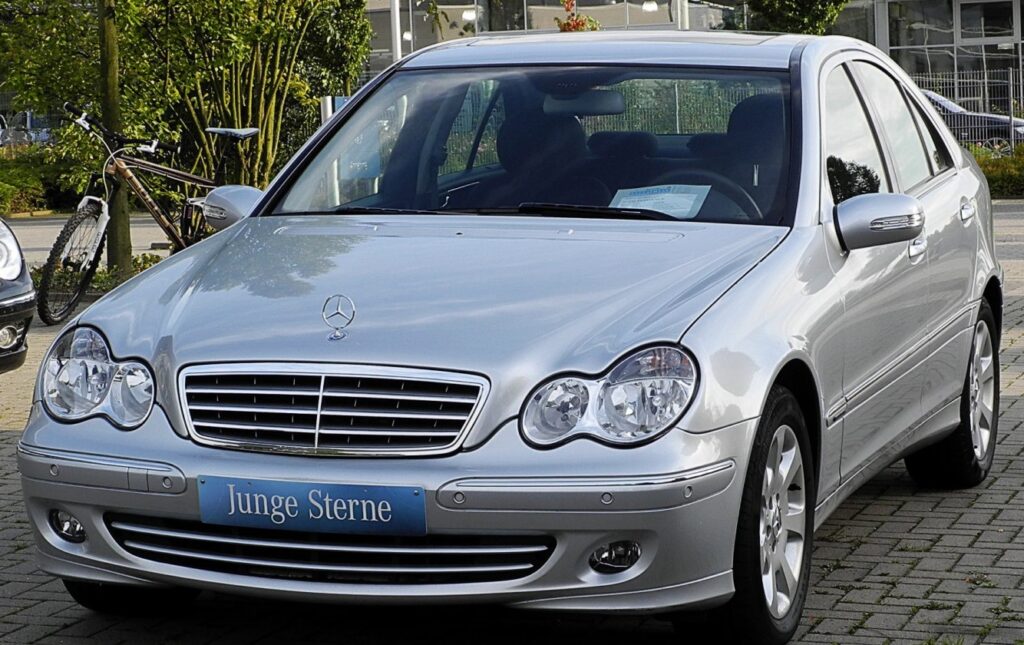
The Mercedes-Benz C-Class (W203) facelift C 270 CDI, produced from April 2004 to June 2005, represented a significant offering in the compact executive car segment. This variant, powered by a 2.7-liter five-cylinder turbodiesel engine producing 170 horsepower, occupied a middle ground within the W203 lineup, appealing to buyers seeking a balance of performance, fuel efficiency, and refinement. It was positioned as a more economical alternative to the gasoline-powered C 280 and C 320 models, while offering more power and a more sophisticated driving experience than the entry-level C 200 CDI and C 220 CDI.
Technical Specifications
| Brand | Mercedes-Benz |
| Model | C-Class |
| Generation | C-Class (W203, facelift 2004) |
| Type (Engine) | C 270 CDI (170 Hp) |
| Start of production | April, 2004 |
| End of production | June, 2005 |
| Powertrain Architecture | Internal Combustion engine |
| Body type | Sedan |
| Seats | 5 |
| Doors | 4 |
| Fuel consumption (urban) | 9.7 l/100 km (24.2 US mpg) |
| Fuel consumption (extra urban) | 5.1 l/100 km (46.1 US mpg) |
| Fuel consumption (combined) | 6.8 l/100 km (34.6 US mpg) |
| CO2 emissions | 181 g/km |
| Fuel Type | Diesel |
| Acceleration 0 – 100 km/h | 8.9 sec |
| Acceleration 0 – 62 mph | 8.9 sec |
| Acceleration 0 – 60 mph | 8.5 sec |
| Maximum speed | 230 km/h (142.92 mph) |
| Emission standard | Euro 3 |
| Weight-to-power ratio | 8.9 kg/Hp |
| Weight-to-torque ratio | 3.8 kg/Nm |
| Power | 170 Hp @ 4200 rpm |
| Torque | 400 Nm @ 1600-2800 rpm (295.02 lb.-ft.) |
| Engine layout | Front, Longitudinal |
| Engine Model/Code | OM 612.962 |
| Engine displacement | 2685 cm3 (163.85 cu. in.) |
| Number of cylinders | 5 |
| Engine configuration | Inline |
| Cylinder Bore | 88 mm (3.46 in.) |
| Piston Stroke | 88.3 mm (3.48 in.) |
| Compression ratio | 18:1 |
| Number of valves per cylinder | 4 |
| Fuel injection system | Diesel Commonrail |
| Engine aspiration | Turbocharger, Intercooler |
| Valvetrain | DOHC |
| Engine oil capacity | 6.5 l (6.87 US qt | 5.72 UK qt) |
| Coolant capacity | 10.5 l (11.1 US qt | 9.24 UK qt) |
| Kerb Weight | 1510 kg (3328.98 lbs.) |
| Max. weight | 2065 kg (4552.55 lbs.) |
| Max load | 555 kg (1223.57 lbs.) |
| Trunk (boot) space (minimum) | 455 l (16.07 cu. ft.) |
| Fuel tank capacity | 62 l (16.38 US gal | 13.64 UK gal) |
| Max. roof load | 100 kg (220.46 lbs.) |
| Permitted trailer load (with brakes) | 1500 kg (3306.93 lbs.) |
| Permitted trailer load (without brakes) | 750 kg (1653.47 lbs.) |
| Length | 4526 mm (178.19 in.) |
| Width | 1728 mm (68.03 in.) |
| Width including mirrors | 1980 mm (77.95 in.) |
| Height | 1426 mm (56.14 in.) |
| Wheelbase | 2715 mm (106.89 in.) |
| Front track | 1493 mm (58.78 in.) |
| Rear track | 1464 mm (57.64 in.) |
| Front overhang | 755 mm (29.72 in.) |
| Rear overhang | 1056 mm (41.57 in.) |
| Drag coefficient (Cd) | 0.27 |
| Minimum turning circle | 10.76 m (35.3 ft.) |
| Drivetrain | Rear wheel drive |
| Number of gears | 6 |
| Gearbox type | Manual transmission |
| Front suspension | Independent type McPherson, Transverse stabilizer |
| Rear suspension | Independent multi-link suspension, Transverse stabilizer |
| Front brakes | Ventilated discs |
| Rear brakes | Disc |
| Assisting systems | ABS (Anti-lock braking system) |
| Steering type | Steering rack and pinion |
| Power steering | Hydraulic Steering |
| Tires size | 205/55 R 16 V |
| Wheel rims size | 7 J x 16 H 2 |
Powertrain & Engine Architecture
The heart of the C 270 CDI is the OM 612.962, a 2.7-liter inline five-cylinder diesel engine. This engine was a key component of Mercedes-Benz’s efforts to offer powerful yet fuel-efficient diesel options. It featured a cast iron block and aluminum cylinder head, incorporating a sophisticated common rail direct injection system. This system, operating at extremely high pressures, allowed for precise fuel metering and optimized combustion. The engine also utilized a variable geometry turbocharger (VGT) and an intercooler to enhance power and torque across a broad RPM range. The DOHC valvetrain, with four valves per cylinder, further contributed to the engine’s efficiency and performance. The six-speed manual transmission was standard, providing a good balance between fuel economy and driver control.
Driving Characteristics
The C 270 CDI offered a distinctly different driving experience compared to its gasoline counterparts. While not as overtly sporty as the C 280 or C 320, it delivered strong and readily available torque from as low as 1600 rpm. This made it particularly well-suited for relaxed cruising and effortless overtaking. The six-speed manual transmission allowed drivers to keep the engine in its optimal power band, while the rear-wheel drive configuration provided a balanced and engaging feel. Compared to the lower-powered C 200 CDI and C 220 CDI, the C 270 CDI felt significantly more capable, especially when fully loaded or tackling hilly terrain. However, it lacked the outright acceleration and responsiveness of the higher-output gasoline models.
Equipment & Trim Levels
The C 270 CDI typically came equipped with a respectable level of standard features, including automatic climate control, power windows and mirrors, a multi-function steering wheel, and an audio system. Upholstery was generally cloth, although leather options were available. Optional extras included a sunroof, upgraded audio systems, navigation, and parking sensors. The facelifted W203 models (2004-2005) also benefited from revised interior trim and updated exterior styling cues, including new headlights and taillights.
Chassis & Braking
The W203 C-Class featured an independent suspension setup at all four corners. The front utilized a McPherson strut design, while the rear employed a multi-link suspension. This configuration provided a good balance of ride comfort and handling precision. The C 270 CDI was equipped with ventilated disc brakes at the front and solid discs at the rear. Anti-lock braking system (ABS) was standard, enhancing safety and control during emergency braking situations. Stabilizer bars were fitted to both the front and rear axles to reduce body roll during cornering.
Market Reception & Comparison
The C 270 CDI was generally well-received by automotive critics. It was praised for its fuel efficiency, strong torque output, and refined driving experience. However, some reviewers noted that the engine could be somewhat noisy compared to its gasoline counterparts. Compared to the C 200 CDI and C 220 CDI, the C 270 CDI offered a noticeable performance upgrade, making it a more appealing option for drivers who frequently undertook long journeys or required extra power. Against the gasoline-powered C 280 and C 320, the C 270 CDI offered comparable fuel economy at a lower price point, although it lacked the same level of outright performance.
Legacy
The OM 612 engine family, including the 2.7-liter variant found in the C 270 CDI, has proven to be remarkably durable and reliable. With proper maintenance, these engines can easily exceed 200,000 miles. Today, the W203 C 270 CDI represents a relatively affordable entry point into Mercedes-Benz ownership. While finding well-maintained examples can be challenging, these cars offer a compelling combination of German engineering, fuel efficiency, and practicality. Common issues include wear and tear on suspension components, potential problems with the turbocharger, and the occasional failure of the glow plugs. However, parts availability remains good, and the relatively simple mechanical design makes these cars relatively easy to maintain for experienced DIY mechanics.