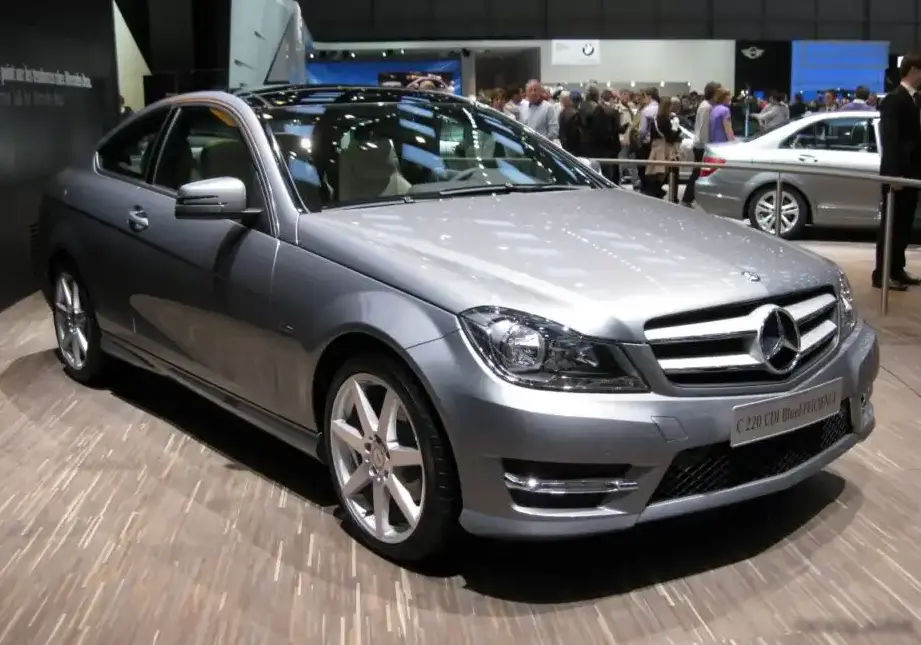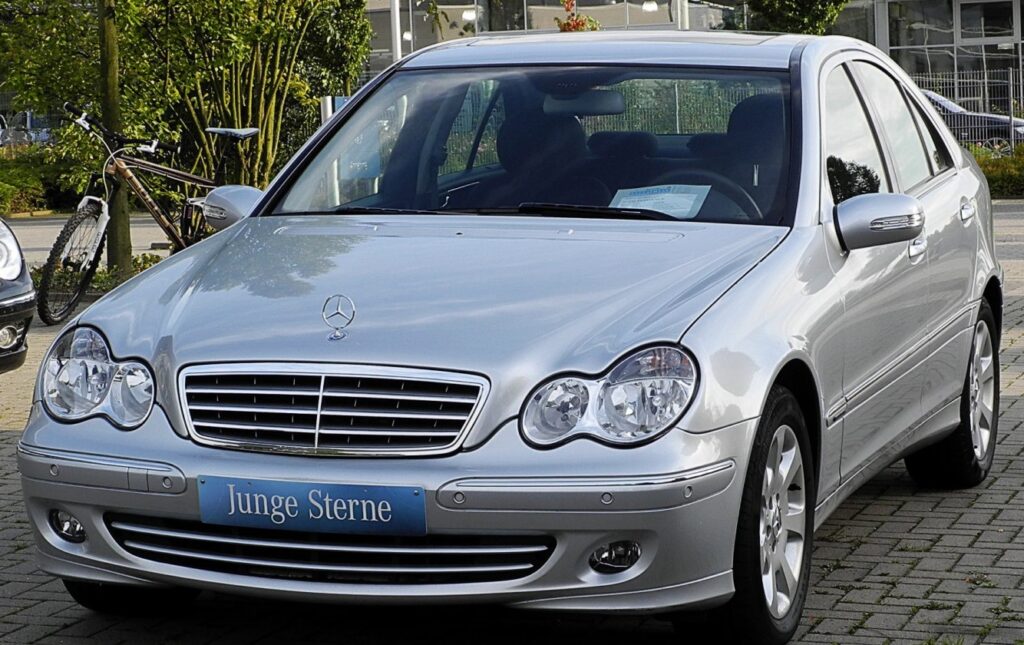
The Mercedes-Benz C-Class (W203) facelift C 270 CDI Automatic, produced from April 2004 to June 2005, represented a significant offering in the premium compact executive car segment. This variant, powered by a 2.7-liter five-cylinder turbodiesel engine paired with a five-speed automatic transmission, aimed to deliver a balance of performance, efficiency, and comfort. It sat within the W203 facelift range, positioned as a mid-range option appealing to buyers seeking strong torque and relaxed highway cruising without the expense of the higher-performance C 320 or C 55 AMG models. The W203 generation, launched in 2000, was a crucial model for Mercedes-Benz, modernizing their entry-level offering and competing directly with the BMW 3 Series and Audi A4.
Technical Specifications
| Brand | Mercedes-Benz |
| Model | C-class |
| Generation | C-class (W203, facelift 2004) |
| Type (Engine) | C 270 CDI (170 Hp) Automatic |
| Start of production | April, 2004 |
| End of production | June, 2005 |
| Powertrain Architecture | Internal Combustion engine |
| Body type | Sedan |
| Seats | 5 |
| Doors | 4 |
| Fuel consumption (urban) | 9.8 l/100 km (24 US mpg, 28.8 UK mpg, 10.2 km/l) |
| Fuel consumption (extra urban) | 5.6 l/100 km (42 US mpg, 50.4 UK mpg, 17.9 km/l) |
| Fuel consumption (combined) | 7.1 l/100 km (33.1 US mpg, 39.8 UK mpg, 14.1 km/l) |
| CO2 emissions | 189 g/km |
| Fuel Type | Diesel |
| Acceleration 0 – 100 km/h | 9.1 sec |
| Acceleration 0 – 62 mph | 9.1 sec |
| Acceleration 0 – 60 mph | 8.6 sec |
| Maximum speed | 225 km/h (139.81 mph) |
| Emission standard | Euro 3 |
| Weight-to-power ratio | 8.9 kg/Hp, 112.6 Hp/tonne |
| Weight-to-torque ratio | 3.8 kg/Nm, 264.9 Nm/tonne |
| Power | 170 Hp @ 4200 rpm |
| Power per litre | 63.3 Hp/l |
| Torque | 400 Nm @ 1600-2800 rpm (295.02 lb.-ft. @ 1600-2800 rpm) |
| Engine layout | Front, Longitudinal |
| Engine Model/Code | OM 612.962 |
| Engine displacement | 2685 cm3 (163.85 cu. in.) |
| Number of cylinders | 5 |
| Engine configuration | Inline |
| Cylinder Bore | 88 mm (3.46 in.) |
| Piston Stroke | 88.3 mm (3.48 in.) |
| Compression ratio | 18:1 |
| Number of valves per cylinder | 4 |
| Fuel injection system | Diesel Commonrail |
| Engine aspiration | Turbocharger, Intercooler |
| Valvetrain | DOHC |
| Engine oil capacity | 6.5 l (6.87 US qt | 5.72 UK qt) |
| Coolant capacity | 10.5 l (11.1 US qt | 9.24 UK qt) |
| Kerb Weight | 1510 kg (3328.98 lbs.) |
| Max. weight | 2065 kg (4552.55 lbs.) |
| Max load | 555 kg (1223.57 lbs.) |
| Trunk (boot) space (minimum) | 455 l (16.07 cu. ft.) |
| Fuel tank capacity | 62 l (16.38 US gal | 13.64 UK gal) |
| Max. roof load | 100 kg (220.46 lbs.) |
| Permitted trailer load (with brakes) | 1500 kg (3306.93 lbs.) |
| Permitted trailer load (without brakes) | 750 kg (1653.47 lbs.) |
| Length | 4526 mm (178.19 in.) |
| Width | 1728 mm (68.03 in.) |
| Width including mirrors | 1980 mm (77.95 in.) |
| Height | 1426 mm (56.14 in.) |
| Wheelbase | 2715 mm (106.89 in.) |
| Front track | 1493 mm (58.78 in.) |
| Rear track | 1464 mm (57.64 in.) |
| Front overhang | 755 mm (29.72 in.) |
| Rear overhang | 1056 mm (41.57 in.) |
| Drag coefficient (Cd) | 0.27 |
| Minimum turning circle | 10.76 m (35.3 ft.) |
| Drivetrain | Rear wheel drive |
| Number of gears | 5 |
| Gearbox type | Automatic transmission |
| Front suspension | Independent type McPherson, Transverse stabilizer |
| Rear suspension | Independent multi-link suspension, Transverse stabilizer |
| Front brakes | Ventilated discs |
| Rear brakes | Disc |
| Assisting systems | ABS (Anti-lock braking system) |
| Steering type | Steering rack and pinion |
| Power steering | Hydraulic Steering |
| Tires size | 205/55 R 16 V |
| Wheel rims size | 7 J x 16 H 2 |
Powertrain & Engine Architecture
The heart of the C 270 CDI was the OM 612.962, a 2.7-liter inline five-cylinder diesel engine. This engine was a key component of Mercedes-Benz’s CDI (Common Rail Direct Injection) range, known for its robust construction and fuel efficiency. The engine utilized a second-generation common rail direct injection system, delivering fuel at extremely high pressures for optimized combustion. A variable geometry turbocharger with an intercooler further enhanced performance, providing increased boost across a wider rev range. The engine featured a double overhead camshaft (DOHC) valvetrain with four valves per cylinder. The five-speed automatic transmission, a 722.6 unit from Mercedes-Benz, was chosen for its smooth operation and suitability for long-distance cruising. It was not a particularly advanced transmission by modern standards, but it was known for its reliability.
Driving Characteristics
The C 270 CDI Automatic offered a distinctly different driving experience compared to its petrol-powered siblings or even the manual diesel variants. The 400 Nm of torque, available from a low 1600 rpm, provided strong acceleration in everyday driving situations. While the 0-60 mph time of around 8.6 seconds wasn’t particularly quick, the engine’s responsiveness made overtaking effortless. The automatic transmission, while smooth, wasn’t known for its sportiness. Gear changes were deliberate, prioritizing comfort over rapid shifts. Compared to the more engaging manual transmission, the automatic felt somewhat less connected to the engine. However, for drivers prioritizing ease of use and relaxed cruising, the C 270 CDI Automatic proved to be a comfortable and capable companion.
Equipment & Trim Levels
The C 270 CDI Automatic typically came equipped with a respectable level of standard features. These included automatic climate control, power windows, central locking, and an audio system. Interior upholstery was generally cloth, although leather options were available. The dashboard layout was typical of the W203 facelift, featuring a relatively conservative design with clear instrumentation. Optional extras included a sunroof, upgraded audio systems, parking sensors, and heated seats. The trim level could vary depending on the market, but generally, the C 270 CDI Automatic occupied a mid-range position in the C-Class lineup.
Chassis & Braking
The W203 C-Class featured an independent suspension setup at all four corners. The front utilized a McPherson strut design, while the rear employed a multi-link suspension. This configuration provided a good balance of ride comfort and handling. The C 270 CDI, due to its weight, often featured slightly stiffer springs and dampers compared to lighter models. Braking was handled by ventilated discs at the front and solid discs at the rear. Anti-lock Braking System (ABS) was standard. The steering was a hydraulic power-assisted rack and pinion system, offering a reasonably direct feel.
Market Reception & Comparison
The C 270 CDI Automatic was generally well-received by automotive critics. It was praised for its fuel efficiency, strong torque, and comfortable ride. However, some reviewers noted the automatic transmission’s lack of sportiness and the engine’s slightly agricultural character compared to some of its competitors. Compared to the C 200 CDI, the C 270 CDI offered significantly more performance, but at a higher price point. The C 320, with its larger petrol engine, provided even greater performance but sacrificed fuel economy. The C 270 CDI struck a balance between these two extremes, appealing to buyers who wanted a capable and efficient car without the expense of the top-of-the-line models.
Legacy
The OM 612 engine family, including the 2.7-liter variant found in the C 270 CDI, proved to be remarkably durable. Properly maintained examples can still be found on the road today, often with high mileage. The five-speed automatic transmission is also generally reliable, although it may require servicing as it ages. In the used car market, the C 270 CDI Automatic represents a relatively affordable entry point into Mercedes-Benz ownership. Its fuel efficiency and robust engine make it a practical choice for those seeking a comfortable and reliable car for everyday use. However, potential buyers should be aware of the potential for diesel particulate filter (DPF) issues and the cost of maintaining a vehicle of this age.