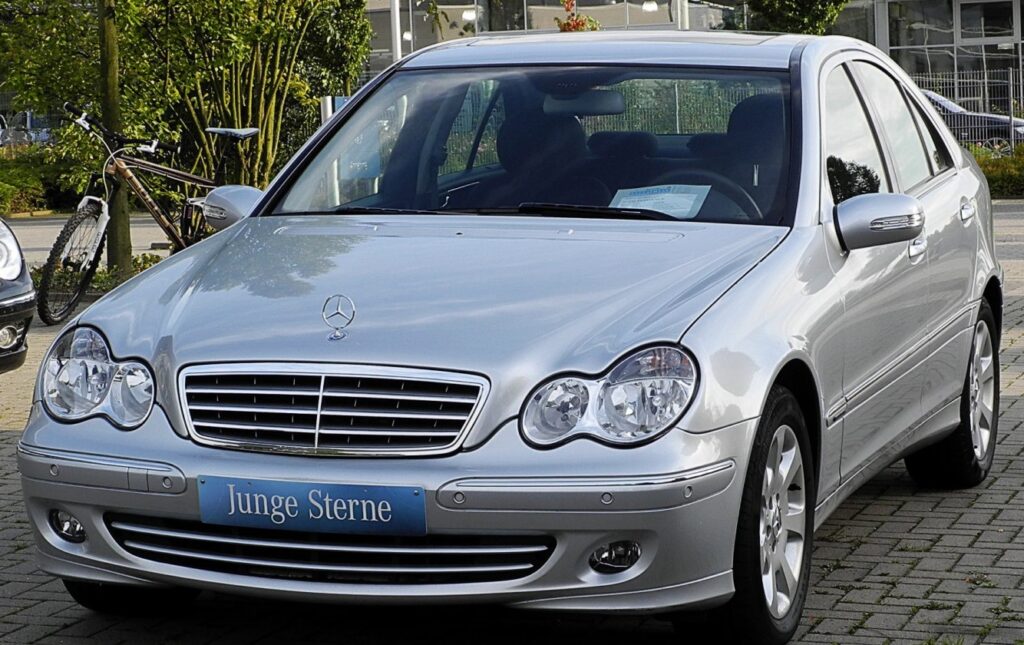
The Mercedes-Benz C 320 CDI, part of the W203 facelift series produced from March 2005 to February 2007, represented a significant offering in the premium compact executive car segment. Positioned as a mid-to-high range trim within the W203 lineup, it combined a powerful diesel engine with a comfortable, refined driving experience. The W203 facelift, introduced in 2004, brought styling updates and technological improvements to the C-Class, aiming to address criticisms of the pre-facelift model and better compete with rivals like the BMW 3 Series and Audi A4. This variant was primarily sold in Europe and other markets where diesel engines were favored, offering a blend of performance and fuel efficiency.
Technical Specifications
| Brand | Mercedes-Benz |
| Model | C-class |
| Generation | C-class (W203, facelift 2004) |
| Type (Engine) | C 320 CDI V6 (224 Hp) |
| Start of production | March, 2005 |
| End of production | February, 2007 |
| Powertrain Architecture | Internal Combustion engine |
| Body type | Sedan |
| Seats | 5 |
| Doors | 4 |
| Fuel consumption (urban) | 9.8-10.1 l/100 km (24 – 23.3 US mpg) |
| Fuel consumption (extra urban) | 5.3-5.5 l/100 km (44.4 – 42.8 US mpg) |
| Fuel consumption (combined) | 6.9-7.2 l/100 km (34.1 – 32.7 US mpg) |
| CO2 emissions | 183-190 g/km |
| Fuel Type | Diesel |
| Acceleration 0 – 100 km/h | 8.1 sec |
| Acceleration 0 – 62 mph | 8.1 sec |
| Acceleration 0 – 60 mph | 7.7 sec |
| Maximum speed | 246 km/h (152.86 mph) |
| Emission standard | Euro 4 |
| Weight-to-power ratio | 6.9 kg/Hp |
| Weight-to-torque ratio | 3.7 kg/Nm |
| Power | 224 Hp @ 3800 rpm |
| Torque | 415 Nm @ 1400-3800 rpm (306.09 lb.-ft.) |
| Engine layout | Front, Longitudinal |
| Engine Model/Code | OM 642.910 |
| Engine displacement | 2987 cm3 (182.28 cu. in.) |
| Number of cylinders | 6 |
| Engine configuration | V-engine |
| Cylinder Bore | 83 mm (3.27 in.) |
| Piston Stroke | 92 mm (3.62 in.) |
| Compression ratio | 17.7:1 |
| Number of valves per cylinder | 4 |
| Fuel injection system | Diesel Commonrail |
| Engine aspiration | Turbocharger, Intercooler |
| Valvetrain | SOHC |
| Engine oil capacity | 8.5 l (8.98 US qt | 7.48 UK qt) |
| Coolant capacity | 7.6 l (8.03 US qt | 6.69 UK qt) |
| Kerb Weight | 1555 kg (3428.19 lbs.) |
| Max. weight | 2110 kg (4651.75 lbs.) |
| Max load | 555 kg (1223.57 lbs.) |
| Trunk (boot) space | 455 l (16.07 cu. ft.) |
| Fuel tank capacity | 62 l (16.38 US gal | 13.64 UK gal) |
| Length | 4526 mm (178.19 in.) |
| Width | 1728 mm (68.03 in.) |
| Height | 1426 mm (56.14 in.) |
| Wheelbase | 2715 mm (106.89 in.) |
| Front track | 1493 mm (58.78 in.) |
| Rear track | 1464 mm (57.64 in.) |
| Drivetrain Architecture | Rear wheel drive |
| Number of gears | 6 |
| Gearbox type | Manual transmission |
Powertrain & Engine Architecture
The heart of the C 320 CDI is the OM 642.910 3.0-liter V6 diesel engine. This engine, a cornerstone of Mercedes-Benz’s diesel offerings in the mid-2000s, featured a common rail direct injection system, delivering fuel at extremely high pressure for optimized combustion. The engine employed a single overhead camshaft (SOHC) valvetrain with four valves per cylinder. A variable geometry turbocharger and intercooler were crucial components, boosting power and improving torque across a wide RPM range. The engine’s robust construction and advanced fuel injection technology allowed it to produce 224 horsepower at 3800 rpm and a substantial 415 Nm (306 lb-ft) of torque between 1400 and 3800 rpm. The six-speed manual transmission was standard, providing precise gear changes and contributing to the car’s overall driving dynamics. While an automatic transmission was available as an option, the manual was favored by enthusiasts for its responsiveness.
Driving Characteristics
The C 320 CDI with the manual transmission offered a compelling driving experience. The engine’s abundant torque meant strong acceleration in everyday driving situations, with effortless overtaking capabilities. The six-speed gearbox was well-matched to the engine’s powerband, allowing drivers to keep the engine in its sweet spot for optimal performance. Compared to the C 220 CDI or C 200 Kompressor models, the C 320 CDI provided a noticeably more powerful and refined experience. While not a sports car, it offered a confident and engaging drive. The rear-wheel-drive configuration contributed to balanced handling, although traction could be a concern in slippery conditions. The steering was precise, and the suspension provided a comfortable ride without sacrificing too much handling agility.
Equipment & Trim Levels
The C 320 CDI typically came well-equipped, reflecting its position as a mid-range to premium trim level. Standard features included automatic climate control, power windows and mirrors, a multi-function steering wheel, and a high-quality audio system. Interior upholstery was typically a combination of cloth and leatherette, with full leather options available. Optional extras included a sunroof, navigation system, premium sound system, and parking sensors. The dashboard layout was typical of Mercedes-Benz at the time, with a focus on functionality and a generally understated elegance.
Chassis & Braking
The W203 C-Class featured an independent suspension setup, with McPherson struts at the front and a multi-link suspension at the rear. This configuration provided a good balance between ride comfort and handling. Stabilizer bars were fitted to both axles to reduce body roll during cornering. Braking duties were handled by ventilated discs at the front and solid discs at the rear. Anti-lock Braking System (ABS) was standard, enhancing safety and control. The chassis was designed to provide a stable and predictable driving experience, with a focus on comfort and refinement.
Market Reception & Comparison
The C 320 CDI was generally well-received by automotive critics. It was praised for its powerful and fuel-efficient engine, comfortable ride, and refined interior. Compared to its competitors, the C 320 CDI offered a compelling combination of performance and economy. The BMW 330d and Audi A4 3.0 TDI were its main rivals, offering similar levels of performance and refinement. However, the Mercedes-Benz often stood out for its luxurious interior and comfortable ride. Fuel economy was a strong point, with combined figures around 34 mpg, making it an attractive option for drivers covering long distances. Reliability was generally good, although some owners reported issues with the diesel particulate filter (DPF) and certain electronic components.
Legacy
The OM 642 engine family, including the 3.0-liter V6 found in the C 320 CDI, proved to be a durable and reliable powerplant. These engines are known for their longevity and relatively low maintenance costs, provided they are properly maintained. In the used car market, the C 320 CDI remains a popular choice for those seeking a comfortable, refined, and fuel-efficient executive car. However, potential buyers should be aware of the potential for DPF issues and the importance of regular servicing. The W203 C-Class, and particularly the C 320 CDI variant, represents a significant chapter in Mercedes-Benz’s history, showcasing the brand’s commitment to diesel technology and its ability to deliver a premium driving experience.