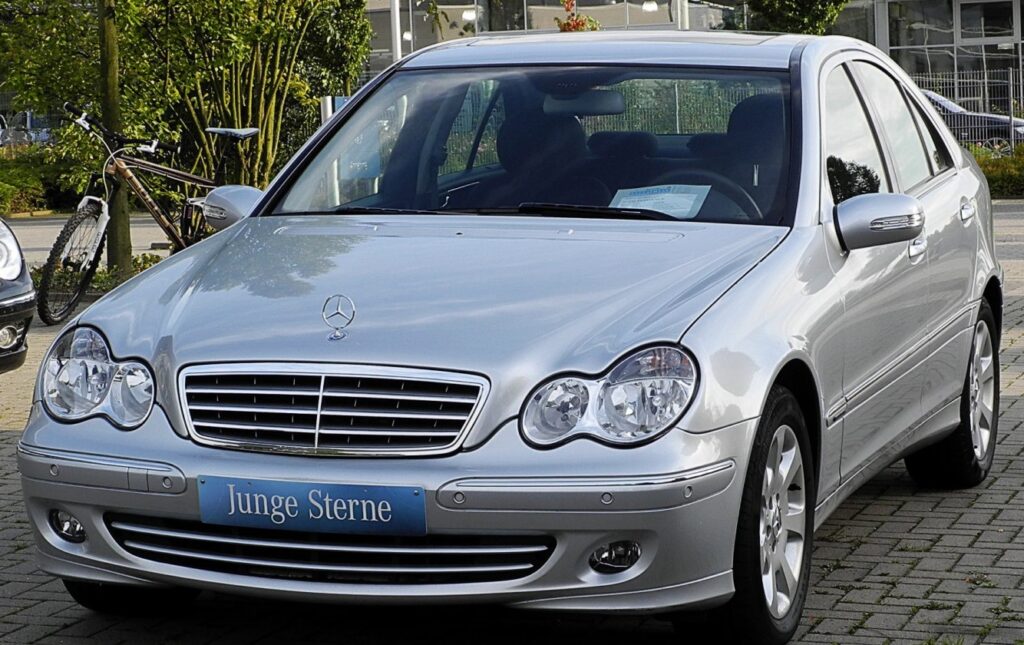
The Mercedes-Benz C 350 V6 4MATIC, produced from July 2005 to January 2007, represented a performance-oriented variant within the W203 C-Class facelift range. Positioned as a near-top-of-the-line offering, it bridged the gap between the more economical four-cylinder models and the high-performance AMG variants. This model was primarily aimed at buyers seeking a blend of luxury, performance, and all-weather capability, particularly in markets where inclement weather was common. The C 350 4MATIC utilized Mercedes’ then-new M272 V6 engine, paired exclusively with a five-speed automatic transmission and a full-time all-wheel-drive system.
Technical Specifications
| Brand | Mercedes-Benz |
| Model | C-class |
| Generation | C-class (W203, facelift 2004) |
| Type (Engine) | C 350 V6 (272 Hp) 4MATIC |
| Start of production | July, 2005 |
| End of production | January, 2007 |
| Powertrain Architecture | Internal Combustion engine |
| Body type | Sedan |
| Seats | 5 |
| Doors | 4 |
| Fuel consumption (urban) | 14.4-14.7 l/100 km (19.6 – 19.2 UK mpg, 6.9 – 6.8 km/l) |
| Fuel consumption (extra urban) | 7.9-8.2 l/100 km (35.8 – 34.4 UK mpg, 12.7 – 12.2 km/l) |
| Fuel consumption (combined) | 10.3-10.6 l/100 km (27.4 – 26.6 UK mpg, 9.7 – 9.4 km/l) |
| CO2 emissions | 248-253 g/km |
| Fuel Type | Petrol (Gasoline) |
| Acceleration 0 – 100 km/h | 6.9 sec |
| Acceleration 0 – 62 mph | 6.9 sec |
| Acceleration 0 – 60 mph | 6.6 sec |
| Maximum speed | 250 km/h (155.34 mph) – Electronically limited |
| Emission standard | Euro 4 |
| Weight-to-power ratio | 5.8 kg/Hp, 172.2 Hp/tonne |
| Weight-to-torque ratio | 4.5 kg/Nm, 221.5 Nm/tonne |
| Power | 272 Hp @ 6000 rpm |
| Torque | 350 Nm @ 2400-5000 rpm (258.15 lb.-ft. @ 2400-5000 rpm) |
| Engine layout | Front, Longitudinal |
| Engine Model/Code | M 272.970 |
| Engine displacement | 3498 cm3 (213.46 cu. in.) |
| Number of cylinders | 6 |
| Engine configuration | V-engine |
| Cylinder Bore | 92.9 mm (3.66 in.) |
| Piston Stroke | 86 mm (3.39 in.) |
| Compression ratio | 10.7:1 |
| Number of valves per cylinder | 4 |
| Fuel injection system | Multi-port manifold injection |
| Engine aspiration | Naturally aspirated engine |
| Valvetrain | DOHC |
| Engine oil capacity | 8 l (8.45 US qt | 7.04 UK qt) |
| Coolant capacity | 10 l (10.57 US qt | 8.8 UK qt) |
| Kerb Weight | 1580 kg (3483.3 lbs.) |
| Max. weight | 2135 kg (4706.87 lbs.) |
| Max load | 555 kg (1223.57 lbs.) |
| Trunk (boot) space (minimum) | 455 l (16.07 cu. ft.) |
| Fuel tank capacity | 62 l (16.38 US gal | 13.64 UK gal) |
| Max. roof load | 100 kg (220.46 lbs.) |
| Permitted trailer load (with brakes) | 1800 kg (3968.32 lbs.) |
| Permitted trailer load (without brakes) | 750 kg (1653.47 lbs.) |
| Length | 4526 mm (178.19 in.) |
| Width | 1728 mm (68.03 in.) |
| Width including mirrors | 1980 mm (77.95 in.) |
| Height | 1430 mm (56.3 in.) |
| Wheelbase | 2715 mm (106.89 in.) |
| Front track | 1493 mm (58.78 in.) |
| Rear track | 1464 mm (57.64 in.) |
| Front overhang | 755 mm (29.72 in.) |
| Rear overhang | 1056 mm (41.57 in.) |
| Drag coefficient (Cd) | 0.27 |
| Minimum turning circle | 10.76 m (35.3 ft.) |
| Drivetrain Architecture | ICE driving all four wheels permanently |
| Drive wheel | All wheel drive (4×4) |
| Number of gears/gearbox type | 5 gears, automatic transmission |
| Front suspension | Independent type McPherson, Transverse stabilizer |
| Rear suspension | Independent multi-link suspension, Transverse stabilizer |
| Front brakes | Ventilated discs |
| Rear brakes | Disc |
| Assisting systems | ABS (Anti-lock braking system) |
| Steering type | Steering rack and pinion |
| Power steering | Hydraulic Steering |
| Tires size | 225/45 R 17 |
| Wheel rims size | 7.5 J x 17 H 2 |
Powertrain & Engine Architecture
The heart of the C 350 4MATIC was the M272.970 3.5-liter V6 engine. This engine represented a significant departure from the older inline-six engines previously used in the C-Class. The M272 featured all-aluminum construction, three valves per cylinder (two intake, one exhaust), and a variable valve timing system (VVT) on both intake and exhaust camshafts. Fuel delivery was handled by a multi-port fuel injection system. The engine produced 272 horsepower at 6,000 rpm and 350 Nm (258 lb-ft) of torque between 2,400 and 5,000 rpm. The five-speed automatic transmission (722.6) was the sole transmission option, chosen for its smoothness and suitability for both spirited driving and comfortable cruising. The 4MATIC system was a full-time all-wheel-drive system, utilizing a center differential to distribute power between the front and rear axles.
Driving Characteristics
The C 350 4MATIC offered a noticeably more engaging driving experience than the base C-Class models. The V6 engine provided ample power for confident acceleration and highway passing. While not as overtly sporty as the C55 AMG, the C 350 delivered a refined and responsive feel. The five-speed automatic transmission, while not as advanced as some contemporary transmissions, shifted smoothly and provided adequate control. The 4MATIC system enhanced traction, particularly in adverse weather conditions, providing a surefooted feel. However, the added weight of the all-wheel-drive system did slightly diminish the car’s agility compared to rear-wheel-drive C-Class variants. The gear ratios were tuned for a balance of performance and fuel economy, with a focus on providing strong mid-range torque.
Equipment & Trim Levels
The C 350 4MATIC typically came well-equipped, reflecting its position as a premium model. Standard features included leather upholstery, automatic climate control, a multi-function steering wheel, and a premium audio system. Optional extras included a sunroof, navigation system, heated seats, and upgraded wheels. The interior trim was generally finished with wood or aluminum accents, offering a luxurious ambiance. The C 350 4MATIC was often bundled with appearance packages that included body-colored side skirts and spoilers.
Chassis & Braking
The C 350 4MATIC utilized a McPherson strut front suspension and a multi-link independent rear suspension. The suspension was tuned to provide a comfortable ride while maintaining reasonable handling characteristics. Stabilizer bars were fitted to both the front and rear axles to reduce body roll. The braking system consisted of ventilated disc brakes at the front and solid disc brakes at the rear. Anti-lock brakes (ABS) were standard, along with electronic brake-force distribution (EBD). The chassis was reinforced to accommodate the added weight and stresses of the all-wheel-drive system.
Market Reception & Comparison
The C 350 4MATIC was generally well-received by automotive critics. It was praised for its powerful engine, comfortable ride, and all-weather capability. However, some reviewers noted that the five-speed automatic transmission felt dated compared to newer transmissions with more gears. Compared to the C 230 Kompressor (supercharged four-cylinder), the C 350 offered significantly more power and refinement. Against the C 55 AMG, the C 350 provided a more balanced blend of performance and fuel economy, albeit with less outright speed. Fuel economy was respectable for a V6-powered vehicle of its size, but it was notably lower than the four-cylinder models.
Legacy
The M272 V6 engine proved to be a reliable powerplant, and well-maintained examples of the C 350 4MATIC continue to be sought after in the used car market. While not as iconic as some of Mercedes-Benz’s other engines, the M272 established a solid foundation for the company’s future V6 offerings. Common issues with these vehicles tend to be related to age and mileage, such as worn suspension components, failing sensors, and potential oil leaks. The 4MATIC system itself is generally robust, but regular maintenance, including fluid changes, is essential to ensure its continued functionality. Today, the C 350 4MATIC represents a compelling option for buyers seeking a comfortable, capable, and relatively affordable luxury sedan.