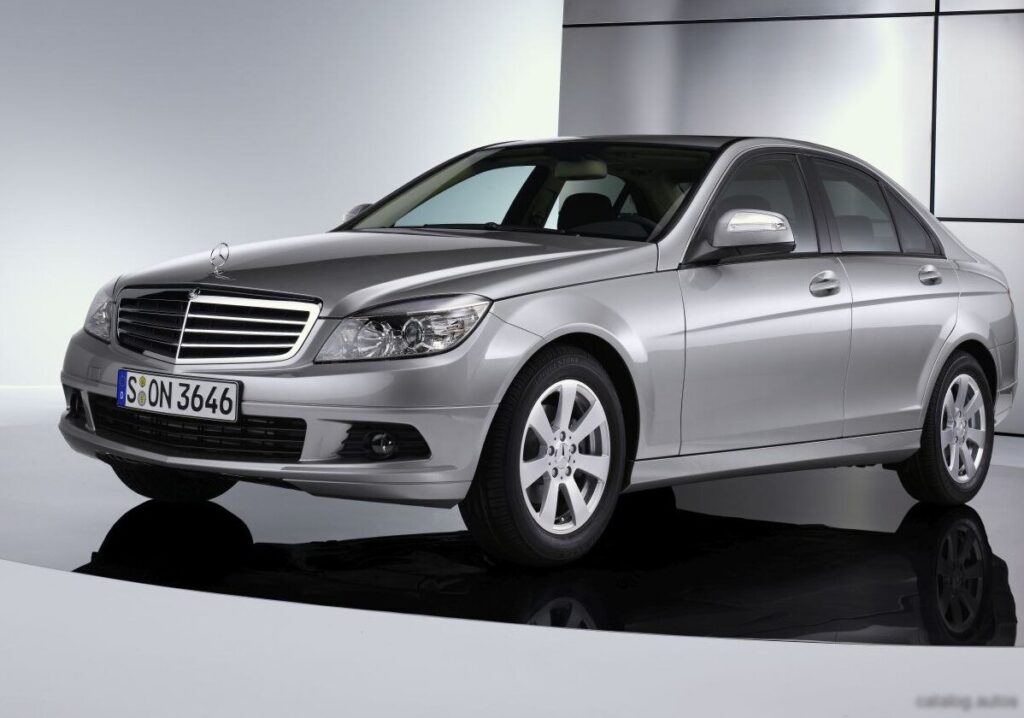
The Mercedes-Benz C-Class (W204) C 180 1.8 Kompressor was a variant produced between 2007 and 2008, positioned as an entry-level offering within the broader W204 C-Class range. It served as a more accessible gateway into the C-Class lineup, appealing to buyers prioritizing fuel efficiency and a comfortable ride over outright performance. This model occupied the lower end of the engine spectrum, sitting below the C 200 Kompressor, C 230, C 280, C 320 CDI, and the performance-oriented C 350 and C 63 AMG models. The W204 generation, built on the Mercedes-Benz MRA platform, represented a significant step forward in terms of interior quality and driving dynamics compared to its W203 predecessor.
Technical Specifications
| Brand | Mercedes-Benz |
| Model | C-Class |
| Generation | C-Class (W204) |
| Type (Engine) | C 180 1.8 Kompressor (156 Hp) |
| Start of production | 2007 |
| End of production | 2008 |
| Powertrain Architecture | Internal Combustion engine |
| Body type | Sedan |
| Seats | 5 |
| Doors | 4 |
| Fuel consumption (urban) | 10.5-10.7 l/100 km (22.4 – 22 US mpg, 26.9 – 26.4 UK mpg, 9.5 – 9.3 km/l) |
| Fuel consumption (extra urban) | 5.6-5.8 l/100 km (42 – 40.6 US mpg, 50.4 – 48.7 UK mpg, 17.9 – 17.2 km/l) |
| Fuel consumption (combined) | 7.4-7.6 l/100 km (31.8 – 30.9 US mpg, 38.2 – 37.2 UK mpg, 13.5 – 13.2 km/l) |
| CO2 emissions | 177 g/km |
| Fuel Type | Petrol (Gasoline) |
| Acceleration 0 – 100 km/h | 9.5 sec |
| Acceleration 0 – 62 mph | 9.5 sec |
| Acceleration 0 – 60 mph | 9 sec |
| Maximum speed | 223 km/h (138.57 mph) |
| Emission standard | Euro 4 |
| Weight-to-power ratio | 9 kg/Hp, 110.6 Hp/tonne |
| Weight-to-torque ratio | 6.1 kg/Nm, 163.1 Nm/tonne |
| Power | 156 Hp @ 5200 rpm |
| Power per litre | 86.9 Hp/l |
| Torque | 230 Nm @ 2600-4600 rpm (169.64 lb.-ft. @ 2600-4600 rpm) |
| Engine layout | Front, Longitudinal |
| Engine Model/Code | M 271.952 |
| Engine displacement | 1796 cm3 (109.6 cu. in.) |
| Number of cylinders | 4 |
| Engine configuration | Inline |
| Cylinder Bore | 82 mm (3.23 in.) |
| Piston Stroke | 85 mm (3.35 in.) |
| Compression ratio | 9.3:1 |
| Number of valves per cylinder | 4 |
| Fuel injection system | Multi-port manifold injection |
| Engine aspiration | Supercharger, Intercooler |
| Valvetrain | DOHC |
| Engine oil capacity | 5.5 l (5.81 US qt | 4.84 UK qt) |
| Kerb Weight | 1410 kg (3108.52 lbs.) |
| Max. weight | 1970 kg (4343.11 lbs.) |
| Max load | 560 kg (1234.59 lbs.) |
| Trunk (boot) space – minimum | 475 l (16.77 cu. ft.) |
| Fuel tank capacity | 66 l (17.44 US gal | 14.52 UK gal) |
| Max. roof load | 100 kg (220.46 lbs.) |
| Permitted trailer load with brakes (12%) | 1700 kg (3747.86 lbs.) |
| Permitted trailer load without brakes | 740 kg (1631.42 lbs.) |
| Permitted towbar download | 75 kg (165.35 lbs.) |
| Length | 4581 mm (180.35 in.) |
| Width | 1770 mm (69.69 in.) |
| Width including mirrors | 2020 mm (79.53 in.) |
| Height | 1447 mm (56.97 in.) |
| Wheelbase | 2760 mm (108.66 in.) |
| Front track | 1549 mm (60.98 in.) |
| Rear (Back) track | 1552 mm (61.1 in.) |
| Front overhang | 765 mm (30.12 in.) |
| Rear overhang | 1056 mm (41.57 in.) |
| Drag coefficient (Cd) | 0.29 |
| Minimum turning circle (turning diameter) | 10.84 m (35.56 ft.) |
| Drivetrain Architecture | The Internal combustion engine (ICE) drives the rear wheels of the vehicle. |
| Drive wheel | Rear wheel drive |
| Number of gears and type of gearbox | 6 gears, manual transmission |
| Front suspension | Independent type McPherson, Transverse stabilizer |
| Rear suspension | Independent multi-link suspension, Transverse stabilizer |
| Front brakes | Ventilated discs, 288 mm |
| Rear brakes | Disc, 278 mm |
| Assisting systems | ABS (Anti-lock braking system) |
| Steering type | Steering rack and pinion |
| Power steering | Hydraulic Steering |
| Tires size | 195/60 R16; 205/55 R16; 225/45 R17 |
| Wheel rims size | 6J x 16; 7J x 16; 7.5J x 17 |
Powertrain & Engine Architecture
The C 180 Kompressor utilized the M271.952 engine, a 1.8-liter (1796 cc) inline-four cylinder powerplant. This engine was characterized by its mechanically driven supercharger (Kompressor in Mercedes terminology), which provided increased torque at lower engine speeds compared to naturally aspirated engines. The supercharger, an Eaton Roots-type unit, was engaged below approximately 3800 rpm, supplementing the engine’s output and improving responsiveness. Fuel delivery was handled by a multi-port fuel injection system. The engine featured a double overhead camshaft (DOHC) valvetrain with four valves per cylinder, contributing to its relatively high specific output. The compression ratio was set at 9.3:1. The engine was mounted longitudinally in the engine bay, driving the rear wheels. The standard transmission was a 6-speed manual, though a 5-speed automatic transmission was also available, impacting performance and fuel economy.
Driving Characteristics
The C 180 1.8 Kompressor, particularly when equipped with the manual transmission, offered a reasonably engaging driving experience for an entry-level luxury sedan. The supercharger provided a noticeable boost in low-end torque, making it feel more responsive in city driving than its displacement might suggest. However, with 156 horsepower, acceleration was not particularly brisk, taking around 9.5 seconds to reach 60 mph. The automatic transmission, while offering convenience, resulted in slightly slower acceleration and a less direct feel. Gear ratios were tuned for fuel efficiency and comfortable cruising rather than outright performance. Compared to the C 200 Kompressor (which offered more power) or the C 230 (with a larger displacement), the C 180 felt less potent, but it provided a good balance of usability and economy.
Equipment & Trim Levels
The C 180 Kompressor typically came standard with features expected of a premium compact sedan, including air conditioning, power windows and locks, a multi-function steering wheel, and an audio system. Interior upholstery was generally cloth, though leather options were available. Dashboard trim was typically wood or aluminum. Optional extras included a sunroof, upgraded audio systems, navigation, and parking sensors. Trim levels were relatively simple, with options packages adding features rather than distinct model designations. The focus was on providing a comfortable and well-equipped vehicle at a competitive price point.
Chassis & Braking
The W204 C-Class featured an independent suspension system at all four wheels. The front suspension utilized a McPherson strut design with a transverse stabilizer bar, while the rear employed a multi-link setup, also with a stabilizer bar. This configuration provided a good balance of ride comfort and handling. Braking duties were handled by ventilated discs at the front and solid discs at the rear. Anti-lock braking system (ABS) was standard. The chassis was designed to provide a stable and predictable driving experience, prioritizing comfort over sporty handling characteristics.
Market Reception & Comparison
The C 180 Kompressor was generally well-received as an affordable entry point into the C-Class range. Critics praised its fuel efficiency and comfortable ride, but noted its relatively modest performance. Compared to the more powerful C 200 Kompressor, the C 180 offered lower running costs but lacked the same level of driving excitement. The C 180’s fuel economy figures of around 32 mpg combined were competitive for its class. Reliability was generally good, although the supercharger system required periodic maintenance.
Legacy
The M271 engine, including the 1.8-liter Kompressor variant, proved to be a relatively reliable powerplant when properly maintained. The supercharger, while adding complexity, generally held up well over time. Today, used W204 C 180 models are relatively affordable and represent a good value for buyers seeking a comfortable and well-built German sedan. However, potential buyers should be aware of the need for regular maintenance, particularly regarding the supercharger and timing chain. The C 180 Kompressor remains a popular choice for those seeking a blend of luxury, efficiency, and affordability in the used car market.